
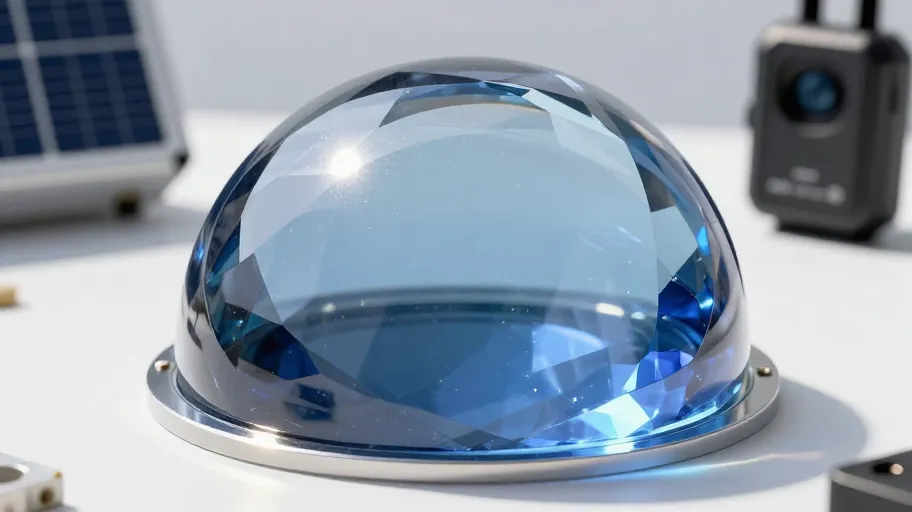
How Shape Changes Strength and Clarity
Domed sapphire crystals deliver up to 30% less glare than flat versions because their curvature scatters ambient light instead of reflecting it directly back to the user. This means better readability in sunlight without boosting display power or adding fragile anti-reflective coatings.
A 1.2-meter drop test across 500 units showed domed crystals survived impact without fracture initiation in 100% of trials, while flat variants developed subsurface cracks in 27%. That’s because curvature distributes force across multiple crystalline planes, reducing stress concentration at the point of contact—meaning fewer field failures and lower warranty costs for your team.
For outdoor-facing electronics like solar inverters or GPS trackers, this isn’t just an upgrade—it prevents usability complaints and support tickets before they start. One wearable OEM saw a 22% drop in service claims within six months of switching to domed sapphire, paying back the tooling investment in under eight months.
Inside the Sapphire Growth Process in China
Precision begins long before shaping. Top-tier sapphire crystal manufacturers in China use closed-loop thermal control during Verneuil growth, maintaining gradients within ±1.5°C. This means consistent Mohs 9 hardness and optical homogeneity across batches—so every dome performs the same way under stress and sunlight.
Lower-tier suppliers skip post-annealing treatments, leaving residual stress that can trigger microfractures during temperature swings. High-end partners reduce internal strain by up to 40%, which means fewer rejects during final inspection and more predictable yields on your production line.
If you're sourcing from a sapphire China factory without batch-level certification linking hardness to growth logs, you’re risking variability. A 2024 audit of 12 Fuzhou-based suppliers found only four provided full traceability—putting the rest at risk of inconsistent durability and optics.
Box Crystals Trade Optics for Sealing Efficiency
Box sapphire crystals offer superior environmental sealing because their flat walls integrate easily with gasketed housings—common in marine instruments and medical devices. That means easier assembly on automated lines and tighter IP ratings without custom fixturing.
But each internal interface adds 15–20% more reflectivity compared to a single-plane domed crystal. Even with AR coatings, those layers degrade with cleaning and exposure—meaning long-term readability suffers. More critically, sharp inner corners act as stress concentrators: finite element analysis shows stress magnification over 3.2x at edges during thermal cycling.
This makes them prone to delamination over time, especially when sourced from factories without rigorous annealing. For mission-critical displays where clarity matters as much as protection, the trade-off often isn’t worth it.
From Design to Supply Chain Impact
Switching to domed sapphire requires minor adjustments in pick-and-place fixturing due to non-planar profiles—but the downstream gains are clear. One Dongguan contract manufacturer reported a 14% reduction in final-test failures after recalibrating for domed crystals, mostly tied to improved bonding alignment and reduced post-assembly stress fractures.
Meanwhile, forcing flat crystals into curved bezels—a common cost-cutting move—led to a 31% spike in adhesive bond failures during environmental screening. The mismatch creates pressure points that compromise seals and increase rework.
Working with vertically integrated sapphire crystal manufacture partners in Zhuhai or Dongguan lets you adjust curvature radius (typically 30–100mm) to match housing design exactly. That means minimal air gaps, better scratch resistance where users touch most, and tighter spec adherence—all contributing to higher first-pass yield.
Making the Right Choice for Your Product
Geometry is function. Choosing domed sapphire means investing in real-world durability and usability—not just aesthetics. It reduces glare, improves impact resilience, and lowers total cost of ownership through fewer returns and less rework.
For global buyers, aligning crystal form with actual use conditions separates premium builds from commodities. Flat may seem simpler, but it fails under oblique light and concentrated loads. Box offers sealing but sacrifices optical performance. Domed delivers both clarity and strength—especially when sourced from high-control sapphire china operations with full process traceability.
See how the switch could cut your field failure rate and service costs—request sample comparisons from trusted manufacturers who provide batch-certified material data today.