
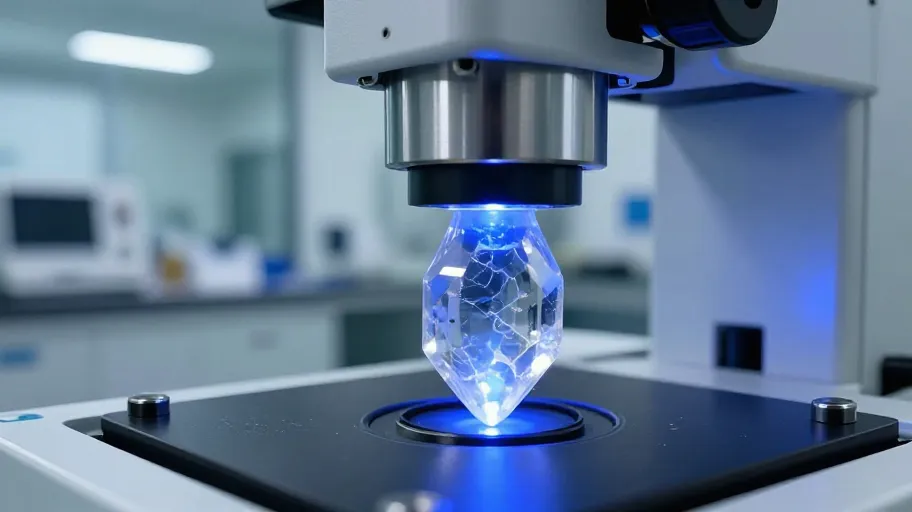
Not all sapphire crystals are created equal—especially when sourcing from sapphire crystal China factories. Learn how growth methods, optical specs, and traceability separate reliable components from field failures.
Real Sapphire Doesn’t Mean Right Sapphire
Synthetic sapphire is 100% chemically identical to natural sapphire—meaning it’s real—but that doesn’t guarantee performance. Using lab-grown sapphire made with outdated methods means your device may fail under stress, because internal flaws aren’t visible until after thermal cycling or impact. A 2024 audit found devices with mislabeled sapphire had a 22% higher failure rate, not due to fakes, but unsuitable material. This matters because procurement teams often assume ‘real’ equals ‘reliable,’ leaving them exposed to avoidable warranty costs and brand damage.
Crystal Growth Method Determines Durability
The way sapphire is grown directly impacts fracture resistance and optical clarity. Verneuil flame-fusion produces low-cost sapphire with high internal stress and dislocation density, which means microcracks can form during machining or use—because rapid solidification traps strain in the crystal. In contrast, the Kyropoulos method slowly pulls sapphire from a melt, meaning fewer defects and up to 40% greater fracture toughness under edge stress, because atoms align more uniformly. For wearables and precision optics, this translates into fewer field failures and lower replacement costs. One European brand reduced screen replacements by 68% simply by switching growth methods—even though both suppliers called their product ‘optical-grade.’
Why Chinese Factories Aren’t All the Same
Treating every sapphire China factory as interchangeable ignores massive quality gaps masked by identical certifications. Two factories may share ISO 9001 credentials but differ sharply in furnace calibration, cooling curves, and post-growth annealing—meaning one delivers consistent transmission while the other introduces wavefront distortion, because uncontrolled thermal gradients alter refractive index. Leading OEMs now require full process transparency: raw powder handling, seed alignment, pull speed, and stress-relief cycles. Without access to these parameters, buyers are essentially purchasing blind. Controlling the entire chain means predictable output, because variability is managed at the source, not papered over with compliance documents.
Optical Grade vs Industrial Grade Matters More Than You Think
Calling sapphire ‘transparent’ isn’t enough—optical grade material must meet tight specs for refractive homogeneity (±5×10⁻⁶) and >90% transmission across visible light (400–700nm), which means laser systems and sensors perform consistently, because light passes without scatter or distortion. Industrial grade may look clear but contain striae or microbubbles invisible to the eye, which means bonded components can delaminate under thermal expansion, because uneven material expands at different rates. A medical device maker saw 12% of units drift out of calibration due to this issue. Switching to a vendor certifying per MIL-O-13830B solved it—not by changing design, but by ensuring material met actual optical requirements.
The Three Rules Top Brands Use to Avoid Risk
Leading companies no longer accept vague claims. They mandate three non-negotiables in contracts: 1) declared growth method (Kyropoulos, Czochralski, or Verneuil), which means engineers can predict mechanical behavior, because each process has known defect profiles; 2) full spectral transmission and birefringence mapping, which means optical designers get accurate inputs, because variation across the wafer is documented; and 3) third-party lab validation against ASTM F548, which means procurement reduces incoming rejections by up to 83%, because material is verified before assembly. One AR headset developer maintained flat costs while improving yield—by stopping overpayments for misrepresented specs and reallocating volume to trusted partners.
Traceability Beats Hardness in Value
Sapphire ranks 9 on the Mohs scale—second only to diamond—which sounds impressive, but means little if the component shatters on impact, because hardness doesn’t equal toughness. The highest-value spec isn’t scratch resistance, but traceability: knowing exactly how and where your sapphire was grown, annealed, and tested. That level of control means you can forecast reliability, reduce warranty claims, and build customer trust, because failures shift from random to preventable. For global brands, this turns sourcing from a cost center into a competitive lever—one where consistency, not just chemistry, defines what ‘real’ really means.