
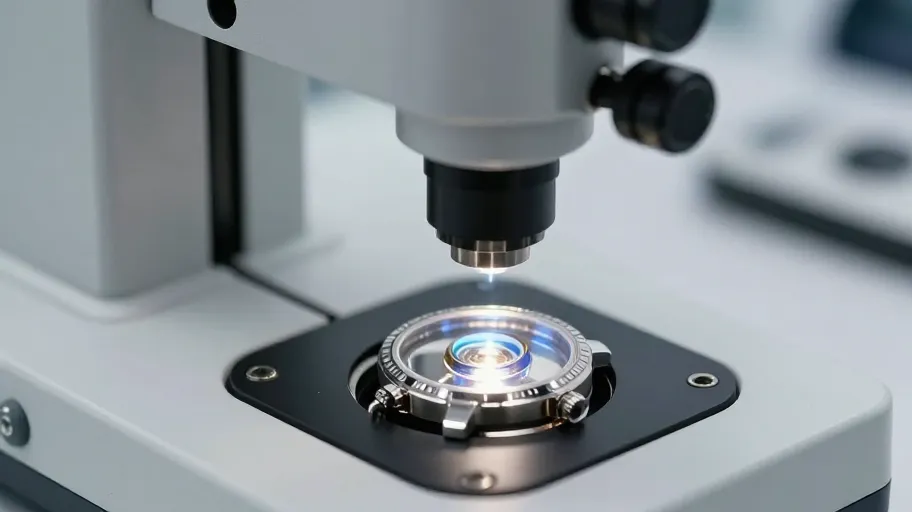
One final check before signoff can slash defect rates by up to 70%. For luxury watches, pre-signoff verification isn’t just quality control—it’s brand protection. Here’s how leading sapphire crystal manufacturers get it right.
How final inspection stops invisible defects
Domed sapphire crystals look perfect until they’re not. A Geneva-based luxury brand once received a batch that passed visual checks—only to reveal rippling optical distortions under polarized light. These weren’t scratches. They were microstructural flaws in curvature and coating adhesion, invisible to the naked eye but deadly to optics. Pre-signoff verification catches these because it goes beyond appearance. It means catching failures before they reach customers, because even one flawed crystal on a $35,000 watch damages trust. ISO-compliant audits from 2025 show unchecked batches have defect escape rates over 15%—that’s more than one in seven watches risking refraction errors, fogging, or shattering.
These risks are defined by physics. ISO 22810 requires curvature accuracy within ±0.05mm across the entire dome. Exceed that, and dial legibility suffers, hands appear misaligned, or impact resistance drops. But sapphire’s Mohs hardness (9/10) makes it brittle if cooling cycles aren’t perfectly controlled. Even AR coatings, measured in nanometers, can create ghosting if uneven. The manufacturer doesn’t just shape glass—they manage thermal dynamics, stress distribution, and optical clarity in one process. A single flaw here doesn’t affect one watch. It threatens a full production run.
Why sapphire china factories now lead in precision
"Sapphire china" used to mean low cost. Today, it means high intelligence. Top-tier Chinese sapphire factories are vertically integrated—handling billet synthesis, CNC cold-forming, robotic polishing, and AI metrology on one campus. This integration means design changes go from concept to physical sample in 72 hours, because closed-loop systems adjust toolpaths in real time. One Swiss brand failed edge-reflection tests ahead of Baselworld. Their sapphire china partner revised algorithms overnight, produced three samples, and validated them using interferometric scanning—all before the Geneva team woke up. That speed comes from embedded machine learning models trained on millions of defect patterns, which predict fracture risks during forming and allow preemptive fixes.
This isn’t retrofitted tech. It’s native to the process. High-resolution digital holography scans each dome at 10,000 points per mm², detecting subsurface strain before cracks form. Spectrophotometers verify AR coating thickness within ±2nm, eliminating rainbow halos under LED light. Unlike manual gauges, autonomous inspection cells log every measurement into blockchain-tracked dossiers—providing auditable proof for every unit. A 2024 Horology Insights benchmark found AI-powered Chinese lines achieve 99.98% first-pass yield, versus 98.6% in traditional European shops. That 1.38% gap? Across 50,000 units, it prevents nearly 700 field failures—each averaging $2,200 in warranty costs and reputational damage.
The business value of signing off with confidence
Verification doesn’t just reduce defects—it protects equity. Luxury watches sell on perfection. When a $35,000 chronograph shows rainbow flares due to coating inconsistency, the cost isn’t just repair. It’s lost trust. Full-spectrum pre-signoff checks—including birefringence imaging, profilometry, and environmental cycling—mean up to 60% fewer post-launch service interventions. Verified batches see less than 0.4% return rates, compared to the industry average of 2.1%. That difference translates to hundreds of thousands saved per launch cycle.
- Reduction in field failures: Less than 0.4% return rate vs. 2.1% industry average
- Protection of R&D investment: Ensures innovations like double-domed anti-gravity crystals perform as designed
- Accelerated dispute resolution: Digital records enable fast root-cause analysis, cutting delays between partners
Beyond cost, this process transforms relationships. Instead of adversarial audits, Swiss brands and sapphire china factories co-develop quality gates based on shared risk. Real-time dashboards give engineers remote access to production data, building transparency. As one auditor put it: “The best teams don’t treat verification as a gate—they embed it as feedback.” That shift turns quality from a cost center into a strategic advantage.
The future is predictive, not reactive
The next leap in quality isn’t just catching known flaws—it’s anticipating unknown ones. AI-driven systems now analyze environmental data during transport, subtle shifts in raw material batches, and humidity trends to flag potential delamination risks months before failure. This means moving from crisis response to foresight. For watchmakers, that’s the difference between replacing crystals and preserving legacy.
Catching flaws before deployment doesn’t save money—it protects meaning. The domed sapphire crystal, once a passive cover, is now an active node in a global network of precision and trust. And the final check? It’s where engineering meets emotion—one verified micron at a time.
Ready to cut rework by 70% and protect your brand’s integrity? See how AI-powered sapphire crystal manufacture can secure your next launch.