
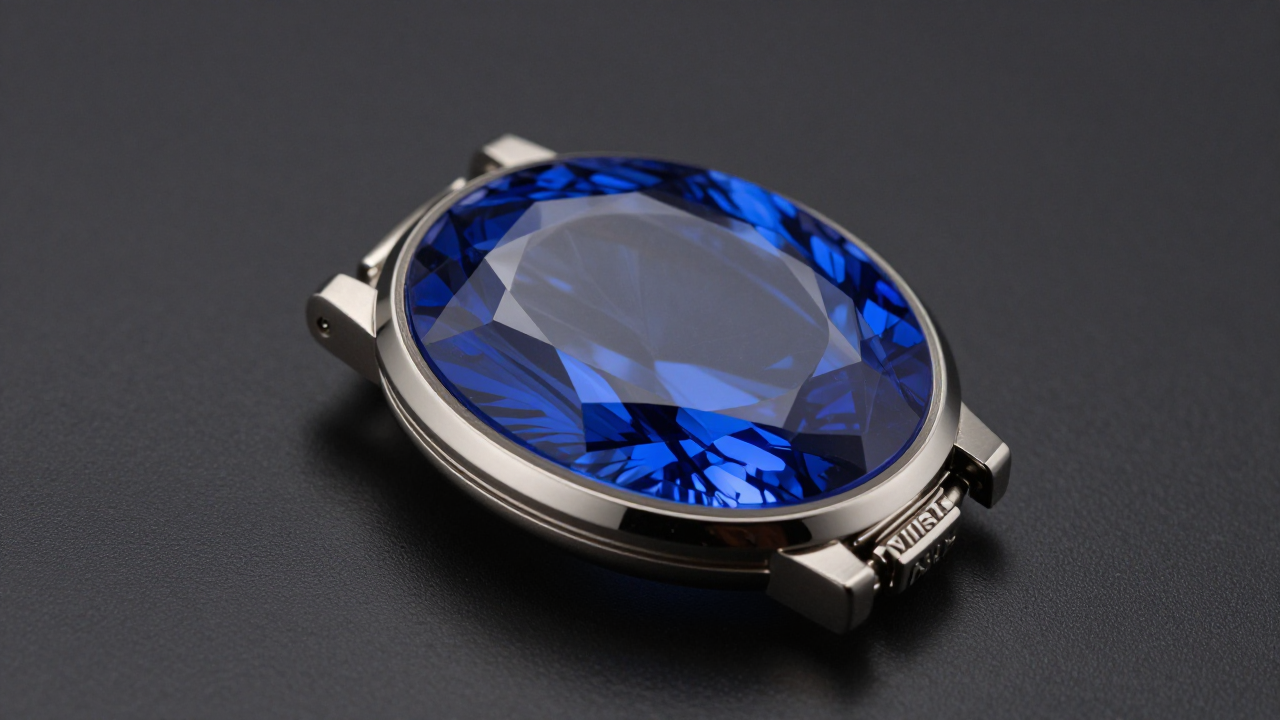
Budget $200 to $500 for a professionally installed sapphire watch crystal in 2026, and plan on 3 to 5 years to break even against the mineral glass replacement cycle.…
Below $120 installed, you are not getting a deal — you are financing a problem that lands on someone else's invoice later.
What a Sapphire Watch Crystal Actually Costs in 2026
A quality sapphire watch crystal runs $40 to $180 as a bare part and $200 to $500 once it is fitted, sealed, and pressure-tested. OEM blanks from Rolex, Omega, or Grand Seiko sit at the top of that band. Generic blanks cut from chemically identical aluminum oxide sit at the bottom, and the gap between $40 and $180 is tooling, edge finishing, and coating — not raw material.
That last point is where most buyers get lost. Synthetic sapphire is aluminum oxide grown into a single-crystal boule using the Kyropoulos method, then core-drilled, ground, lapped, and polished. Mohs 9. Knoop hardness near 2,000 kg/mm² against roughly 550 for mineral glass. The material itself is cheap; a two-inch boule yields dozens of small crystals. What you actually pay for is a dome height held to ±0.05 mm, a 0.15 to 0.30 mm chamfer on the edge, and whether the anti-reflective coating went on the underside alone or both faces.
The Costs That Never Make the Quote
The number you hear over the counter covers two things: the part and the bench time. Everything below is yours.
Downtime. A crystal swap is 45 minutes of work. Sourcing the right crystal is 5 to 21 days. A dealer holding 60 watches in inventory is not losing bench time, they are losing turns — and at Miami-level carrying costs that adds up faster than the parts bill. Under-coating haze. The anti-reflective layer on the underside of a sapphire crystal is a consumable, not a permanent feature. In humid climates it clouds somewhere between year five and year eight. Stripping it runs $60 to $90, and polishing to strip coating changes the dome geometry by a few hundredths of a millimeter, which you will notice at the edges. The resale flag. An aftermarket crystal noted on a service record reads to a buyer as a signal that other shortcuts exist. On watches above roughly $1,500, that flag costs $300 to $700 at offer time. Second-opening risk. Every case opening risks the bezel insert, the caseback gasket, and occasionally a full movement service at $350 to $600. Watchmakers who have done this for twenty years still crack inserts.What Went Wrong in Austin and Chicago
In July 2022, a watch repair network in Austin, Texas, placed a 500-unit order for sapphire crystals at $38 each from a trading company they had used twice before. The spec called for a 1.20 mm dome height at ±0.05 mm. Delivered units, measured in September, came in between 1.32 and 1.38 mm.
Roughly 40% of the batch would not clear the seconds hand on one movement family. The return rate hit 31%. Add restocking labor, two-way freight, refunds, and two scuffed dials, and a $19,000 order produced about $2,400 in losses plus a month of technician time. We were asked to redraw the spec that October. The root cause was almost embarrassing: the supplier was grinding to a nominal target and checking it with a caliper read by eye, not a dial indicator on a granite surface plate.
Chicago, March 2021. A collector had a $120 aftermarket crystal fitted to a 2016 Rolex Submariner 116610LN at a jewelry counter. The cyclops landed about 0.4 mm off center, four times the factory tolerance. Nobody pressure-tested the case. He swam in Lake Michigan that August, the movement took on water, and the service came to $650. When he sold in November 2024, the aftermarket crystal shaved $700 off his best offer.
$120 plus $650 plus $700 against a proper $450 OEM swap. That is a $1,020 lesson, and it is the single most common failure pattern we see from the parts side.Running the ROI Math on a $275 Watch
The formula that matters is incremental, not absolute:
Incremental ROI = ((Avoided Recurring Spend + Resale Uplift) − Sapphire Spend) ÷ Sapphire Spend × 100
Take a 2022 Seiko 5 Sports SRPD, $275 new, mineral crystal, worn four days a week for six years, then sold.
Path A, stay with mineral: two replacements at $70 installed over six years, $140 total. Resale at year six falls $45 short of a comparable watch with clean glass, because haze and micro-scratches show in photos.
Path B, sapphire: $165 installed once with underside AR and a pressure test. No further spend. Resale holds.
Avoided recurring spend: $140. Resale uplift: $45. Sapphire spend: $165.
ROI = (($140 + $45) − $165) ÷ $165 × 100 = 12.1% over six years
That is about 3.3% annualized. Thin, and honest.
The marginal view tells a different story, and this is the part most calculators miss. The sapphire cost only $25 more than the mineral path over the same horizon, and it returned $45 more at sale. On the extra $25, the return is 80%. Cash break-even lands around month 44; value break-even, including resale, lands around month 26. That is where the "3 to 5 years" figure in every ROI conversation actually comes from.
Where Almost Everyone Miscalculates
1. Confusing hardness with impact resistance. Mohs 9 describes scratching, nothing else. A 1.0 mm flat sapphire ground with a sharp 90° edge chips on a doorframe. The same crystal with a 0.25 mm chamfer survives. Cheap suppliers skip the chamfer because it is the slowest step in the whole process, and the "sapphire upgrade" then fails at month 14.
2. Comparing part prices instead of installed prices. A $55 crystal that needs a $45 pressure test and a $22 gasket is a $122 crystal.
3. Assuming the AR coating is permanent. It is a thin-film stack, and it degrades.
4. Ignoring the OEM/non-OEM resale split on anything over $1,500. This one flips the ROI negative on its own.
When a Sapphire Crystal Is the Wrong Purchase
Vintage pieces where originality carries the value. A 1968 Omega Speedmaster with original Hesalite loses 15% to 25% at resale the moment a sapphire goes in. Collectors pay for the acrylic.
Watches with a resale value under about $150. At $165 installed, the crystal costs more than the case is worth.
Anything you intend to flip inside 12 months. The payback never lands.
Non-round geometries. Tank, tonneau, and cushion shapes require dedicated tooling, and low-volume tooling runs $900 to $2,500 amortized across a short batch. That cost gets passed to you, and it usually kills the math.
Watches rated at 3 ATM. If the case was never engineered to hold pressure, sapphire buys you scratch resistance and nothing else. The gasket work becomes theater.
Practical Habits That Protect the Investment
Never open a case without a fresh gasket and a pressure test. AWCI-certified watchmakers in most US metros charge $35 to $60, and it is the cheapest insurance in the trade.
Ask your supplier for the dome height and chamfer spec in writing, along with the measurement method. If they cannot describe how they inspect, that is your answer. Our own shop in Shenzhen runs 300-plus staff and inspects every crystal lot on granite with dial indicators, because the Austin order taught the whole industry that eyeballing does not scale.
Keep the original crystal when you swap. It travels with the watch at sale and settles the originality question before a buyer raises it.
Frequently Asked Questions
How much does a sapphire watch crystal cost in 2026?
Between $40 and $180 for the bare part, and $200 to $500 installed with a new gasket and a pressure test. OEM parts from major Swiss and Japanese brands sit at the top of that range.
How long should a sapphire watch crystal last?
The crystal itself lasts decades without meaningful wear. The underside anti-reflective coating is the limiting factor and can haze in five to eight years in humid climates. Budget $60 to $90 for coating removal around year ten.
Is sapphire better than mineral glass for a daily wear watch?
For scratch resistance, yes, by a wide margin. For impact resistance on a thin 1.0 mm crystal with a sharp edge, no. Chamfer quality and a thickness of 1.5 mm or more matter as much as the material choice.
Why do watchmakers refuse to install customer-supplied sapphire crystals?
Liability. If water enters after the watch leaves the bench, the watchmaker owns the outcome. Many AWCI members will only fit parts they sourced themselves, so they can pressure-test to ISO 22810 and stand behind the result.
Do aftermarket sapphire crystals hurt resale value?
On watches above roughly $1,500, yes. A crystal flagged as aftermarket on a service record can reduce a resale offer by $300 to $700, because buyers read it as evidence of other shortcut work.