
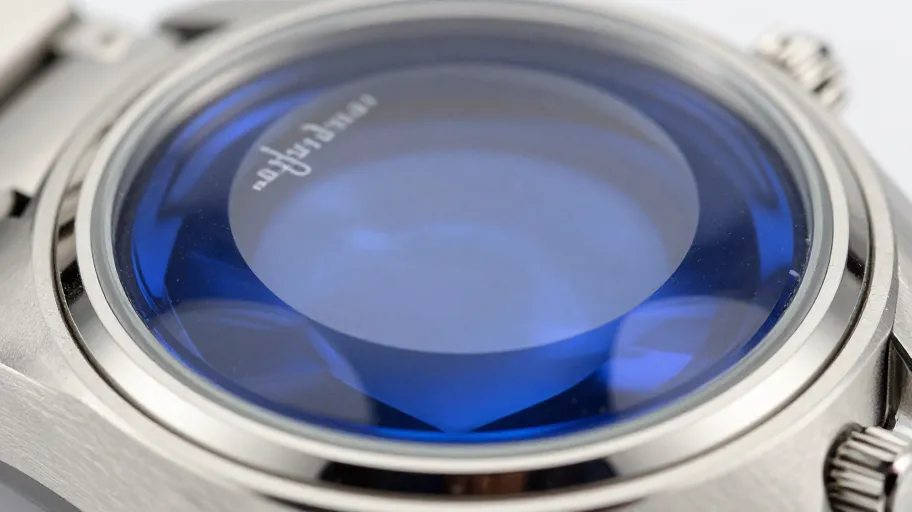
If you are asking how much does a sapphire glass cost?, the honest answer is that a watch crystal has no single price: cost is set by your specification. Diameter, thickness, dome profile, coatings, printing, tolerance class and approval requirements each shift the quotation. Your real task as a buyer is not to find a number — it is to lock a spec so quotations from different suppliers become comparable.
This guide gives you a working framework, a decision table and the approval questions to put in writing before you commit.
Why there is no single price — and why that helps you
When a search returns a figure for "sapphire glass cost," that figure describes someone else's part: their geometry, their coating, their volume and their quality terms. Applied to your project, it is noise.
That is good news for a professional buyer. If price is spec-driven, then price is also spec-controllable. Every parameter you define precisely removes a variable a supplier would otherwise price defensively — and removes a reason for re-quoting later.
The parameters that move cost most fall into four groups:
- Geometry — diameter, thickness, dome or flat profile, date-window cut-outs, step flanges and edge finishes.
- Optical treatments — anti-reflective coating on one or both faces, and any colour or tint requirements.
- Decoration — logo printing, indexes, lacquer and other applied elements.
- Verification burden — tolerance class, inspection requirements, documentation and the approval loop you require before series production.
Each of these is a decision you make, and each deserves a line in your specification sheet before you request a quotation.
The SPEC–QUOTE–APPROVE framework
To get a price you can act on, run your sourcing in three disciplined phases:
SPEC — define before you ask. Write the part completely: drawing, geometry, material grade expectation, coating, decoration, tolerance intent and destination market requirements. Note which parameters are fixed and which are negotiable. A supplier can price a defined part accurately; they can only estimate an undefined one.
QUOTE — structure the response. Require every supplier to quote against the same line items: unit price at your stated volumes, tooling or setup (if any), sample charges, coating and printing as separate lines, packaging, and any documentation you need. A structured quotation is the only one you can compare across suppliers. Ask what is and is not included, and get exclusions in writing.
APPROVE — control the sample loop. Before ordering samples, agree in writing how samples are produced, what a conforming sample means, how revisions are handled, and what happens if a sample does not meet the agreed drawing. Sample fees, shipping responsibility and any credit arrangements are supplier policies you must confirm directly at the time of enquiry — do not assume terms carry over between projects or orders.
Decision table: spec choices and what to confirm with the supplier
| Spec decision | Why it affects cost | What to confirm in writing with the supplier |
|---|---|---|
| Diameter and thickness | Material volume and growth-cycle yield relate directly to size | What dimensional verification is performed, and against what drawing revision |
| Flat vs. dome profile | Domes need additional shaping and polishing stages | Which profiles they produce in-house and which are subcontracted, if any |
| AR coating (none / one side / both sides) | Coating adds process steps and inspection requirements | Which coating types they offer and how coating conformity is checked |
| Printing, logo, indexes | Each applied element adds tooling, process and QA burden | How print alignment and durability are verified before approval |
| Date window or cut-outs | Machining complexity and scrap risk increase | How cut-out positions are measured and reported |
| Tolerance class | Tighter inspection effort increases unit cost | What tolerance they can hold and how it is documented per batch |
| Order volume | Volume changes unit economics | At what quantity tiers pricing is revisited, and current MOQ if any |
| Packaging and shipping terms | Logistics and packaging affect landed cost | Incoterms offered, packaging spec, and who arranges export documentation |
| Documentation and compliance | Test reports and certificates add administrative work | Which documents they can issue for your market, and current certification status |
Use this table as a meeting agenda. A supplier's willingness to answer these questions precisely is itself useful sourcing information.
Structuring the quotation so prices are comparable
A bare unit price tells you almost nothing. Require every candidate supplier to respond in the same format:
- Unit price at each of your stated volumes, quoted separately.
- Tooling, setup or fixture charges, if any, listed as one-time or recurring.
- Sample charges as a distinct line, with the current policy on any credit toward series orders — confirm directly, do not assume.
- Coating and printing as separate lines so you can compare process pricing, not just part pricing.
- Packaging, labelling and export documentation.
- What is excluded, stated explicitly.
When quotations arrive in this format, differences between suppliers become visible and discussable. When they arrive as single numbers, you are comparing unlike things.
Samples and approval: the questions that protect you
The sample stage is where most sourcing friction appears, because expectations that were never written down surface as disputes. Put these questions to the supplier before samples are ordered, and keep the answers on file:
- What is your current sample policy — charge, timeline, and how many revisions it covers? (Confirm directly; policies change.)
- Who covers sample shipping, and under which terms? (Confirm directly.)
- Against which drawing revision will the sample be produced, and how will conformity be evidenced — dimensional report, visual standard, or both?
- If a sample does not meet the agreed drawing, what is the correction process and cost position?
- Does the approved sample become the binding reference for series production, and how is that recorded?
- What batch-level documentation accompanies series production?
None of these questions presumes a particular answer. Their purpose is to make the approval loop explicit, so both sides know what "approved" means before money moves.
Pre-contact sourcing checklist
Before you send your first enquiry to any sapphire crystal supplier, complete this checklist:
- Full drawing or geometry spec, with revision number and date
- Thickness, profile and edge finish defined
- Coating requirement stated (none / one side / both sides) with type
- Decoration and printing specified, with artwork files ready
- Tolerance intent and inspection expectations documented
- Target volumes and quantity tiers stated
- Destination market and required documentation listed
- Quotation format defined (line items as above)
- Sample and approval questions prepared in writing
- Single point of contact and decision timeline on your side confirmed
A complete package shortens quotation cycles and filters suppliers by responsiveness — those who answer precisely are easier to work with through approval and series production.
FAQ
Why do quotations for "the same" sapphire crystal differ so much between suppliers? Because the quotes are almost never for the same thing. Coating scope, tolerance class, inspection depth, packaging and documentation differ even when geometry matches. Structuring the quotation with fixed line items exposes where the differences actually sit.
What information does a supplier need to quote accurately? A complete drawing with revision, geometry, coating and decoration requirements, tolerance intent, target volumes, and the documentation you need. The more that is fixed, the more the price reflects the part rather than the supplier's uncertainty.
Should I approve samples before series production? For custom and OEM watch crystals, a written approval against a drawing revision is the mechanism that makes the series order verifiable. How samples are charged, shipped and revised is a supplier policy you must confirm directly before ordering.
How do I compare suppliers in Shenzhen and Hong Kong fairly? Give every supplier the same specification package and require the same quotation format and the same written answers to the approval questions. Comparability comes from process, not from geography.
Can I change the spec after quoting? You can, but expect re-quoting — changes to coating, printing or tolerance affect processing and inspection. Keep a revision log so every quotation and sample is tied to a spec version.
Get the sourcing brief
The fastest way to a comparable, decision-ready quotation is a complete brief. 获取采购 Brief and use it to run SPEC–QUOTE–APPROVE with every candidate supplier — including JadeZone Sapphire, which manufactures custom sapphire watch crystals and precision sapphire components from Shenzhen and Hong Kong for watch brands and OEM buyers worldwide. Confirm current pricing, sample policy and terms directly with our team as part of your enquiry.
Prefer to start smaller? Download the pre-contact sourcing checklist above and send your first enquiry with a complete package — it is the single highest-leverage step in the whole process.