
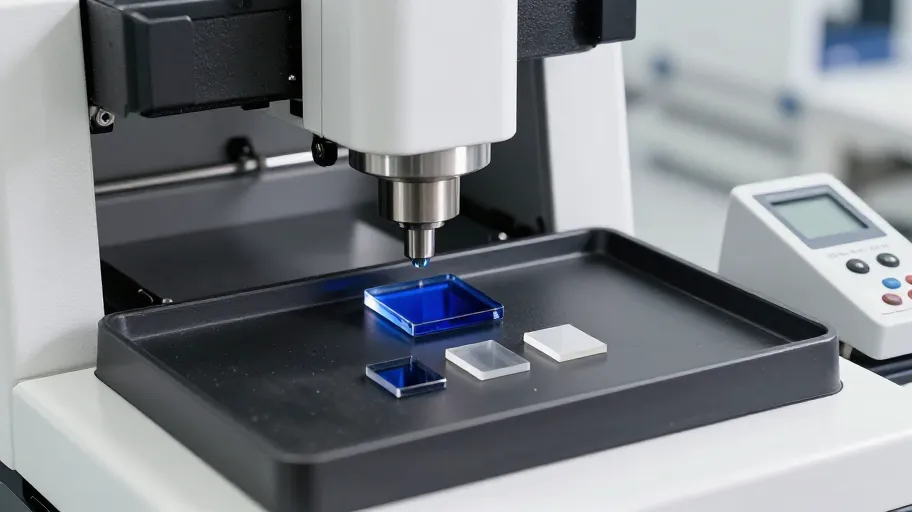
The honest answer to "how much is sapphire glass worth?" is that a sapphire watch crystal has no single fair price — its worth is set by a specification stack: crystal growth method, dimensions, cut and polish, coating, tolerance and inspection requirements, all layered onto order volume and tooling. A quote without that stack is not a price; it is a placeholder. This guide gives you a framework to price the spec, verify it with samples, and approve through documented gates.
What "worth" means for a sapphire watch crystal
When a consumer asks what sapphire glass is worth, they mean resale or prestige. When a sourcing manager asks, the question is operational: is the value I'm being quoted consistent with the specification I need, and can this supplier hold that specification across a production run?
That reframing matters because the same crystal shape can be produced to different material grades, surface finishes and dimensional controls. The worth of the part is the worth of the spec behind it — plus the supplier's ability to prove it.
Value drivers: what you are actually paying for
Use this list to decompose any quote:
- Material origin and growth method. Ask how the sapphire boule is grown and how crystal orientation is selected for watch applications. Document the answer.
- Geometry. Diameter, thickness, dome profile, bevel, date-window cuts and drilled features all add machining complexity. Complex geometry costs more than flat discs of the same diameter — confirm how your drawing is priced step by step.
- Surface finish. Polish quality on both faces affects optical clarity and readability. Ask what inspection verifies finish, and request the method, not just an adjective.
- Coating. Anti-reflective coating — whether applied, on which face, and to what verification standard — changes both cost and performance. Ask what test evidence supports the coating claim.
- Dimensional and geometric control. Ask what dimensional checks are performed and at what stage; never accept an unstated tolerance. Request the tolerance table for your part.
- Inspection and documentation. Batch traceability, inspection reports and AQL-style controls have a cost and a value. Specify what documentation you require in the RFQ.
- Tooling and setup. Custom crystals need custom tooling. Ask whether tooling is a separate line item, who owns it, and how it is amortised.
- Order volume and programme length. Volume affects unit economics; ask how the supplier prices scaling across your programme.
The Spec–Sample–Gate framework
Step 1 — Price the spec
Write a complete specification package before requesting quotes: drawing with tolerances, material requirement, finish, coating, marking, packaging and documentation requirements. Send the identical package to every supplier. Quotes for incomplete specs are not comparable — and a supplier who quotes without asking clarifying questions has told you something worth noting.
Step 2 — Verify with samples
Approve samples against the drawing, not against a general impression. Inspect geometry, finish, coating behaviour and fit in your case and movement stack. Record every deviation in writing.
Step 3 — Approve through gates
Define written approval gates: drawing sign-off, first-article approval, and any pre-production verification you require. Each gate should have named acceptance criteria and a documented result. Never approve volume on an undocumented verbal confirmation.
Decision table: reading a quote against spec completeness
| What the quote shows | What it signals | Your action |
|---|---|---|
| Full tolerance table, coating spec, inspection plan, itemised tooling | Supplier prices to specification; quote is comparable | Compare on total landed spec value; proceed to sample stage |
| Unit price only, "high quality sapphire" language, no tolerance | Value cannot be assessed; risk is hidden | Return the spec package; re-quote against defined requirements |
| Clarifying questions about geometry, coating faces, case fit | Supplier has read the drawing and priced real work | Document the answers; they become your approval criteria |
| Vague assurance in place of test or inspection evidence | Claims are unverified | Ask what evidence supports each claim; do not approve without it |
| Significantly lower price for an identical spec | Something in the spec is being omitted or substituted | Ask line-by-line what differs; verify with first articles |
Approval questions to ask any sapphire supplier
- How is the sapphire grown, and how is crystal orientation selected for this part?
- What dimensional and geometric controls are applied, and at which stage of production?
- What inspection method verifies polish quality, and what report will I receive per batch?
- If coating is specified, on which face is it applied and what evidence verifies performance?
- How are deviations from drawing handled, escalated and documented?
- What are the approval gates from drawing sign-off to volume production?
- What documentation travels with each shipment?
- How are changes to the drawing controlled after approval?
For sample fees, tooling charges, minimum order quantities and timelines: confirm the current policy directly with the supplier, and record the policy in writing as part of your approval file.
Sample evaluation checklist
- Sample evaluated against the controlled drawing revision
- All dimensions and geometry checked and recorded
- Surface finish inspected on both faces
- Coating presence and behaviour verified (if specified)
- Fit tested in case and with movement/hands stack
- Deviations logged in writing with supplier response
- Approval gate result documented and signed off
- Supplier's current sample, tooling and order policies recorded in the project file
FAQ
Is sapphire glass worth more than mineral glass for a watch? For a watch brand, sapphire offers superior scratch resistance, which supports positioning, warranty exposure and long-term product perception. Whether the premium is worth it depends on your price point and brand promise — evaluate it as a product decision, not only a cost line.
Why do sapphire crystal quotes vary so much between suppliers? Because the quotes are rarely for the same thing. Material grade, dimensional control, coating, inspection level, tooling and documentation differ invisibly between quotes. Making the specification identical and complete is the only way to make prices comparable.
How do I know a crystal is really sapphire? Ask what material verification the supplier performs and what documentation accompanies it. Combine supplier evidence with your own incoming inspection or third-party verification for critical programmes.
Should I approve a supplier based on a good sample alone? No. A sample proves capability at one moment; gates prove consistency. Approve through documented drawing sign-off, first-article approval and batch-level inspection terms.
What should I send to get a comparable quote? A complete package: controlled drawing with tolerances, material and finish requirements, coating spec, expected volumes, documentation requirements and your approval gates.
Get the procurement brief. 获取采购 Brief — JadeZone Sapphire's structured RFQ and approval brief for custom sapphire watch crystal programmes. Use it to make every quote comparable and every gate documented.
Not ready for that? Start with the sample evaluation checklist above — copy it into your next supplier review and confirm each item against the current policy directly.