
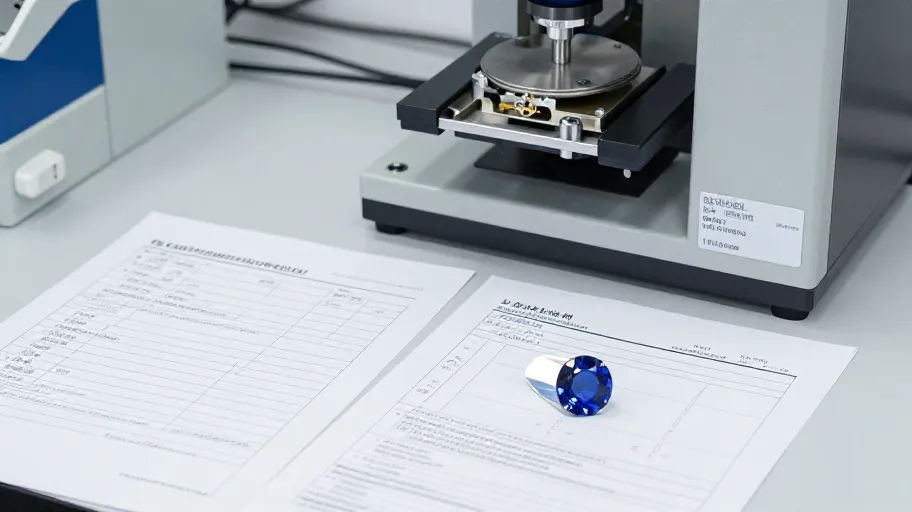
Sapphire watch crystals cost more than mineral glass because the material and its processing are harder to make and machine — but "expensive" is the wrong frame. For a B2B buyer, the real question is what specification you are paying for, what approval risk you carry, and what total cost of ownership the crystal creates across your production run.
Why "expensive" is a spec question, not a material question
When a sourcing manager asks whether sapphire glass is expensive, the honest answer is: compared to what, at which specification, and under which approval process? Two crystals that look identical on a product render can differ in cost several times over once you account for geometry, thickness, coating, finishing and quality-gate requirements.
A useful way to structure this evaluation is the TCO-SAP framework: Total Cost of Ownership — Spec, Approval, Process.
- Spec. Diameter, thickness, doming, step heights, edge finishes, hole positions, coating layers and print details all change processing effort — and therefore cost — before a single unit ships.
- Approval. Every dimension and surface treatment you require must be defined, measured and signed off. Undefined approval criteria create rework, disputes and the most expensive outcome of all: a rejected batch discovered at assembly.
- Process. How the supplier grows, cuts, grinds, polishes and inspects the crystal determines repeatability. Process documentation, not unit price, is what protects you across a production programme.
The buyer who controls Spec and Approval controls Process risk. The buyer who only compares unit prices absorbs it.
What drives the cost of a sapphire watch crystal
Use this decision table to identify which cost drivers apply to your project, and what to verify with the supplier before quoting.
| Cost driver | Why it moves cost | What to confirm with the supplier |
|---|---|---|
| Crystal geometry | Flat, domed, double-domed and stepped profiles require different machining and polishing operations | Which geometries they can produce to your drawing, and how deviations are handled |
| Thickness and tolerance bands | Tighter bands demand more inspection and higher rejection upstream | What tolerance they propose per dimension, and how it is measured and documented |
| Coating (e.g. anti-reflective treatments) | Each layer adds process steps and inspection criteria | Which coating options they offer, and how coating quality is verified per lot |
| Surface finish and edge treatment | Polish quality and edge chamfers affect both appearance and assembly fit | Finish standards they work to and how they are approved on samples |
| Features (holes, date windows, printed indices) | Additional features compound handling and inspection effort | Feature-specific inspection methods and acceptance criteria |
| Packaging and logistics requirements | Anti-scratch material still needs scratch-free handling in transit | Their packaging method and how transit damage claims are handled — confirm current policy directly |
| Order volume and programme cadence | Volume changes how tooling and setup effort is spread across units | How they price tooling versus per-unit cost for your programme shape |
None of these rows has a fixed answer. Each one is a question your procurement package should answer in writing before you compare quotes.
Specs, samples and approval: the workflow that controls cost
The most expensive sapphire crystal is not the one with the highest unit price. It is the one that fails approval late. A disciplined workflow keeps cost visible and risk bounded:
- Freeze the drawing. Lock geometry, thickness, tolerances, finish and coating into one controlled document. Any "to be confirmed" line item is a future cost.
- Define measurement and acceptance. For every dimension, state how it will be measured and by whom. Ask the supplier what they measure in-house versus what they need you to approve visually.
- Approve samples against the drawing — not against a previous sample. Approving "make it like the last one" transfers all spec responsibility to memory. Approve against the controlled document.
- Document the sample policy before ordering. Sample availability, any fees, shipping responsibility and whether fees offset production orders vary by supplier and project. Do not assume — confirm the current policy in writing for your specific project.
- Set the dispute path. Agree in advance what happens if a delivered lot does not meet the approved drawing: inspection method, evidence required, and resolution route.
Concrete approval questions to ask any sapphire crystal supplier:
- Can you confirm in writing which dimensions you measure, with which equipment, and which you ask the buyer to approve visually?
- What documentation accompanies each production lot — inspection reports, coating records, material traceability?
- What is your proposed first-article process, and what do you need from our side to run it?
- How do you handle a deviation found after delivery, and what evidence do you require?
- What are your current sample, tooling and order policies for a project of this spec — and where might they change?
These questions do not commit you to a supplier. They reveal whether a supplier can be approved at all.
How to compare suppliers without misleading unit prices
Comparing quotes for custom sapphire crystals is only valid when the specs are identical — which, for custom parts, they never quite are. Instead:
- Normalise the spec package. Send every supplier the same controlled drawing and acceptance criteria. Quote differences then reflect supplier differences, not spec differences.
- Separate one-time cost from recurring cost. Tooling, first-article inspection and setup behave differently from per-unit price across a production programme.
- Weight approval capability. A supplier with documented measurement and lot traceability may quote higher and still cost less over the programme by preventing rejects.
- Confirm everything in writing. Sample policy, fee structure, shipping responsibility and deviation handling must be current-policy confirmations from the supplier — not assumptions carried over from other projects or other suppliers.
Pre-quote checklist: before you ask "is sapphire glass expensive?"
Run this checklist before requesting any quotation:
- Controlled drawing released: geometry, thickness, all tolerances, finish, edge treatment
- Coating requirement specified, including which side(s) and acceptance criteria
- Features defined: holes, windows, print, positions and dimensions
- Measurement and acceptance method agreed per critical dimension
- First-article approval process and evidence requirements agreed
- Sample, fee, tooling and shipping policies requested in writing from the supplier
- Deviation and dispute path documented before the first order
- Volume scenario shared so tooling and setup can be quoted across the programme
A buyer who arrives with this package gets quotes that can be compared, approved and defended internally.
FAQ
Is sapphire glass more expensive than mineral glass for watch crystals? As a material category, synthetic sapphire costs more to produce and machine than mineral glass, and for many watch programmes that premium buys scratch resistance and durability. Whether the premium is justified is a product-positioning decision: verify the spec-level cost difference for your exact drawing rather than relying on category-level impressions.
Why do sapphire crystal quotes vary so much between suppliers? Because the quotes are not for the same thing. Geometry, tolerance bands, coating layers, inspection depth and approval requirements all change processing effort. Normalise the spec package across suppliers before comparing, and ask each supplier to state what their quote includes.
What should I approve on a sapphire crystal sample? Approve the sample against the controlled drawing: every dimension, the finish, the coating appearance and the fit in your case. Document what you measured, what you approved visually, and who signed off. This record is your reference for the entire production run.
Can I get samples before committing to a production order? Sample practice varies by supplier, project and spec. Confirm the current policy directly — including any fees, shipping responsibility and how samples relate to a production order — in writing, before you build your project timeline around it.
How do I keep sapphire crystal cost down without cutting quality? Control the spec and the approval process. Freeze the drawing early, avoid unnecessary tolerance tightening, define acceptance criteria up front, and document the deviation path. Most avoidable cost in custom crystal programmes comes from late spec changes and disputed approvals, not from the material itself.
获取采购 Brief
Ready to turn "is sapphire glass expensive?" into a spec-level answer for your own project? 获取采购 Brief and build the documentation package that makes quotes comparable, approvals clean and costs defensible. JadeZone Sapphire supports watch brands and component buyers across Shenzhen and Hong Kong with custom sapphire watch crystal development — confirm current project policies directly with our team.
Low-friction option: start with the pre-quote checklist above. Complete it, and you are ready to request a structured quotation on your terms.