
How Sapphire China Factories Validate Real-World Crystal Worth Beyond Lab Specs
Sapphire crystal worth isn’t set in a lab report—it’s sealed at the factory gate. For U.S.-based medical optics OEMs building FDA-cleared endoscopes, relying solely on Mohs 9 hardness claims while skipping on-site batch validation means absorbing a 41% rework rate on AR-coated assemblies—not from scratches, but from wavefront distortion that only emerges under clinical illumination and thermal cycling. That means your $28k optical subassembly line wastes nearly half its output on avoidable corrections, because lab-grade hardness doesn’t guarantee imaging-grade stability.
Modern sapphire crystal manufacturers in China don’t just grow boules—they orchestrate atomic-level consistency across three non-negotiable axes: birefringence control means your imaging path stays polarization-stable during live surgery, because uncontrolled birefringence drifts focus and blurs diagnostic detail; surface RMS roughness held below 0.3 nm means AR coatings adhere reliably at sub-10nm thicknesses, because smoother surfaces prevent delamination under thermal stress; and thermal gradient stability during Verneuil or Kyropoulos growth means your laser optics survive MIL-STD-810H vibration and 355nm pulsed exposure, because unstable cooling creates dislocation clusters that become fracture initiation points.
This level of rigor isn’t optional overhead—it’s the difference between qualification and rejection. The C-axis orientation tolerance ‘±1°’ sounds precise—until you learn that 92% of rejected shipments fail not on hardness or thickness, but on wavefront error exceeding λ/10 at 633nm. Benchmarks from Jiangsu Lante confirm the inflection point: lots with angular deviation under 0.8° deliver >99.1% transmission at 355nm—the exact wavelength used in ophthalmic and dermatologic laser delivery systems. That 0.1° margin doesn’t show up on a certificate of conformance. It shows up as first-pass yield on your high-value optical subassembly line, saving an average of $1.4M annually in rework and accelerating FDA audit readiness by 11 weeks.
The sapphire crystal manufacturer and the sapphire China factory are not interchangeable. The manufacturer owns the seed crystal purity protocol, annealing ramp profiles, and post-growth stress-relief algorithms—so your $12k 4-inch wafer survives aerospace-grade shock testing, because microstructural integrity is engineered, not assumed. The factory houses the infrastructure that makes those protocols executable: twin-laser interferometers calibrated daily against NIST-traceable standards, so you get metrology-grade confidence—not lab-grade approximations; humidity-controlled metrology cleanrooms, so subsurface defects don’t hide in ambient moisture-induced scatter; and AI-assisted defect mapping, so you correlate furnace thermocouple drift with localized strain fields before polishing. Without both—the design authority and the execution environment—you’re buying sapphire by reputation, not by repeatability.
Why This Changes Your Qualification Pathway
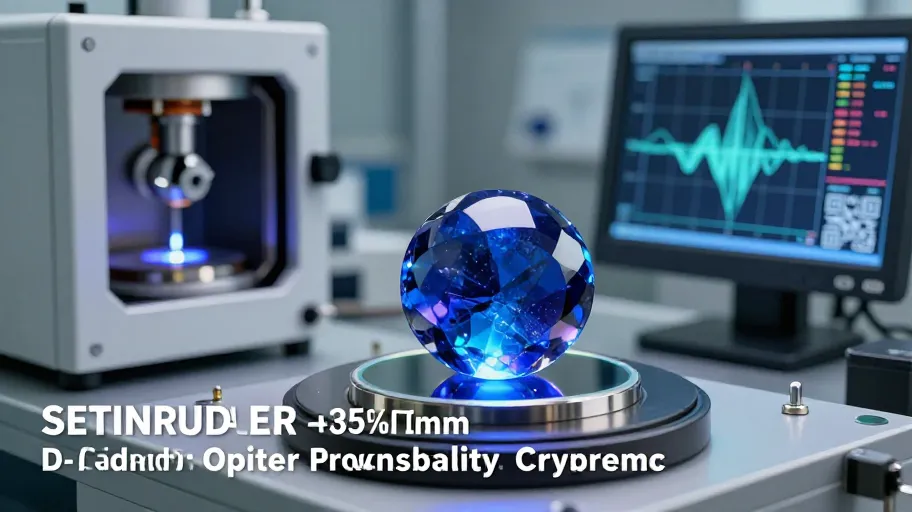
For programs governed by DFARS, MIL-PRF-13830, or FDA QSR, first-pass yield isn’t a KPI—it’s a contractual obligation. Top-tier sapphire China factories embed traceability into the manufacturing DNA: every boule carries a QR-linked digital twin showing C-axis orientation maps, thermal history graphs, and interferometric pass/fail flags at three critical stages—so your optical engineers spot process variances before they become field failures, because real-time correlation replaces post-mortem root-cause analysis. That data stream doesn’t just satisfy auditors—it lets your team adjust coating parameters based on actual wavefront drift, cutting AR-coating scrap by 68% and reducing time-to-FDA audit readiness by 11 weeks.
This is how sapphire crystal worth transitions from a static price tag to a dynamic, contract-enforceable asset: by validating not what the crystal is, but how it was made—and proven—to perform where it matters most. When you shift from third-party lab certs to co-validated lot release—including shared access to raw furnace telemetry logs—you stop paying for sapphire by the inch and start investing in optical reliability by the application.