
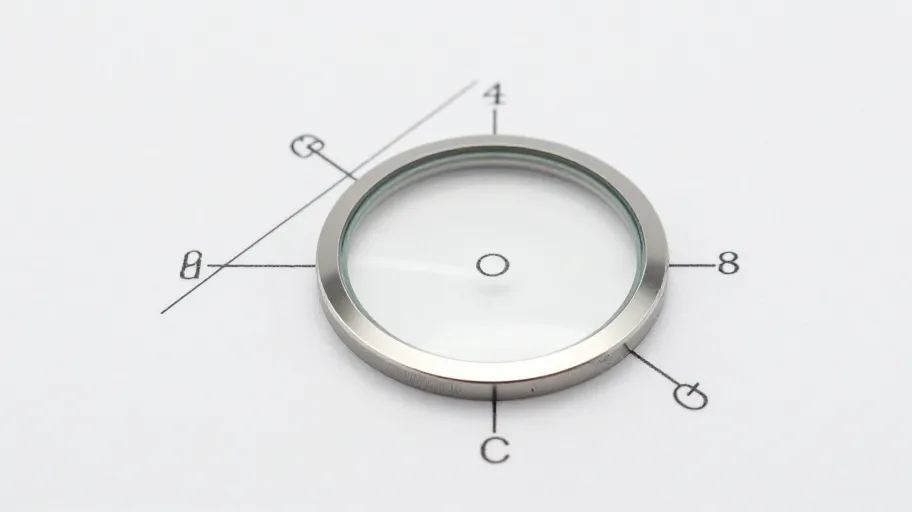
A first brief for a custom sapphire watch crystal tends to cover the obvious diameter and thickness while missing the measurements that determine fit, sealing and optical performance. These include the crystal seat geometry, gasket or adhesive interface, chamfer and edge profiles, curvature, coating requirements and print or logo positioning. Preparing these dimensions before first contact reduces clarification loops and lets a supplier assess manufacturability in one pass. The Crystal Brief Completeness Check below organises what to prepare across three dimensions of readiness.
Why first briefs create rework
When a sourcing team sends only an outer diameter and a thickness, the supplier cannot yet evaluate the part. Every missing dimension becomes a question, and every question becomes a delay. The purpose of the first brief is not to close a deal — it is to give the engineering team enough information to judge feasibility, propose a process route and identify risk areas.
The Crystal Brief Completeness Check splits readiness into three dimensions:
- Geometry readiness — every defining shape and profile of the crystal itself is dimensioned.
- Interface readiness — every surface where the crystal meets the case, gasket, bezel or movement opening is specified.
- Environment readiness — the conditions the crystal must withstand and the optical or coating features required are documented.
A brief that satisfies all three allows a meaningful technical dialogue from the first exchange.
The Crystal Brief Completeness Check: what to measure
| Category | Measurement or specification | Why it matters | What to document |
|---|---|---|---|
| Geometry | Outer diameter | Defines overall fit with the case opening | Nominal dimension on the drawing with reference datum |
| Geometry | Thickness at centre and edge | Affects dome profile, strength and hand clearance | Both values, especially for domed designs |
| Geometry | Dome or curvature profile | Determines optical behaviour and tooling approach | Radius, height of curvature, or profile sketch |
| Geometry | Chamfer and edge profile | Influences seating, sealing and appearance | Angle, width and location of each chamfer |
| Geometry | Date window or aperture cut-out | A separate machining operation with its own geometry | Position, size, corner radii |
| Interface | Crystal seat diameter | The surface the crystal rests on inside the case | Dimension and datum referencing the case drawing |
| Interface | Gasket channel or adhesive surface | Determines sealing strategy compatibility | Cross-section reference and surface finish callout |
| Interface | Bezel overlap or exposed height | Affects appearance and pressure-bearing geometry | Height above case, overlap width |
| Interface | Mounting method intent | Compression, adhesive or snapped fit changes geometry needs | Note the intended method in the brief |
| Environment | Coating requirement | Anti-reflective or other coatings change thickness and process | Which surfaces, if any, require coating |
| Environment | Print or logo placement | Adds an operation with registration requirements | Position, size, colour, which face |
| Environment | Intended use conditions | Guides material grade and process discussions | Description of expected use environment |
| Environment | Inspection criteria | Defines how acceptance will be judged | Which features are critical dimensions |
Not every project needs every row. The value of the framework is that the buyer decides deliberately which rows are not applicable rather than omitting them by accident.
Dimensions that belong to the interface, not the crystal
A frequent source of confusion is ownership of dimensions. The crystal does not exist in isolation: its seat, gasket and bezel geometry live on the case drawing, but they constrain the crystal. When the case and crystal are sourced from different suppliers, the buyer must carry interface dimensions between both drawings and state which document is the controlling reference.
Ask internally before the first brief:
- Which drawing is the master reference for the crystal-to-case interface?
- Has the gasket, if used, been dimensioned from the same datum as the crystal?
- Are chamfers dimensioned on the side that contacts the seal, not only the visible side?
- Who will verify that the case opening and the crystal seat agree?
Approval questions to settle before confirming a specification
Once a drawing exists, these questions help the sourcing team and supplier align before tooling or sampling discussions begin. None of these have answers supplied here; each is a project-specific question to confirm in writing.
- Which dimensions on this drawing are critical, and how should they be marked as such?
- Can the supplier manufacture the specified dome profile, chamfer and aperture in one process route, or does the design need adjustment for manufacturability?
- What dimensional reporting or measurement data will accompany first articles, and in what format?
- Which surface is the sealing-critical face, and what finish does it require?
- How should coating, print or logo registration be inspected and approved?
- What datum scheme does the supplier recommend so case and crystal measurements reconcile?
- What changes to the case drawing would simplify crystal manufacture?
- Confirm the current policy directly on samples, tooling, quantities and timelines — these vary by project and are not stated here.
Documented answers to these questions form an approval record that protects both sides if questions arise later in the project.
Comparing briefs: a decision table for sourcing teams
When evaluating whether your first brief is ready to send, use this decision table:
| Situation | Risk | Recommended action |
|---|---|---|
| Only diameter and thickness supplied | Supplier cannot assess feasibility; long clarification cycle | Complete the geometry readiness rows first |
| Crystal drawing exists but case interface undefined | Fit and sealing cannot be verified | Add interface dimensions and name the controlling drawing |
| Interface defined but coating and print unspecified | Late changes after process route is set | Add environment readiness rows before technical review |
| All three readiness dimensions covered | Quotation and feasibility review can proceed in one pass | Submit the drawing or dimension sheet |
| Unclear which dimension is critical | Acceptance disputes at inspection stage | Mark critical dimensions and agree inspection criteria in writing |
FAQ
Which document should I submit for a custom sapphire watch crystal enquiry: a drawing or a written spec? A dimensioned drawing is preferable because it communicates geometry, datums and callouts in one reference. If a drawing is not yet available, a dimension sheet listing each measurement from the completeness check is a workable starting point.
How do I specify a domed crystal if I don't have a formal radius? Provide a profile sketch with the height of curvature and centre and edge thicknesses, and note that the radius is to be derived. Ask the supplier which additional measurement they need to confirm the profile.
Who is responsible for interface dimensions when the case comes from another supplier? The buyer coordinates. State which drawing controls the interface and verify that both suppliers reference the same datum scheme before approving either part.
What if I only have a sample watch and no drawings at all? Ask the supplier what measurements they would take from the sample and how they document them, then approve that measurement plan before it is executed. Confirm the current policy directly on how samples are handled.
Can I request dimensional measurement data with first articles? Ask what dimensional reporting the supplier can provide and in what format, then write the agreed format into the approval record before the project advances.
Submit your drawing or dimension sheet
If you have a drawing, a dimension sheet or even a marked-up sketch for a custom sapphire watch crystal, submit it for technical review. JadeZone Sapphire, a Shenzhen and Hong Kong B2B manufacturer of custom sapphire watch crystals and precision sapphire components, can assess the geometry, interface and environment dimensions against the completeness check and identify any measurement gaps before quotation begins.
Low-friction alternative: Not ready to send a drawing? Run the Crystal Brief Completeness Check above against your current documentation and mark which rows are missing — then submit the completed dimension sheet when ready.
Pre-submission checklist
- All geometry dimensions listed and datum referenced
- Interface dimensions identified and controlling drawing named
- Critical dimensions marked
- Coating, print and aperture requirements noted
- Intended mounting method stated
- Inspection criteria and reporting format discussed with the supplier
- Written approval of the measurement plan