
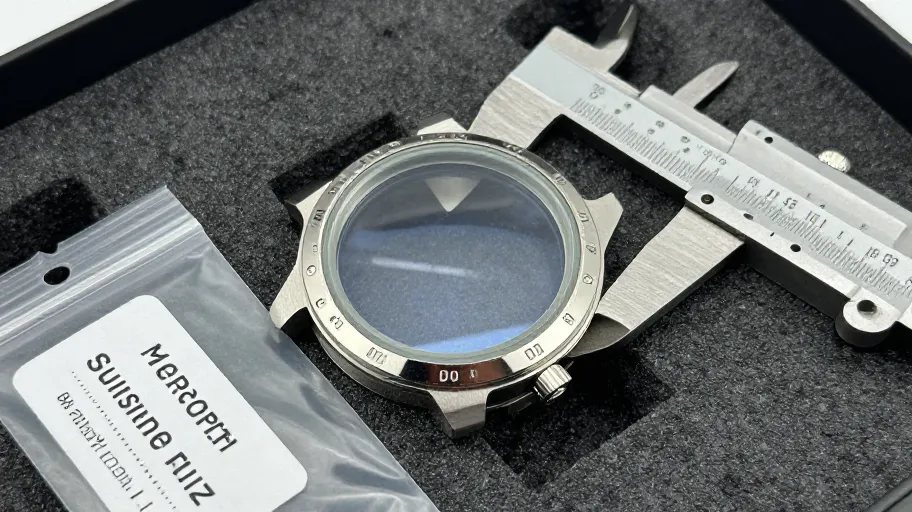
Before a sapphire watch glass supplier can quote accurately, you need to provide a complete drawing with dimensions and tolerances, the case reference and sealing method, the required coating or surface treatments, crystal shape and features, approval and inspection requirements, and your packaging and delivery expectations. Missing any of these forces the supplier to quote wide or guess.
Every sourcing team has experienced the same frustrating loop. You send a drawing to three suppliers, receive three quotes that are barely comparable, and spend the next round of emails untangling assumptions. One supplier quoted a flat crystal where you needed a double-domed one. Another assumed no anti-reflective coating. A third built in a tolerance assumption your movement or case design cannot accept.
The problem is not the suppliers. The problem is the brief. A quotation for custom sapphire watch glass is an engineering estimate, and its accuracy is limited by the precision of the inputs. This article gives you a structured way to prepare a quote-ready brief so the first response you receive is one you can act on.
The C-C-S-A-P Quote-Ready Framework
When preparing a request for quotation, work through five inputs in order. The framework exists because each element changes the manufacturing process, and a supplier who has to assume any of them will price in uncertainty.
C — Case reference. How the crystal mounts and seals against the case: the fitting method, whether a gasket or adhesive is involved, and the relevant case dimensions or a case sample. The supplier cannot engineer a sealing surface without knowing how the crystal interfaces with the rest of the watch.
C — Coating and surface treatment. Whether you require anti-reflective coating — and if so, on which faces — plus any colour tints, decorative printing, metallisation or logos. Coating and print operations are separate process steps, and each adds questions the supplier must answer before pricing.
S — Specification. The drawing itself: crystal geometry (flat, domed, stepped, box), thickness profile, hole positions for a date window, edge finish, and the dimensional tolerances your design actually requires. State tolerances explicitly. A supplier who receives a drawing without tolerances must either ask or assume, and assumptions do not survive first article inspection.
A — Approval requirements. What you will inspect and approve before production: measurement reports, sample approval stages, first article inspection, and any documentation you expect to accompany shipments. If your quality process requires specific reports, name them at quotation stage so the supplier can scope them into the price.
P — Packaging and logistics. How the parts must be packed to survive transit and suit your assembly line — trays, tape, individual protective packaging — plus destination and any import considerations you want the supplier to handle. Packaging for precision glass is not an afterthought, and it belongs in the quote.
Decision table: are you ready to request a quote?
| Element | Quote-ready | Not ready — action needed |
|---|---|---|
| Drawing | 2D drawing with tolerances plus 3D model where geometry is complex | Sketch or reference photo only — create a dimensioned drawing first |
| Case interface | Case reference, fitting method and sealing approach documented | "It fits a standard diver case" — obtain case drawings or a sample |
| Coating | Coating type, faces and any print/logo specified with artwork | "AR coating if possible" — decide and specify which faces |
| Volume | Target quantity and forecast range stated for discussion | No quantity, or a single unqualified number — state a range and confirm what the supplier can support |
| Quality approval | Inspection criteria and approval stages named | "Good quality" — define measurable acceptance criteria |
| Packaging & delivery | Packing method and destination stated; timelines to be confirmed directly | Unstated — specify packaging; ask the supplier about current lead times rather than assuming |
Approval questions to ask any sapphire watch glass supplier
Use these questions in your first conversation. They are framed to surface project-specific answers rather than assumptions — and every one of them depends on the supplier's current policy, not on any norm you can rely on in advance.
- What dimensional and geometric tolerances can you hold for this specific geometry, and how will you verify them?
- What coating options do you currently offer for this part, and how do you document coating conformance?
- What approval stages do you propose — sample, first article, pilot run — and what does each stage include?
- What inspection reports accompany each shipment, and can we audit the measurement method?
- What is your current sample policy, including any fees, shipping responsibility and whether fees change on order? Confirm the current terms directly rather than assuming.
- What is your current MOQ for this specification, and how does price scale across our forecast volume range?
- What are your current lead times for sampling and production, and what factors in this design could extend them?
- How do you handle and document non-conforming parts, and what is your process for corrective action?
None of these questions has a universal answer. A supplier who answers them with specific, documented responses for your part is demonstrating the engineering seriousness you need.
Comparing quotes fairly
Once you have quote-ready responses from several suppliers, compare them on a fixed grid: what each quote includes, what each excludes, and which assumptions each supplier made. A low quote that excludes coating, inspection reports and protective packaging is not a low quote — it is an incomplete one.
Document everything. Ask each supplier to state their assumptions in writing alongside the price. If two suppliers quote the same part with different tolerance interpretations, the price difference tells you nothing about which supplier is better; it tells you your brief was still ambiguous somewhere.
For OEM programmes where the crystal design may evolve, ask suppliers how they price engineering changes mid-project. A supplier's change-management process matters as much as the initial number.
Build your quote-ready brief
Use this checklist before sending your next RFQ to a sapphire watch glass supplier:
- Dimensioned 2D drawing with explicit tolerances (plus 3D model if geometry is complex)
- Crystal shape and thickness profile confirmed against case design
- Case interface documented: fitting method, sealing approach, case reference or sample
- Coating specified: type, faces, plus print, logo or artwork files
- Date window or hole positions specified
- Target quantity and forecast range stated
- Inspection criteria, approval stages and required reports named
- Packaging requirements and destination stated
- Supplier's current MOQ, sample policy, fees and lead times confirmed in writing
- All supplier assumptions documented alongside the quote
FAQ
Do I need a finished watch design before requesting a sapphire crystal quote? You need a defined crystal specification and case interface. The watch design can still be evolving elsewhere, but the crystal drawing, tolerances and mounting method must be settled enough for the supplier to engineer the part.
Can I get a quote from a photo or a sample crystal? A photo is enough for an orientation conversation, not an accurate quote. A sample crystal can be reverse-engineered, but confirm directly with the supplier what they can measure, what they cannot, and whether a dimensioned drawing will still be required.
Should I specify tolerances, or let the supplier recommend them? Do both. Bring your design's functional requirements, then ask the supplier what they can hold for this geometry and at what cost consequence. Tolerances agreed in dialogue survive production; tolerances assumed in silence do not.
How do I know if a supplier's coating offering fits my product? Ask what coating options they currently run, on which faces, and how conformance is documented. Request coating samples for evaluation and verify them against your own acceptance criteria before approving production.
What single input most improves quote accuracy? A complete, toleranced drawing tied to the case interface. Almost every wide or unusable quote traces back to a supplier guessing at geometry, sealing or tolerance.
Next step
Prepare a quote-ready brief using the C-C-S-A-P framework and the checklist above, and bring it to JadeZone Sapphire — a Shenzhen and Hong Kong B2B manufacturer of custom sapphire watch crystals and precision sapphire components — for evaluation and a quotation. Our engineering team will review your drawing, confirm what we need, and respond on the basis of your actual specification rather than assumptions.
Not ready yet? Download or copy the quote-ready checklist above and work through it with your design team — then come back with a brief any supplier can quote accurately on the first pass.