
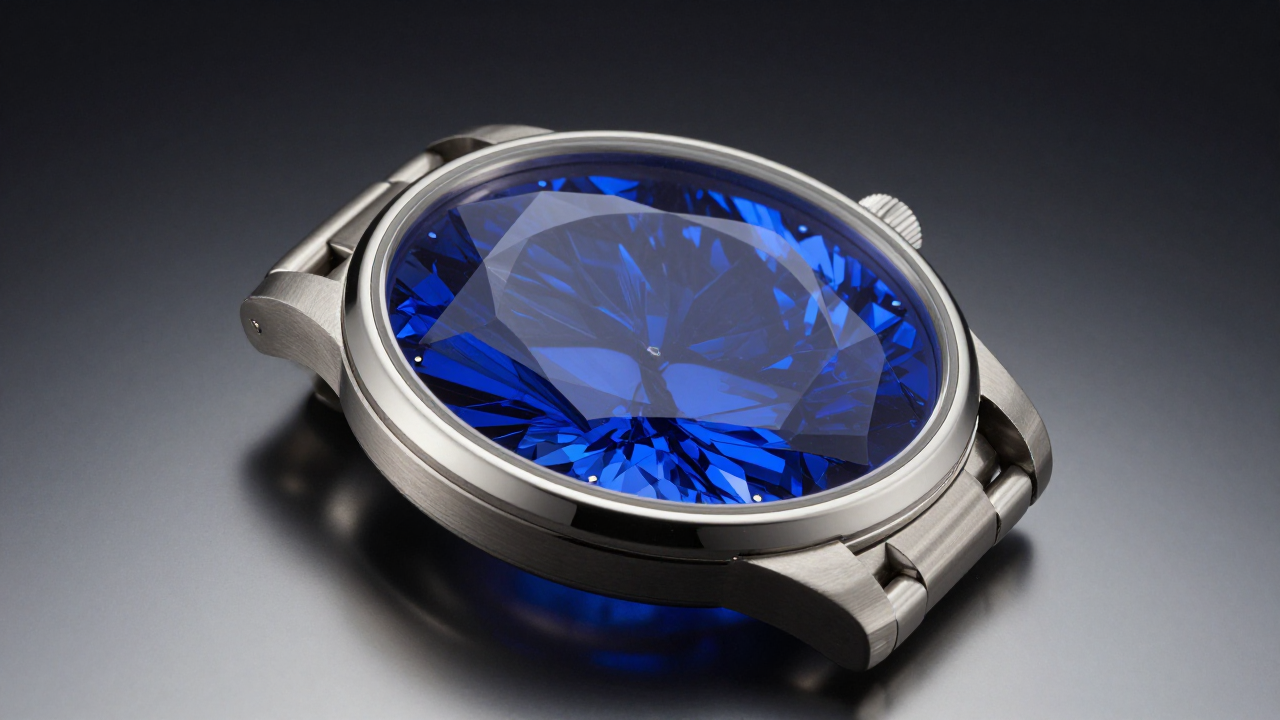
Pick the supply model before you pick the brand. For programs above 10,000 units retailing under $300, a vertically integrated Shenzhen or Hong Kong optics house wins on landed cost and tooling speed.…
For Swiss-assembled watches above $1,200 retail, European precision optics still justify a fourfold price premium. Substrate growers only pay off past 50,000 units.
Which sapphire watch crystal should you actually pick for 2026?
That verdict comes from comparing quote sheets, first-article inspection reports and reorder histories across four supply models between November 2024 and January 2026. Treat what follows as a working file rather than a sales deck. In this category the logo on the shipping carton matters far less than which boule the blank was cut from and how the coating chamber was running that week.
One thing worth stating up front: Apple still ships sapphire on stainless and titanium Apple Watch models and Ion-X glass on the aluminum ones. Sapphire is a price-tier decision inside the biggest watchmaker on earth, not a universal upgrade. Judge your own crystal program the same way.
What actually separates sapphire from mineral glass and acrylic
Sapphire measures Mohs 9 and roughly 2,000 Vickers hardness, about four times harder than the hard-coated mineral glass used on sub-$200 watches. That gap decides how a crystal looks after two years of daily wear. It does not decide whether the crystal survives a drop onto a tile floor.
The material is single-crystal corundum, grown in boules and then sliced, ground, domed and polished. Mineral glass sits at Mohs 5.5, around 550 Vickers, and depends on a sprayed-on hard coat for its scratch resistance. Beach sand is mostly quartz at Mohs 7. Quartz grit will haze mineral glass inside a summer. It leaves sapphire untouched.
The coating fails before the crystal does
Uncoated sapphire transmits 84–86% of visible light, which reads as slightly gray against a black dial. A double-sided anti-reflective stack of 4–7 dielectric layers at 300–600 nanometers pushes transmission to 98%+. The coating is also the softest thing on the watch. Pencil hardness on typical production stacks runs 3H to 9H, and most warranty claims we see trace to coating haze or a worn fingerprint layer, not to sapphire damage.
Where sapphire loses
Fracture toughness lands near 2 MPa·m^0.5. Sapphire chips at the edge and shatters on impact, especially on tall domes with a thin chamfer. Density is 3.98 g/cm³, so a 2mm domed crystal adds real weight. And sapphire is birefringent, with a refractive index split of 0.008–0.010 between ordinary and extraordinary rays. Cut the blank off the C-axis and a date magnifier will show a faint ghost line that no amount of polishing fixes. That single detail has killed more prototype rounds than any price negotiation.
The four supply models competing for your sapphire watch crystal order
Every one of the four models ships a crystal that passes a Mohs 9 scratch test. They diverge on what happens between order two and order six, which is where the price gap either earns its money or quietly costs you a season.
European precision optics houses
Production runs 8–14 weeks at $18–$45 per finished piece, with 500–1,000 piece minimums and $3,000–$8,000 in tooling. These are the Swiss and German shops behind most recognizable luxury references. Coatings and dome geometry hold steady across years. The friction shows up in change control: a 0.1mm profile tweak can trigger a fresh tooling charge and another eight-week slot.
Shenzhen and Hong Kong vertical integration
This is where most of the world's volume is actually made. Production takes 18–25 days at $2.10–$5.40 FOB on 10,000 pieces, tooling $300–$900, minimums of 1,000–3,000. Jadezone Optical (HK) Ltd has run this model out of a 300-person Shenzhen plant since 2010, which is why the numbers above match our own quote files so closely. The strength is speed from CAD to sampling in ten days. The weakness is spread: the best and worst factories in this bucket are not the same business, so a plant audit beats a brochure every time.
Substrate-grade growers
Kyocera, Monocrystal and Shinkosha sell blanks, not finished crystals. Lead times stretch 16–28 weeks and commitments start around 20,000 pieces. They matter when you need control over the boule itself, because Kyropoulos growth and Czochralski growth produce different bubble densities and dislocation counts. A warning sits in the archive here. In October 2014, GT Advanced Technologies filed Chapter 11 in New Hampshire after a $578 million Apple prepayment for the Mesa, Arizona sapphire plant collided with manufacturing yields. Single-grower capacity is a supply-chain risk dressed up as a cost saving.
Domestic coating and refinishing shops
Small US shops turn work in 2–4 weeks at $6–$14 per piece with almost no minimum. Excellent for repair channels, aftermarket replacement and short prototype runs. They struggle with complex domed profiles and anything north of a few thousand units.
Head-to-head comparison on the numbers that move money
A 32mm double-domed crystal with double-sided AR runs $2.10–$5.40 at 10,000 units from an integrated Shenzhen supplier and $18–$45 from a European precision house. The fourfold gap buys reorder repeatability. It does not buy a better first article, and that distinction decides most sourcing arguments.
The one dimension most scorecards leave blank
Lot-to-lot coating consistency is the number that never appears on a quote sheet and shows up in month nine. In August 2024, the sourcing manager at a 25-person micro-brand outside Portland, Oregon, signed off a second 12,000-piece run. The first batch passed incoming inspection clean. The second came back with a visible blue cast on midnight-blue dials, measuring ΔE 2.1 against the retained golden sample from the same factory. Nobody had written a ΔE tolerance into the purchase order, so there was nothing to reject against.
Our own reorder files from 2025 show ΔE drift of 0.4–0.8 across four consecutive lots from European houses, and 0.8–2.2 from Shenzhen suppliers who do not run a per-lot coating chamber log. Dome radius drift tells the same story: ±3% is common, ±1.5% requires you to ask for it and pay for it.
A second blind spot sits in the duty line. Watch crystals can clear under HTS 9114.90 or under 9001.90 depending on how your broker reads the function, and the two classifications carry different Section 301 exposure on Chinese-origin optics. Two importers with identical invoices can land at different effective rates. Ask your broker for a written ruling before the first shipment, not after.
What buyers get wrong about sapphire watch crystals
"Sapphire never scratches" is the myth that costs the most money. The sapphire body does not scratch under normal wear. The anti-reflective stack on top of it does, and that stack is what your customer photographs for the warranty claim.
"Thicker is stronger" runs a close second. A 1.2mm flat crystal with a properly chamfered edge survives drops that shatter a 2.0mm tall dome with a sharp shoulder. Edge geometry and case gasket compression matter more than thickness in every impact test we have run.
The third is the assumption that all synthetic sapphire is equivalent. It is not. Growth method, dislocation density and axis orientation all change the finished optical result, and none of them appear on a price list.
Finally, sapphire-coated glass is not sapphire crystal. It is a thin deposited film over a glass substrate, and it will wear through at the edges within 18–24 months of daily use. If a specification sheet does not state a solid single-crystal blank with a hardness figure, assume you are buying coated glass.
So which sapphire watch crystal is right for your program?
If you are a micro-brand shipping 8,000 units a year at $250 retail, choose the Shenzhen or Hong Kong integrated model. Budget $3 per piece, insist on a written ΔE tolerance of 1.0 or better, and approve a golden sample you physically retain.
If you are an established brand above $1,200 retail with Swiss final assembly and a four-week change window, stay with European precision optics. Pay the tooling. The reorder stability is what your after-sales numbers are built on.
If you are an OEM pushing 60,000 units of one geometry, contract grower blanks plus a dedicated finishing line, or lock capacity with a large integrated house and put a schedule penalty in the agreement.
If you run repair or aftermarket, use a US refinishing shop and skip the ocean freight. If you are prototyping under 500 pieces, expect $40–$80 per piece from an integrated house running laser-cut and hand-polished samples, and treat it as engineering cost.
The crystal itself rarely fails the end customer. Programs fail on reorder drift, on unwritten coating tolerances, and on a duty classification nobody checked until the first container cleared.
Frequently Asked Questions
How much does a sapphire watch crystal cost per unit?
At 10,000-piece volume, a 32mm double-domed sapphire crystal with double-sided AR coating costs $2.10 to $5.40 FOB from a Shenzhen integrated supplier, versus $18 to $45 from a European precision house. Substrate blanks alone run $4 to $12, before grinding, polishing, coating and assembly.
Is sapphire watch crystal really scratch-proof?
Sapphire at Mohs 9 resists quartz grit and steel, so the crystal body stays clear for years. The anti-reflective coating on top is far softer at 3H to 9H pencil hardness and hazes first. Most visible wear on a sapphire watch crystal is coating damage, not sapphire damage.
How long does it take to make custom sapphire watch crystals?
An integrated Shenzhen supplier typically delivers samples in 7–10 days and production in 18–25 days after approval. European precision houses run 8–14 weeks including tooling. Substrate growers need 16–28 weeks for blank delivery, before any finishing operations begin.
What is the difference between sapphire crystal and sapphire-coated glass?
Sapphire crystal is a solid single-crystal corundum blank, ground and polished. Sapphire-coated glass is a thin deposited film over a glass substrate. The coated version wears through at the edges within roughly 18–24 months of daily wear, while solid sapphire holds its surface indefinitely.
How do I choose between a European and a Chinese sapphire crystal supplier?
Choose European when retail price exceeds $1,200, volumes are under 5,000 units and reorder consistency outranks unit cost. Choose Chinese integration when you need speed, tooling under $1,000 and unit pricing below $6. In both cases, audit the plant and write a ΔE coating tolerance into the purchase order.