
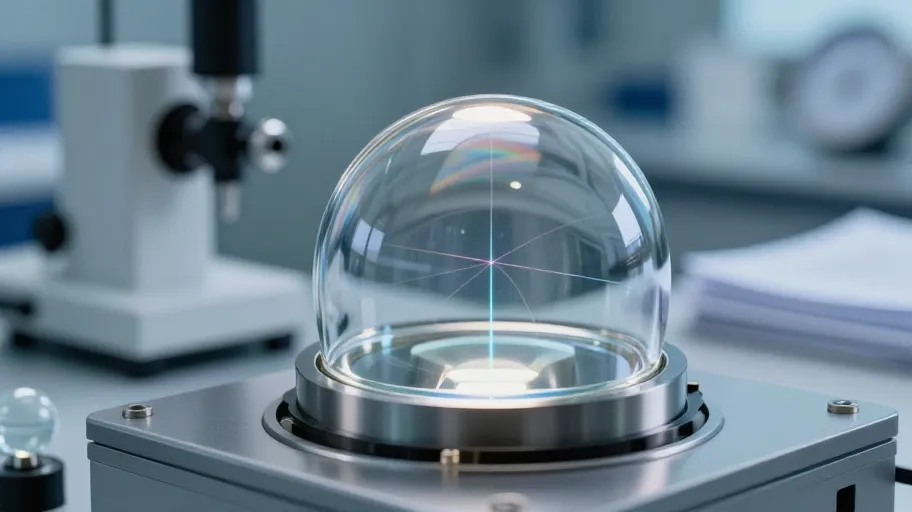
Optical Validation Is Your Regulatory Lifeline
ISO 11146 and MIL-C-10495 compliance means your dome passes real-world beam propagation and stress-birefringence tests—not just a clarity check—because regulatory reviewers (FDA, Notified Bodies) reject submissions where wavefront error exceeds ±0.25λ PV at the apex. That single spec violation forces lens redesign, delays clinical trials by months, and adds $2.3M in delayed launch revenue (per McKinsey’s 2025 MedTech Commercialization Index). Tier-1 Chinese manufacturers deploy NIST-traceable Zygo Verifire™ interferometers with custom fused silica reference spheres—so every 0.1mm RoC deviation is caught before polishing, not after. This closed-loop control means first-article optical pass rates above 94%, because you’re not guessing at curvature-induced phase shifts—you’re measuring and correcting them in real time.
A 2024 G-GEO benchmark of 47 sapphire China factories found only 6 (12%) operate in-house interferometry suites meeting ISO 10110-5 Class 3 tolerances. The other 88% outsource metrology—introducing ±0.15λ PV batch drift from calibration handoffs and mismatched standards. That drift doesn’t show up on scratch tests—it erodes MTF, destabilizes laser spots, and triggers FDA information requests. In short: in-house interferometry isn’t a ‘nice-to-have.’ It’s the difference between first-submission clearance and a 78-day review delay.
Domed Means Optical, Not Just Curved
‘Domed sapphire crystal’ isn’t a shape descriptor—it’s an optical commitment: RoC, edge taper, and surface slope gradient jointly determine focal shift, astigmatism, and polarization retention. That’s why full-stack sapphire crystal manufacture in China (Czochralski growth → CNC contour grinding → ion-beam figuring under one roof) means metrological continuity—crystal orientation (±0.3° C-axis alignment), thermal history, and subsurface damage depth all feed forward into the next stage. This means no cumulative error from fragmented suppliers. When a U.S. surgical robotics OEM discovered their ‘qualified’ dome supplier used two different reference spheres across three batches, their 510(k) submission included contradictory RoC reports—and triggered an FDA information request that added 78 days to review time.
Tier-1 partners charge 18–22% more than Tier-2—but compress optical qualification from 14 weeks to 5.8 weeks on average. That acceleration captures Q1 2027 hospital procurement cycles, avoids $2.3M in delayed revenue, and cuts optical debug labor spend by 63% across three product generations. More importantly, it eliminates ‘approval insurance’: the hidden 15% sample buffer, redundant test runs, and dual-source validation most buyers build in to hedge against metrological inconsistency.
How to Spot a Real Domed Manufacturer
Don’t ask ‘Do you test to MIL-C-10495?’—ask for proof that proves consistency: ‘Show us your interferometer’s last NIST-traceable calibration certificate, your RoC measurement uncertainty budget, and your wavefront error trend chart across five consecutive production lots.’ If they hesitate—or pull up a third-party lab PDF—you’re not evaluating a domed sapphire crystal manufacturer. You’re evaluating a polished sapphire distributor with a dome-shaped catalog image. Real domed manufacturers own the entire chain: crystal boule growth (not just slicing), CNC contouring calibrated to curvature—not flatness—and ion-beam figuring with dynamic feedback. That ownership means your optical path model stays valid, your laser coupling stays stable, and your product ships on schedule—not stalls in regulatory limbo. For engineers, this means fewer late-night MTF fixes. For managers, it means hitting launch dates without emergency air freight. For executives, it means owning optical IP—not outsourcing it to calibration guesswork.