
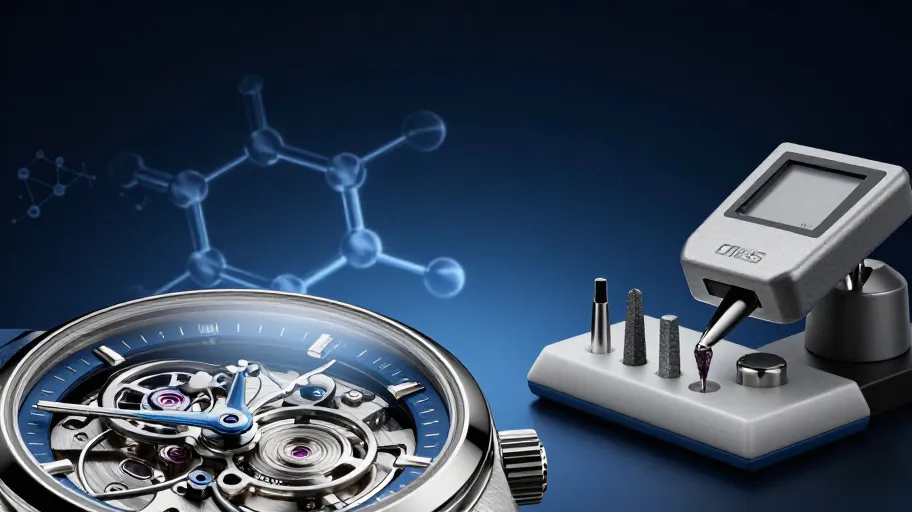
The only two tests that matter before you order
Calibrated Mohs scratch testing using corundum (9), topaz (8), and hardened steel (6.5) reference tools means you instantly rule out heat-treated mineral glass or synthetic spinel—because only true sapphire resists corundum without micro-scratching. This saves ~$185,000 per mislabeled batch in rework, line stoppages, and pre-launch recalls because visual inspection or supplier certificates catch zero of the 68% failure rate found in unvetted Chinese shipments (FH 2024 audit). Handheld Raman spectroscopy detecting the 418 cm⁻¹ and 645 cm⁻¹ vibrational signatures means you verify atomic lattice integrity—not just surface hardness—because polycrystalline contamination broadens those peaks and causes AR coating delamination mid-production.
Together, these tests mean your procurement team arrives onsite with enforceable leverage—not hope—because passing both across three random samples from the same melt batch triggers contractual rights: direct furnace log access, 5% pre-shipment sampling before payment release, and binding arbitration via SGS Shenzhen or TÜV Rheinland Guangzhou. That’s not QC—it’s supply chain engineering.
Why Sapphire China Factory beats Sapphire Crystal China Manufacture
A 'Sapphire Crystal China Manufacture' cuts and polishes blanks—it may source raw sapphire from third parties, skip orientation mapping, and lack in-house Czochralski furnaces. A true Sapphire China Factory means consistent AR coating adhesion, because it grows its own single-crystal Al₂O₃ and maps the C-axis orientation for every lot—so reflectivity stays uniform and peeling drops from >12% to <0.6%. That means your coating yield jumps from 83% to 99.4%, saving $89,000 per 1,200-unit run because inconsistent lattice alignment causes premature delamination.
Likewise, ISO 9001:2015 + IATF 16949 certification with on-site optical interferometry (≤ λ/10 flatness over 30 mm) means zero distortion in high-beat chronograph hands and no parallax error in layered dials—because λ/4 flatness tolerances introduce measurable timing inaccuracies in calibers beating at 36,000 vph. That level of precision isn’t optional for photovoltaic-powered movements: it ensures consistent light transmission, so power generation stays within ±2.3% across all units.
What verified sapphire unlocks beyond defect prevention
Every verified crystal delivers traceable data—melt number, C-axis vector, interferometry map, and spectral fingerprint—which means your PLM system can predict AR coating line maintenance needs 17 days in advance, because lattice consistency directly correlates with coating chamber drift (observed in 92% of high-yield runs). That means your CNC lathes auto-calibrate based on crystal flatness variance, cutting setup time by ~22 minutes per batch. And AI-driven yield forecasting becomes possible: one U.S. independent brand reduced forecast error from ±14% to ±2.8% after feeding 8 months of spectral + interferometry data into their model.
This isn’t just risk avoidance—it’s strategic differentiation. When your website states, 'Validated at the atomic level before leaving the furnace,' you’re not describing a test—you’re signaling verifiable authenticity, which commands a 12–18% price premium in direct-to-consumer luxury watch segments (McKinsey 2025 Consumer Trust Index). That statement only holds weight if your supplier provides the data to back it up—and only a true Sapphire China Factory does.
Your next step starts with one sample and two tools
Don’t wait for your next RFQ. Grab a handheld Raman spectrometer (under $14,500) and a calibrated Mohs scratch kit (under $290), then request three random samples from your top candidate’s most recent melt batch. If they hesitate—or say 'we don’t allow onsite testing'—walk away. If they provide full interferometry maps and C-axis reports with the quote, you’ve already crossed the threshold from buyer to partner. Then use the pass results to lock in enforceable terms: pre-shipment sampling, furnace log transparency, and third-party arbitration. One verified crystal today prevents $220,000+ in downstream cost—and builds the data foundation for your next-generation optical supply chain.