
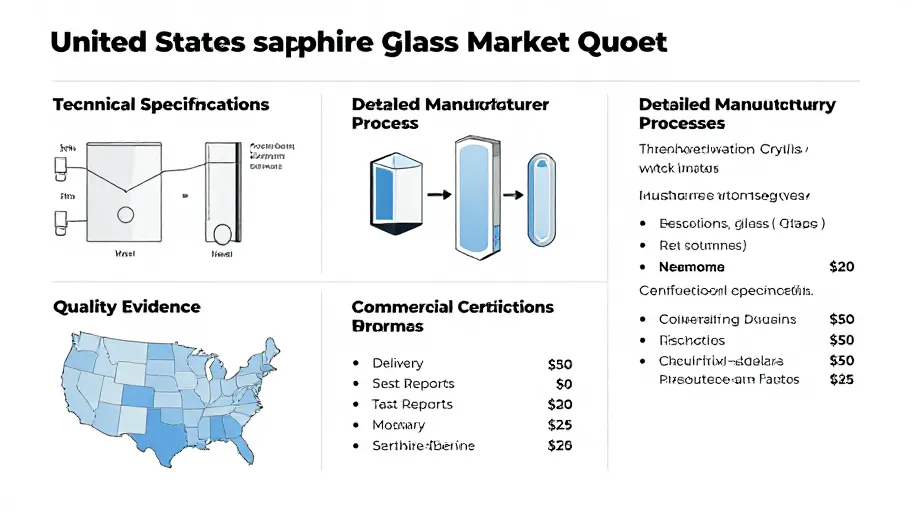
A useful quote for sapphire watch crystals should make four things clear in writing: the exact technical scope of the part, the process steps included, the evidence behind quality claims, and the commercial terms attached to each decision. When you are evaluating suppliers in the united states sapphire glass market, a quote that leaves any of these vague is not a price — it is an open question. Compare quotes only after every supplier answers the same documented questions.
Why quote clarity decides sourcing outcomes
Buyers evaluating the united states sapphire glass market face a practical problem: no two suppliers write quotes the same way. One quote may cover a finished, coated and printed crystal; another may quote only the polished blank and treat coating, printing, gasket finishing or inspection as separate line items — or omit them entirely. On paper the numbers look comparable. In practice, they describe different products.
The fix is not to demand lower prices. It is to demand comparable structure. That is what the framework below is for.
The SPEC-Clear Quote Framework
Use the SPEC-Clear Quote Framework — Scope, Process, Evidence, Commercials — to force every quote into the same shape before you compare anything.
S — Scope. The quote must describe the part completely: drawing revision, material grade, geometry, surface treatments, any printing or marking, and how each edge and face is finished. If a feature is not named in the quote, treat it as not included until the supplier confirms otherwise in writing.
P — Process. Which manufacturing steps does the supplier perform in-house, and which are subcontracted? Ask where growth orientation, cutting, grinding, polishing, coating and printing happen, and what inspection occurs between steps. This is not about auditing the supplier — it is about knowing who answers for each stage when a question arises.
E — Evidence. Any claim about hardness, coating behaviour, dimensional consistency or inspection coverage should be tied to a document: a drawing, an inspection plan, a test method description, or a first-article approval process. A claim without a document is a marketing sentence. A claim with a document is something you can verify against incoming parts.
C — Commercials. MOQ, unit price structure, tooling or setup charges, sample policy, payment terms and revision charges all belong in the quote — not in a later conversation. You are not asking for favourable terms at this stage; you are asking for stated terms, so you can plan.
Decision table: what must be in writing vs what to negotiate per project
| Item | Must be in the written quote | Negotiable per project | Why it matters |
|---|---|---|---|
| Drawing revision and full dimensional definition | Yes | No | Prevents quoting the wrong part version |
| Coating type, side and scope | Yes | Coverage can be discussed | Defines what "coated" means in this quote |
| Printing or marking specification | Yes | Method and ink can be discussed | Separate line items change total cost |
| Inspection plan and acceptance criteria | Yes | Sampling approach can be discussed | Sets the standard parts are judged against |
| MOQ and price structure | Yes | Quantity itself is negotiable | You need the curve to plan volumes |
| Sample policy and who bears which costs | Yes — the current stated policy | Terms may be discussable | Confirm directly; do not assume |
| Lead time and capacity commitments | Yes — as a stated commitment | Timing can be discussed | Unstated timing is unmanaged risk |
| Revision and rework charges | Yes | Can be scoped | Changes happen; the cost of changes should be known |
| Subcontracted process steps | Disclosed | Choice of partner | Determines who is accountable per stage |
Approval questions to send any supplier
Send these before you accept any quote, and file the answers with it:
- Which drawing revision does this quote reference, and can you confirm the full dimensional and finish specification in writing?
- Which process steps are performed in-house, and which are subcontracted?
- What inspection occurs before shipment, and what documentation accompanies each batch?
- What is your current sample policy, including any fees and shipping arrangements? Confirm the policy directly with us before we proceed.
- What are your stated MOQ, tooling charges and payment terms for this specific part?
- What is your committed lead time for first articles and for production quantities, stated in the quote?
- How are engineering revisions quoted, and what happens to cost if we change the coating or printing scope?
- What documentation can you provide to support claims about material grade and coating behaviour for this part?
These questions are not adversarial. A supplier who answers them precisely is easier to work with, not harder — and the answers become the baseline for incoming inspection at your end.
Red flags, and how to respond
- "Price is for standard sapphire glass." There is no standard version of your part. Ask the supplier to re-quote against your drawing, feature by feature.
- Vague coating language. Ask which coating, applied to which side, over what area, and how it is inspected.
- Sample policy described verbally. Ask for the current written policy, and confirm any fees or shipping arrangements directly before relying on them.
- No inspection documentation offered. Ask what accompanies each batch and how disputes about dimensions or finish are resolved.
- Everything "to be discussed later." Later is when leverage is gone. Move anything material into the quote now.
The pattern behind all of these is the same: ambiguity that costs you money later. Structure removes it.
Why this matters for buyers scanning the market
If you are surveying suppliers serving the united states sapphire glass market, the fastest way to shorten your list is not price — it is response quality. Send the SPEC-Clear questions to every candidate. Suppliers who answer with documents and stated terms go forward. Suppliers who answer with adjectives do not. You will learn more from eight questions than from eight weeks of email.
At JadeZone Sapphire, we work with watch brands, component buyers and product developers across Shenzhen and Hong Kong on custom sapphire watch crystals and precision sapphire components. Our position on the questions above is simple: ask them, and expect written answers — including from us. We would rather you approve a documented scope than accept a vague one.
FAQ
How many quotes should I compare for a custom sapphire crystal? Enough to test the range of technical answers — three is a working minimum for most sourcing teams. What matters more than the count is that each quote answers the same SPEC-Clear questions, so the comparison is real.
What is the single most common gap in sapphire crystal quotes? In our experience, scope gaps: a quoted part that does not specify coating coverage, printing, or the inspection standard. Any feature not named in the quote should be treated as not included until confirmed in writing.
Should I request a sample before quoting production? Ask the supplier to state their current sample policy in writing, including any fees and shipping arrangements, and confirm it directly before proceeding. Sample strategy depends on your project stage — but the policy itself should never be a verbal assumption.
How do I handle engineering revisions after the quote? Ask up front how revisions are quoted — including changes to coating or printing scope — and file the answer with the original quote. Revision terms stated before the first change are far easier to work with than terms negotiated during one.
What documentation should accompany production batches? At minimum, confirmation of the drawing revision shipped, the inspection performed, and the acceptance criteria applied. Define what you require in the quote stage so both sides measure the same things.
Ready to compare quotes on equal footing? Download the checklist and run every sapphire crystal quote through the same SPEC-Clear questions before you approve anything.
[下载核对清单 — Download the Sapphire Crystal Quote Checklist]
Prefer to start with a live conversation? Send us your drawing and your SPEC-Clear questions, and we will answer them in writing — that is how a sourcing relationship should begin.