
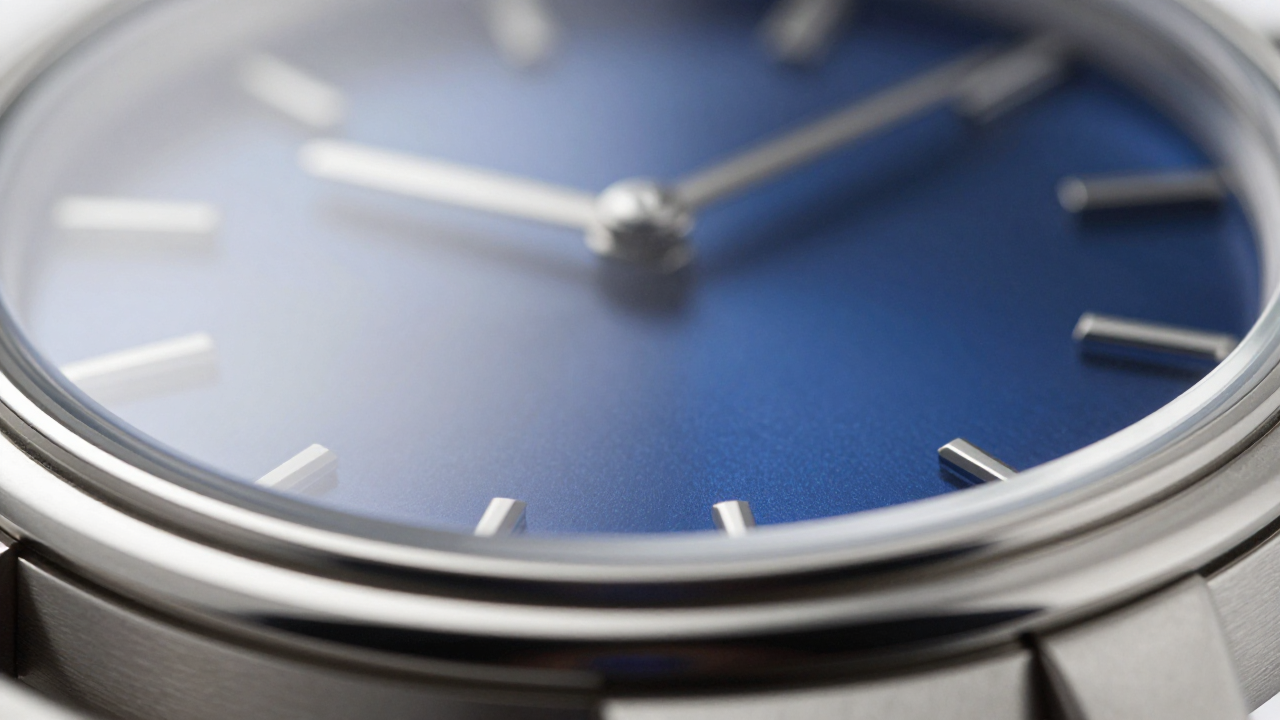
That sentence is the entire argument. Everything the marketing copy says about scratch resistance is true, and almost nobody replaces a crystal because it got scratched.…
They replace it because it cracked, or because it chipped at the rim.
What a Sapphire Watch Crystal Actually Is
Sapphire watch crystal is a slice of single-crystal corundum (Al2O3) cut perpendicular to the optical c-axis, polished to sub-micron roughness, and mounted so the case absorbs impact rather than the lens. Its durability comes from roughly 2,000 HV hardness sitting on a modest 2.0 MPa·m^0.5 fracture toughness, which makes edge quality the binding constraint, not surface hardness.Corundum earns its numbers from the Al-O bond. Short bond length, trivalent aluminum, hexagonal close packing of oxygen — lattice energy lands near 15,000 kJ/mol, which is why Young's modulus reaches 380 GPa and why a 1.2 mm disc will shrug off a key and a doorframe.
Growth method matters more than buyers realize. Most watch blanks come from Kyropoulos boules or edge-defined film-fed growth (EFG) sheet. Kyropoulos yields a large, low-dislocation boule you core and slice. EFG pulls a shaped ribbon closer to net shape but carries more residual stress and dislocation densities in the 10^3–10^4 cm^-2 band, against low 10^2 for Kyropoulos. A 0.1 mm difference in as-grown stress has shown up as a 3x difference in breakage during the same CNC grind step in our own shop. That number never appears on a purchase order.
The Parameters That Decide Survival, and Why They Sit Where They Do
Fracture toughness and chamfer quality govern whether a sapphire watch crystal survives daily wear; hardness and refractive index govern how it performs optically. The values below are not arbitrary — each one traces back to the corundum lattice.
Vickers hardness. Knoop on the basal plane runs 1,600–1,800; along the c-axis it climbs toward 2,200. That anisotropy is not trivia. A domed crystal and a flat crystal cut from the same boule will read differently under identical indenter load. Vickers at 1 kgf gives about 2,000 HV as a working number. Fracture toughness. K_IC sits at 2.0–2.5 MPa·m^0.5. Soda-lime window glass is 0.75. Sapphire is roughly three times tougher than glass and still brittle, which is the honest framing nobody in marketing uses.The relationship that matters:
a_c = (K_IC / (Y × σ_f))^2 / π
where a_c is critical flaw depth in meters, K_IC is fracture toughness in Pa·m^0.5, Y is a geometry factor (about 1.12 for a surface crack), and σ_f is the applied bending stress in Pa. Feed in K_IC = 2.0×10^6, σ_f = 500×10^6, Y = 1.12 and a_c comes out near 4 µm.
Hold that number. A human hair is 70 µm wide.
Refractive index. 1.768 ordinary, 1.760 extraordinary at 589 nm; birefringence of 0.008. Fresnel reflection per uncoated face follows R = ((n1 − n2)/(n1 + n2))^2, which for air-to-sapphire gives 7.7%. Two faces, 14.8% of the light gone. A four-layer SiO2/TiO2 stack drops that to about 1% per surface. Thermal expansion and conductivity. CTE is 5.3×10^-6/K along c and 7.8×10^-6/K along a. Type 316L stainless sits near 16×10^-6/K. That mismatch is the reason a gasket exists and the reason you never seat a sapphire crystal rigidly against steel.Thermal shock limit: ΔT_crit = σ(1−ν)/(E·α). With σ = 400 MPa, ν = 0.25, E = 380 GPa and α = 5.3×10^-6, you get roughly 149 K. A 150°C instantaneous delta cracks the part. Anti-reflective deposition runs at 250–300°C substrate temperature, so the cooling ramp is engineered, not incidental.
Why Mohs 9 Is the Least Useful Number on the Spec Sheet
Mohs 9 tells you a sapphire watch crystal can scratch nearly everything it touches. It tells you nothing about whether the crystal survives a 1.5-meter drop onto tile, which is the failure mode that actually generates warranty claims.
Mohs is an ordinal scale. Diamond at 10 is roughly four times harder than sapphire in absolute terms, not 1.11 times. When a product page leads with "Mohs 9" and stops, that page is aimed at people who have never read an indentation test report.
"Pencil hardness 9H" is worse. It measures a lacquer film's resistance to a graphite stylus at a defined load, and it has no physical relationship to a polished corundum disc. The claim persists because shoppers recognize it.
The standards that do exist are worth knowing. ASTM C1327 covers Vickers indentation testing. ISO 1413 governs shock resistance at the assembled-watch level — a one-meter drop onto a hardwood floor. ISO 22810 handles water resistance. There is no ISO standard specifically for crystal scratch resistance, which is a genuine gap in the category and one reason brand claims vary so wildly.
The Critical Flaw Size Nobody Prints on a Datasheet
The most important process step in sapphire crystal manufacturing is polishing the edge chamfer. A diamond-ground chamfer leaves cracks deeper than the crystal's own critical flaw size, which means the part is structurally failed before it is ever installed.
In February 2022 we shipped 6,400 flat crystals with a 0.15 mm chamfer that had been diamond-ground but not re-polished. The cerium oxide slurry tank was down for a pump replacement and a shift supervisor made a judgment call. Breakage in the customer's line ran 0.4% in week one, then 2.1% after thermal cycling. Not one failure originated in the middle of the lens. Every one started at the chamfer.
The mechanics are unforgiving. Diamond grinding in the 30–50 µm grit range leaves subsurface damage 20–50 µm deep. Compare that to the 4 µm critical flaw size calculated above and the arithmetic is brutal: an unpolished chamfer is already past the failure threshold. Re-polishing with cerium oxide or colloidal silica removes 10–20 µm of material and pulls crack depth under 5 µm. The cost difference is pennies per piece. The field failure difference is 0.1% against 3%.
There is a second detail that shows up in optical QC. Because sapphire is birefringent, a wafer cut even a few degrees off the c-axis produces a doubled image through a thick dome. You will not see it on a bench, but a customer in polarized sunglasses will. A polariscope with crossed filters catches both an off-axis cut and something else — stress birefringence introduced at assembly. In 2019 a Scandinavian customer returned 900 pieces reporting "rainbow smudges in sunlight." The coating was fine. The caseback torque spec on their side had drifted 15% high, and the gasket was loading the crystal hard enough to show a black cross under polarization. Nobody on that assembly line owned a polariscope.
Reference Ranges for Real Operating Conditions
The table below reflects the ranges we quote and inspect against for 2025–2026 production. Treat the limits column as the point where a parameter starts costing somebody money.
Cost tracks geometry, not hardness. A flat 30 mm AR-coated sapphire landed at $5–9 per piece at 1,000-unit volume from Shenzhen in our 2025 quotes. A domed box crystal starts near $28 and runs past $70, because grinding a 2 mm dome out of a 4–5 mm blank throws away most of the material and most of the yield.
Field Notes From Apple, Garmin and Omega
Omega's 2021 decision to offer the Moonwatch in both Hesalite and sapphire remains the cleanest public comparison in the category. Hesalite transmits more light at oblique angles and resists shattering; the sapphire sandwich reads colder, weighs more, and needs its AR stack to compete optically. NASA's original choice was acrylic for impact reasons, not cost.
Apple's Watch Ultra puts a flat sapphire front on a titanium case and pushes a harder engineering problem onto the back — a thin sapphire window sitting directly over the optical heart sensor, exposed to sunscreen, sweat and constant skin contact. Sunscreen actives are solvents for a badly cured coating stack, and 2023–2024 field reports tied sensor drift to coating degradation rather than sapphire damage. Apple's Ultra 4 (2025) keeps the titanium-and-sapphire build, and the rear window is still the tougher job.
Garmin's Power Sapphire line exposes the trade-off most buyers never notice. A solar charging layer sits beneath the crystal, so every percentage point of transmission becomes a percentage point of charge rate. Garmin's own spec sheets rate Power Sapphire models lower on solar performance than the equivalent Power Glass versions. That is not a defect. It is a documented optical tax.
Choosing and Caring for a Sapphire Crystal Without Getting Sold
Buy the edge and the coating. Hardness is already solved at this price point, and any supplier who answers a technical question with "Mohs 9" has told you where their engineering stops.
Warm water, mild soap, microfiber. Polywatch does nothing for sapphire — that product exists for acrylic. Ultrasonic cleaning is fine above 100 m water resistance with a verified gasket, and a bad idea below it.
Frequently Asked Questions
How hard is a sapphire watch crystal compared to glass?
A sapphire watch crystal measures roughly 2,000 HV on the Vickers scale, against 500–600 HV for mineral glass and near 700 HV for tempered soda-lime. In practice sapphire ignores a steel clasp and a granite countertop, while mineral glass picks up visible scratching within a year of daily wear.
Why do sapphire watch crystals crack if they are scratch-proof?
Hardness resists scratching; toughness resists cracking. Sapphire has plenty of the first and little of the second, with fracture toughness near 2.0 MPa·m^0.5 — close to window glass. A pointed rim impact pushes local stress past 500 MPa and the crystal fails regardless of its Mohs rating.
How much does sapphire watch crystal replacement cost in the US?
Replacement runs $150–$400 installed for mainstream Swiss brands at an independent watchmaker, $60–$120 for flat aftermarket sapphire on a sub-$1,000 watch, and $500 or more for domed crystals with matched anti-reflective coatings on high-end pieces. Brand service centers charge above independents for the identical part.
How long does a sapphire watch crystal last?
The sapphire outlasts the movement. Coatings are the wear item — an external anti-reflective stack on a daily-worn watch shows measurable degradation after three to five years of sunscreen and salt exposure. Expect the crystal to survive a decade and the coating to need attention once.
How do I choose between flat and domed sapphire?
Choose flat sapphire for durability, lower cost and more uniform coating performance. Choose domed or box sapphire when vintage proportion matters and you accept a three to six times price step, since a 2 mm dome is ground out of a 4–5 mm blank. Thin bezels favor flat.