
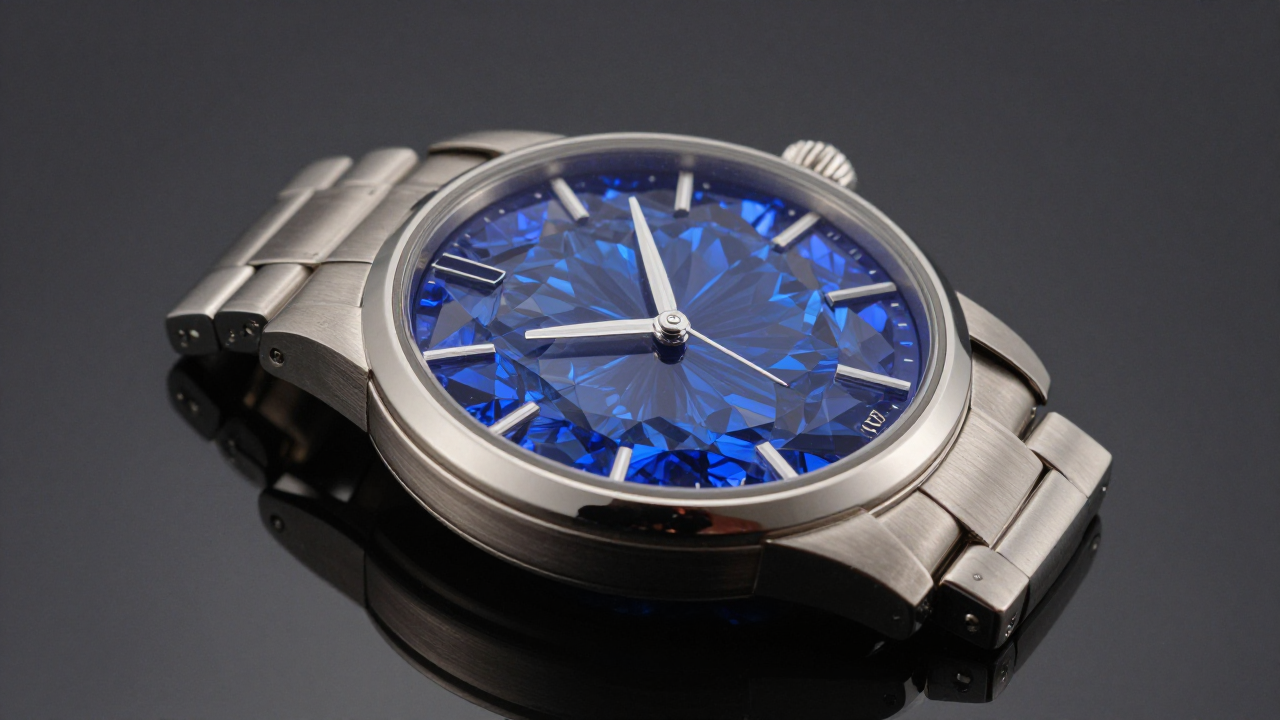
The most common mistake is buying sapphire watch crystals as a commodity. A buyer collects quotes for the same 1.2 mm flat lens, takes the lowest, and never asks what the material actually is.…
Most of those quotes describe solid single-crystal sapphire. At least one describes mineral glass with a sapphire coating.
What Is the Most Common Mistake When Buying a Sapphire Watch Crystal?
We have made these parts in Shenzhen since 2010, and we have also been on the buying side — of boules, of blanks, of coating services. The four mistakes below are the ones that cost real money, ordered by how much.
Mistake 1: Buying Sapphire Without a Written Material Spec
The first mistake is a purchase order that reads "sapphire crystal, 30.00 mm, 1.2 mm, AR coated" and stops there. That line describes a shape, not a material. Solid single-crystal sapphire, sapphire-coated mineral glass, and off-axis cut blanks all fit inside it comfortably.
Sapphire-coated glass is a real product, and it is legal to sell under that name. The coating runs 3 to 10 microns on top of a mineral glass substrate sitting around 550 HV on the Vickers scale. Solid sapphire measures 1,800 to 2,200 HV. Both feel cold in the hand, both look clear on a sample tray, and a buyer handling lenses in a meeting room has no way to separate them.
Grade is the second layer of the same problem. Even among solid sapphire suppliers, the growth method and the cut orientation change what arrives in the box. Kyropoulos-grown boules cut along the C-axis machine and lap predictably. Blanks pulled off-axis chip along the bevel and fail lapping at a higher rate — and nobody stamps the orientation on the shipping carton.
The order that cost us $59,400
In August 2020 we bought 3,600 blanks at $16.50 each from a trader in Bao'an. Total $59,400, half paid up front, invoice line reading "watch grade, KY, C-axis." Our lapping yield on that lot came back at 61% against a normal 84%, and the edge chip rate on the 0.15 mm bevel ran three times budget.
We spent the first two weeks blaming our own lapping line, which is the expensive way to be wrong. Under crossed polarizers, roughly half the lot showed strain patterns consistent with off-axis cut. The lot report attached to the shipment turned out to be a photocopy of another customer's certificate — we found that out in November, from the other customer.
We reworked what we could and ate about $22,000, plus a six-week slip on a November delivery. Our blank purchasing rule has not changed since: no lot ships without a photo of the boule, a traceable lot number, and an orientation statement signed onto the PO.
What to put on the spec sheet
Reject any quote that cannot answer these six lines:
For incoming inspection, keep a Mohs pick set on the bench. A Mohs 6 pick scratches mineral glass and does nothing at all to sapphire. Fifteen seconds, no lab, and it settles arguments a certificate cannot.
Mistake 2: Specifying the Lens but Ignoring the Interface
The second mistake is a crystal that is dimensionally correct and geometrically wrong for the case. Edge profile, step height, and dome radius decide whether the lens seals, whether it chips, and whether it sits under the bezel where it belongs.
This shows up most with US microbrands building their first dive watch on a stock case. The case was designed around a flat 1.5 mm lens with a 0.3 mm step. The brand orders a 1.2 mm double-domed lens because it photographs better, and the step no longer seats the I-ring the way the case designer intended.
In February 2019 a buyer from Oregon was in our Kwun Tong office for sample approval. He picked up the prototype — a $520 retail dive watch — and it went off the table onto tile. The crystal stood 0.4 mm proud of the bezel and took the entire impact on its edge. One chip, 0.6 mm wide, at 12 o'clock. Optically the lens was perfect. As a sample it was dead, and he was flying to Baselworld the following week. We rebuilt it in four days.
The lesson was not "be careful with samples." It was that bezel clearance is a design decision with a cost attached, not a cosmetic preference.
Mistake 3: Skipping the Pressure Test After a Crystal Swap
Replacing a crystal resets water resistance to zero until the watch is tested again. ISO 22810:2010 calls for testing at 1.25 times the rated pressure, and a crystal seated on a reused gasket is the most common leak path in a service center — ahead of a bad caseback seal.
Sapphire is stiff. It transfers shock and pressure load into the case and the gasket rather than absorbing them the way acrylic does, so seat finish and gasket condition matter more on a sapphire build than on the mineral glass watch it replaced.
In March 2021 a service partner in Chicago ran 40 quartz dive watches through a crystal swap ahead of a spring promotion. They spot-tested four of the 40 on a dry tester and shipped the batch. Eleven came back fogged within five weeks. Every gasket in the run had been reused, because the replacement I-ring order arrived late. Nobody had written down which four units were tested, so the whole batch had to be recalled and retested.
Correct sequence: new gasket every time, seat cleaned of old adhesive, dry test first at 1.25x rated pressure, wet test only after a pass, serial numbers logged. It adds about nine minutes per watch.
Mistake 4: Treating Installation and Cleaning as DIY Jobs
Installation and cleaning get treated as chores anyone can do with whatever is on the bench. Both fail in ways that cost more than the crystal.
In June 2022 one of our account managers tried to change a crystal on a customer's display watch at a trade show booth in Las Vegas, using a hand press and a die two sizes off. The lens cracked and the shards scratched the dial. The repair bill came to $800, and most of it was the dial, not the crystal. Presses are cheap. Dies matched to the actual diameter are the part people skip.
Cleaning has the same shape of problem. Anti-reflective coating is 4 to 8 microns of deposited material, softer than the sapphire beneath it, and it is what fails first. Acrylic polishing compounds (PolyWatch and its clones), ammonia glass cleaners, and ultrasonic baths run with the case assembled will haze a coating long before the crystal ever scratches. Mild soap, lukewarm water, microfiber cloth. Sunscreen and salt left on the crystal for weeks do more damage to the gasket underneath than to the sapphire itself.
How to Compare Two Sapphire Crystal Quotes in Ten Minutes
Two quotes for the same drawing usually differ on six to eight specification lines, not on the price of sapphire. Put both against this table and the gap explains itself.
For reference in 2026, a 30 mm flat lens with single-side AR runs $3 to $6 at 1,000 pieces. A double-domed lens with two-sided AR and a stepped edge runs $14 to $25. Custom profile tooling is a one-time $1,500 to $4,000. A quote of $1.80 for that same drawing is not a bargain — it is a different material.
Sapphire with an anti-reflective coating has moved down into the $300 to $500 price tier; Casio's GST-W1000 line ships it now. Volume buyers chasing that tier will be comparing quotes on 20,000 pieces, where a 0.05 mm thickness slip becomes a gasket problem on every single unit.
Sapphire Watch Crystal Checklist
Frequently Asked Questions
How much does a sapphire watch crystal cost?
A 30 mm flat sapphire lens with single-side AR runs $3 to $6 at 1,000 pieces in 2026. Double-domed lenses with two-sided AR and stepped edges run $14 to $25. Custom profile tooling adds a one-time $1,500 to $4,000.
How can I tell if a watch crystal is real sapphire?
A Mohs 6 pick scratches mineral glass and leaves solid sapphire untouched. Sapphire also feels colder to the touch and stays clear while coated glass shows fine scratches within a year. A 10x loupe on the edge often reveals a coating line.
How long does a sapphire watch crystal last?
The sapphire itself typically outlasts the watch, 10 to 20 years in normal wear. The anti-reflective coating and the gasket are the wear items. Coating haze appears after 4 to 8 years of daily use, and gaskets should be replaced every 3 to 5 years.
Can a scratched sapphire crystal be polished out?
Deep scratches in sapphire need diamond abrasive and repolishing on a lap, which usually costs more than a replacement lens at $14 to $25. Coating haze cannot be polished off without stripping the coating. Replacing the lens and gasket is the practical fix.
Why does my sapphire crystal look blue or purple?
That tint comes from the anti-reflective coating, not the sapphire. Double-sided AR coatings reflect a residual 0.5% to 1% of light, and the reflected color is a deliberate design choice. Uncoated sapphire transmits about 85.5% of visible light; coated lenses reach 98% or better.
None of this is exotic. A spec sheet, a Mohs pick, and a pressure tester — roughly $600 of equipment and one page of paperwork — sit between a clean order and a $22,000 rework bill.