
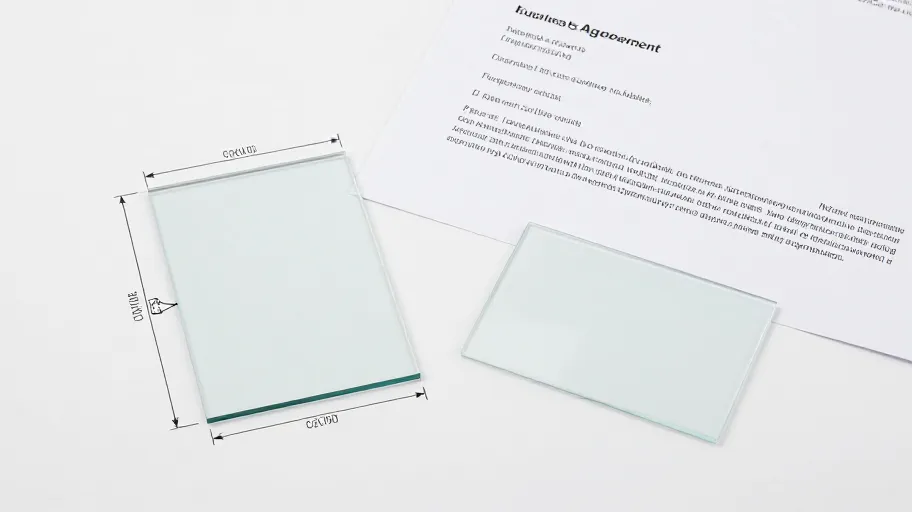
Before you compare samples from any sapphire glass supplier, do three things: freeze your technical drawing with every dimension, coating and finish annotated; define one reference sample that represents your acceptance baseline; and require written agreement from each supplier on how they interpret that drawing. Comparison without those three inputs becomes opinion. With them, it becomes a documented decision you can defend internally and revisit at production.
The DRAw-C framework: Drawing, Reference, Agreement, Consistency
Use this framework to structure your supplier comparison:
- Drawing. Issue one controlled drawing revision to every candidate supplier. Annotate dimensional callouts, edge geometry, coating, surface finish and inspection points. If an element matters to you and is not on the drawing, it is not yet an agreement.
- Reference. Designate one physical reference sample — your own part or an accepted predecessor — as the baseline. Every candidate sample is evaluated against the drawing first and the reference second.
- Agreement. Ask each supplier to return a written interpretation of the drawing before they cut samples: what they understand the critical features to be, which inspection methods they will use, and which questions they have. Disagreement surfaced now costs a conversation; surfaced after production it costs a project.
- Consistency. When revised samples arrive, compare them against the original submission, not against memory. Consistency across revisions tells you more about process control than any single perfect sample does.
Sample-to-drawing decision table
Score each supplier against each element and record the evidence, not just a pass or fail.
| Drawing element | What to verify on the sample | Evidence to record | Approval action |
|---|---|---|---|
| Dimensional callouts | Measured values match the drawing within the tolerance you specified | Your own measurement log, instrument and date noted | Approve, or request revision with the specific callout cited |
| Edge and case-fit geometry | Profile matches drawing views; fit with your case or fixture | Photographs of the sample seated in the case, plus measurement notes | Approve fit, or return with marked-up photos |
| Coating and surface finish | Appearance and behaviour match the specified coating under agreed lighting | Reference sample photographed side by side under identical conditions | Confirm match, or ask the supplier to state their coating process in writing |
| Print / logo / marking | Placement, registration and legibility match drawing | Macro photographs against a scale | Approve, or specify the deviation in writing |
| Inspection method | Supplier's stated method can actually detect the features you care about | Copy of their inspection notes for your sample batch | Accept the method, or require a method that can verify your critical features |
Approval questions to put in writing
Put these to every sapphire glass supplier before you approve samples. Ask for written answers and attach them to your project file.
- Which drawing features do you treat as critical, and which inspection method will you use for each?
- What is your current policy on sample provision, associated fees and shipment arrangements? Confirm the current policy directly.
- What are your current minimum order quantity, pricing basis and production scheduling terms for a project of this specification? Confirm the current policy directly.
- If a production batch deviates from the approved sample, what is your documented resolution process?
- Which certifications, test reports or process documentation can you currently evidence for this product — and can you provide copies before approval?
- Who is the named technical contact for drawing questions during production, and in what language and channel do they respond?
Do not accept verbal answers to any of these. The written record is what protects you when questions arise later.
What to document at every stage
Keep a single comparison file per supplier containing: the controlled drawing revision you issued; their written drawing interpretation; the received sample with batch identification; your measurement and photo log; their answers to the approval questions above; and your internal approval decision with date and signer. When a question arises months later — about a revision, a colour shift, an edge profile — this file answers it without relying on anyone's recollection.
This discipline matters more with sapphire components than with many other watch parts, because a sapphire crystal is finished to the watch, not adjusted after assembly. A misread drawing discovered at case assembly is expensive; the same misread discovered during the written-interpretation step is a five-minute correction.
FAQ
How many suppliers should I compare before approving one? Compare as many as you can evaluate with identical inputs — same drawing revision, same reference sample, same question set. The number matters less than the consistency of the comparison. Two suppliers compared rigorously give better information than five compared loosely.
Should I approve on the sample or on the drawing? Approve on the drawing, with the sample as evidence. The drawing is the contract of intent; the sample is one instance of it. If a supplier's sample exceeds the drawing in some way you like, amend the drawing — otherwise the next batch may not repeat it.
What if suppliers interpret my drawing differently from each other? That difference is information. It tells you where your drawing is ambiguous. Clarify the drawing, reissue one revision to all candidates, and note which suppliers asked questions versus which ones stayed silent — suppliers who ask targeted questions about critical features are engaging with your drawing rather than just quoting it.
Can I rely on a supplier's own inspection report instead of measuring samples myself? Use their report as one input, not as your acceptance decision. Measure the features that matter most to your product with your own instruments and your own record. Two independent measurements of the same feature build far more confidence than one.
How do I handle revisions without losing track of approvals? Version everything: drawing revisions, sample batch identifiers, and approval dates. Never compare a revised sample against a superseded drawing, and never approve a revision without restating in writing which features changed and which remain frozen.
Get the working document
JadeZone Sapphire, a Shenzhen and Hong Kong B2B manufacturer of custom sapphire watch crystals and precision sapphire components, supports buyers who want this comparison done rigorously — with controlled drawings, documented interpretations and written answers before approval.
下载核对清单 — download the supplier comparison checklist and use it as your working document for every sapphire glass supplier evaluation: drawing control, reference samples, written agreement, consistency log and the full approval question set.
Prefer to start with a lighter version? Use the short checklist below for your first round of supplier contact, then download the full checklist when you shortlist candidates.
First-contact mini-checklist:
- One controlled drawing revision issued to every supplier
- Written drawing interpretation requested from each
- Approval question set sent in writing
- Reference sample designated and photographed
- Single comparison file opened per supplier