
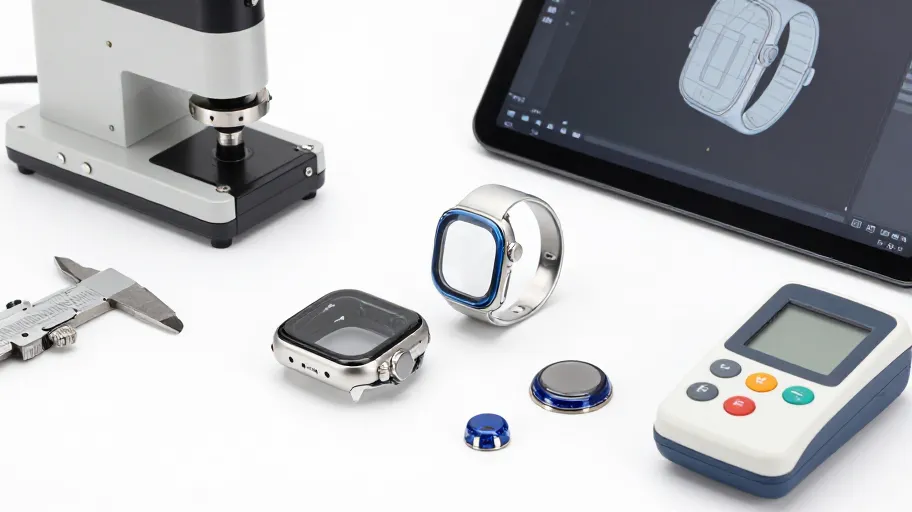
Preparing a custom sapphire appearance-part project for a global smart wearable brand means converting an industrial-design concept into a documented, quotable specification, then validating supplier feedback before any tooling or approval decision. The work splits into four stages: freeze the design brief, run a design-for-manufacturing (DFM) dialogue, hold a delivery gate, and approve against a written checklist. JadeZone Sapphire, a Shenzhen and Hong Kong B2B manufacturer of custom sapphire watch crystals and precision sapphire components, works with buyers through exactly this sequence — and this article gives you the preparation structure before you send the first enquiry.
The Brief–DFM–Gate–Approve framework
Most sourcing friction in sapphire appearance parts comes from skipping a stage, not from the material itself. Sapphire is hard, brittle and processed with abrasive and thermal steps, so decisions that look cosmetic on paper — edge geometry, hole placement, coating stack — carry manufacturing consequences. The framework keeps each decision where it belongs:
| Stage | What you do | What you must not do |
|---|---|---|
| Brief | Document geometry, finish, coating, interfaces, volumes intent and quality expectations in writing | Send a render only and ask for "a quote" |
| DFM | Request manufacturing feedback on draftability, edge radii, hole aspect ratios and measurement methods | Assume the supplier can hit every CAD feature without comment |
| Gate | Compare responses against defined criteria; confirm policies, capacities and documentation | Approve tooling because communication feels smooth |
| Approve | Sign off against a checklist covering drawings, inspection criteria and revision control | Approve verbally or by chat message |
Treat the written brief as the single source of truth. Every later change — a coating swap, a new logo position, a revised datum scheme — should re-enter through the brief and trigger a fresh DFM comment, not a side conversation.
Stage 1: Building the design brief
A useful brief for sapphire appearance parts contains at least these blocks:
- Function and environment: where the part sits on the wearable, what it must resist (abrasion, sweat, cleaning agents, UV), and what failure modes worry your quality team.
- Geometry: outline, thickness transitions, holes, steps and edge conditions — with a drawing or 3D model, not just images.
- Optical and surface requirements: transparency targets, haze, reflection behaviour, whether an anti-reflective or other coating is required, and how each will be measured.
- Interfaces: how the part bonds or seats into the housing; flatness and cleanliness expectations at the interface.
- Cosmetic definition: where and how logo, index or texture features appear, and the viewing conditions under which cosmetics are judged.
- Quality evidence you expect: what inspection reports, measurement methods and process documentation you want quoted — as requirements, not assumptions.
Two things deliberately stay out of the brief: unverified numbers and unstated assumptions. If you do not yet know what dimensional tolerance your design genuinely needs, write "tolerance to be agreed against function" and ask the supplier what they can hold and verify for this specific geometry. Do the same for any parameter you would otherwise guess. A brief full of guesses produces quotes you cannot compare.
Stage 2: The DFM dialogue
When you send the brief, ask for written DFM feedback rather than a price alone. Three questions reveal how the supplier thinks:
- Which features of this design constrain manufacturability, and what alternatives would they propose?
- How will each critical dimension and cosmetic criterion be measured, and with what method?
- What would they flag as risks at this volume and geometry that the design team should know?
A supplier that answers these specifically, referencing your features by name, gives you something to evaluate. A supplier that answers only in generalities gives you nothing to approve against. This is also the stage to confirm current policies directly — minimum order quantities, tooling arrangements, sample availability, sampling fees and shipping responsibilities for samples, lead times, and capacity for your programme. None of these can be assumed; each is project-specific and must be confirmed in writing for your enquiry.
Stage 3: The delivery gate
Before approval, run a structured comparison. A simple decision table keeps the evaluation honest:
| Criterion | What to capture | Evidence to request |
|---|---|---|
| DFM response quality | Specific, feature-referenced feedback vs generic reassurance | Written DFM comments |
| Specification alignment | Every brief item addressed, none silently dropped | Marked-up drawing or matrix |
| Measurement clarity | Named methods for each critical dimension and cosmetic criterion | Inspection plan draft |
| Policy confirmation | MOQ, tooling, samples, fees, shipping responsibility, lead time — all stated for this project, in writing | Quotation with terms |
| Documentation | What quality and process documents accompany delivery | Sample documentation set |
| Communication | Single technical point of contact; revision control agreed | Named contacts and revision procedure |
| Change management | How changes after approval are handled and re-validated | Change-control proposal |
Score each row, note evidence received, and record what is still missing. Approvals fail at missing rows, not low scores — a single unanswered policy question is enough to invalidate a comparison.
Stage 4: The approval checklist
Approve only when every item below has a written answer specific to your project:
- Final drawing revision agreed, dated and referenced in all documents
- Every critical dimension has a stated tolerance and a named measurement method
- Coating specification defined, including how coating quality is judged
- Cosmetic criteria documented, including viewing distance, lighting and acceptance zones
- MOQ, tooling, sample policy, fees, shipping responsibility and lead times confirmed in writing for this project
- Inspection and documentation deliverables listed in the quotation
- Change-control process agreed for post-approval revisions
- Approval recorded by both parties with names and dates
Any unchecked box means the gate stays closed. This protects both sides: the supplier manufactures to an agreed definition, and your team approves a specification rather than a relationship.
FAQ
How detailed does the first enquiry need to be? Detailed enough to be answered. A 3D model plus a one-page description of function, environment and quality expectations lets the supplier respond with substance. Anything less invites assumptions on both sides.
Should we specify tolerances before contacting a supplier? Specify what your function requires; ask the supplier to confirm what they can hold and verify for this geometry. Requirements and capability are different documents — both are needed for approval.
What should we ask about coatings? Ask how the coating stack is specified, how adhesion and appearance are tested, what the measurement methods are, and how coating quality is documented per lot. Confirm current capability for your specific requirement directly with the supplier rather than relying on prior projects.
How do we handle changes after approval? Through a written change request that re-enters the brief, triggers a DFM comment and is re-approved with a new revision. Keep the approval checklist as the gate for every revision.
What is the single most common approval mistake? Proceeding on verbal or chat-based confirmation. If it is not in a dated, referenced document, it is not approved.
Next step: obtain the project brief and use it as your RFQ template — it structures the Brief–DFM–Gate–Approve sequence so your first enquiry already reads like a prepared buyer.
[获取项目 Brief — Obtain the project brief]
Prefer to start smaller? Download the approval checklist above as a one-page gate review and run it against your next supplier conversation first.
[Get the one-page approval checklist]