
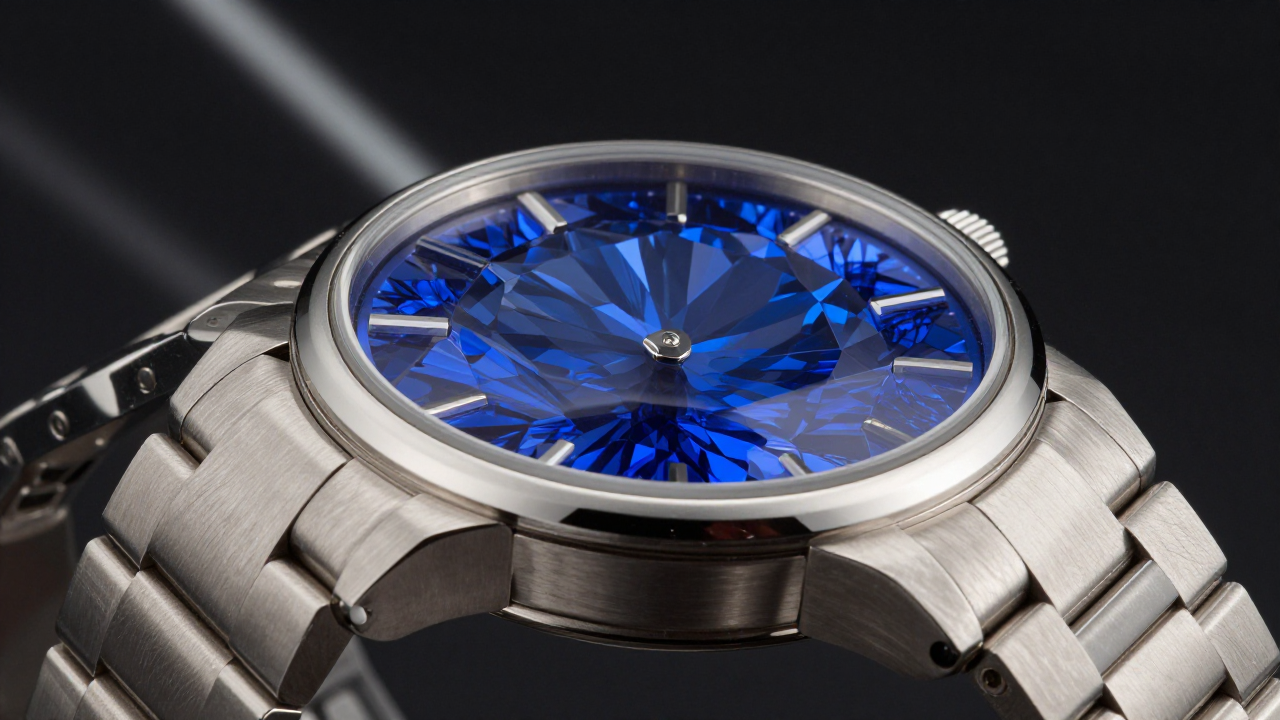
A service center in Dallas, February 2023. The returns bin holds 41 dive watches, all under two years old, all with intact faces and chipped rims. Not one of them was scratched.…
Every one of them failed at the bevel, that 0.2mm ring of edge nobody photographs for the catalog. That bin is the reason this article exists.
> The mechanism in one sentence: A sapphire watch crystal survives impact because a single-crystal corundum lattice (Al₂O₃, Knoop hardness near 2,000 kg/mm²) spreads contact stress across a wide area, so damage begins only when a flaw — usually at the ground edge, not the polished face — grows past the critical size for the load applied.What a Sapphire Watch Crystal Is at the Atomic Level
A sapphire watch crystal is a slice of synthetic single-crystal aluminum oxide, grown from a melt at about 2,050°C, then sliced, curved, lapped and polished into a lens. Nothing in it is amorphous. That single fact explains both the scratch resistance buyers pay for and the brittle failure they don't expect.
The boules come out of Kyropoulos or Czochralski furnaces at 200–300mm diameter and 30–50kg, over a growth cycle measured in weeks, not hours. The crystal is anisotropic — hardness and thermal expansion differ along the c-axis and the a-axis. A Knoop indenter reading on the c-plane lands around 1,600 kg/mm²; on the a-plane it can exceed 2,200. Two crystals cut from the same boule at different orientations behave differently on the same drop rig.
That orientation variable is the first thing purchasing departments never ask about.
Where the Real Limits Sit: Hardness, Thickness, and Dome Geometry
Hardness keeps the face clean. Thickness and geometry decide whether the part survives a door frame. Those are separate problems and the industry conflates them constantly.
Deflection of a clamped circular plate scales roughly as:
w ∝ F × a² / (E × t³)where *w* is center deflection in millimeters, *F* is the impact force in newtons, *a* is the unsupported radius (half the aperture), *E* is Young's modulus and *t* is thickness. For sapphire, *E* runs 345–400 GPa depending on axis — call it 380.
Read the exponent. Going from 1.0mm to 1.4mm thickness cuts deflection by roughly 64% for the same load, because it's *t* cubed in the denominator. That single exponent is why a 44mm case with a box-domed crystal at 2.2mm center thickness feels rigid and a 1.0mm flat crystal on the same case flexes visibly under thumb pressure. It also explains why case diameter drives crystal thickness requirements so hard — *a²* in the numerator punishes wide apertures quadratically.
Boundary condition worth naming: beyond about 2.5mm center thickness, you stop buying impact resistance and start buying weight, parallax distortion and cost. The curve has flattened.
Why Do Sapphire Crystals Still Chip?
Because fracture toughness, not hardness, governs chipping — and sapphire's fracture toughness is genuinely low at roughly 2.0–2.5 MPa·m^0.5. That is closer to window glass than to the metal in the case.
The controlling relationship:
a_c = (K_IC / (Y × σ))²*a_c* is the critical flaw depth in meters, *K_IC* is fracture toughness (2.0 MPa·m^0.5), *Y* is a geometry factor (about 1.12 for a surface crack), *σ* is the tensile stress at the edge in pascals.
Run it. At 300 MPa of bending stress — a realistic number for a hard knock on a 40mm case — *a_c* comes out at roughly 35 microns. A flaw about a third the thickness of a human hair.
Now the part that doesn't appear in most supplier datasheets: a 600-grit diamond grinding wheel used to shape a crystal edge leaves subsurface damage in exactly that range, 20–40 microns deep. The part leaves the grinder looking perfect and already carrying a crack population large enough to fail under a moderate impact. Polishing the bevel with cerium oxide slurry removes that layer. Skipping it saves maybe 40 seconds per piece.
We learned this the expensive way. In February 2023, a purchasing manager at a Portland microbrand called us at 6:40 his time, holding 8,000 box crystals with a 6% field failure rate — all edge-origin, all on parts whose bevel had been moved to a faster two-step grind the previous November. I initially suspected coating adhesion. The SEM cross-sections said otherwise. We put the cerium oxide bevel polish back, tightened the chamfer spec to 0.15–0.25mm at 45°, and the failure rate on the next 12,000-piece run dropped to under 0.4%. Same boule supplier. Same thickness. Same hardness on the certificate.
(Aside: that 0.4% number was measured over a six-month window, so it includes a mild seasonal mix of models. Treat it as directional.)
The Optical Side Has Its Own Arithmetic
Anti-reflective coating isn't cosmetic. Bare sapphire has a refractive index of about 1.77 at 550nm, and each air-to-crystal surface reflects according to Fresnel:
R = ((n_crystal − n_air) / (n_crystal + n_air))²That gives roughly 7.7% per surface, about 15% total light loss before any coating. A four-layer SiO₂/TiO₂ stack knocks it to under 0.5%. Each layer is deposited to a quarter-wave optical thickness:
t = λ / (4 × n_layer)where *t* is physical thickness, *λ* is the target wavelength (typically 550nm, the center of photopic vision) and *n_layer* is that material's index. Change the target to 510nm and the stack shifts blue; the dial looks different under showroom lighting than under sunlight. Buyers notice and can't articulate why.
Rolex, Omega, and Grand Seiko Solve the Same Problem Differently
Rolex molds the Cyclops magnifier into the crystal itself rather than cementing a lens on. That forces a controlled dome radius and a specific local thickness at the lens — the hardest geometry in the category to hold tolerance on, and the reason aftermarket Cyclops crystals so often look wrong from the side. The trade-off is real: a molded lens concentrates stress at its perimeter, so the bevel work has to be better than on a flat crystal.
Omega has historically applied anti-reflective coating to both faces of the front crystal. Optically that's the best answer — under 1% total reflection. Physically, an outer coating is softer than the sapphire beneath it and shows wear as faint blue-ish smudging that can't be polished out. Grand Seiko takes the other side of that bet, coating the inner surface and leaving the outer face bare.
Seiko's mid-tier lines still use Hardlex, a hardened mineral glass around 600 on the Knoop scale. Hardlex is genuinely tougher in impact terms, which is why it appears on tool watches. It just scratches. Nobody has both properties in one material.
Microbrands are experimenting here too. The O&Hora Pictor Smoked Ocean, shown in early 2026, runs sapphire front and back on a 45.5mm lug-to-lug case — double sapphire at a price point that would have been implausible a decade ago, mostly because boule yield and slicing costs have come down.
Reference Ranges for Typical Conditions
That thermal conductivity row earns its place. It's how you settle a dispute about whether a $180 online "sapphire" is real, without a lab: a sapphire crystal pulls heat from your fingertip noticeably, mineral glass doesn't. Soda-lime glass sits near 1 W/m·K, a 30x gap. Anyone who has handled both for a week can feel it.
Mistakes We See in Purchase Specs
Specifying hardness only. A certificate quoting 9 Mohs tells you the face won't scratch. It says nothing about whether the part survives a car door. Ask for edge finish and chamfer tolerance alongside hardness — the second pair of numbers predicts field failure. Coating the outside by default. Double-sided AR looks superb in a light box and wears visibly in eighteen months. If the outer face must be coated, say so explicitly and accept the wear pattern. Treating edge chips as cosmetic. A 30-micron bevel chip is a crack nucleus sitting in the highest-stress region of the part. Warranty data from our US customers puts edge-origin failures at roughly 70% of all sapphire returns, and almost all of those parts passed visual inspection at the factory. Quoting thickness without dome radius. Two crystals at 1.5mm center thickness with different dome radii are not interchangeable in stiffness or in optical distortion. Send the full 2D cross-section to your supplier, not a number.Frequently Asked Questions
How can you tell if a watch crystal is real sapphire?
Real sapphire feels distinctly cold on contact and pulls heat from your fingertip, because single-crystal corundum conducts at 25–35 W/m·K while glass sits near 1 W/m·K. A thermal probe or a trained hand settles it in seconds. Refractive index testing confirms it in a lab.
Why do sapphire crystals still chip if they're so hard?
Hardness resists scratching; fracture toughness resists cracking, and sapphire's toughness is only 2.0–2.5 MPa·m^0.5. A 35-micron edge flaw can propagate under a 300 MPa impact. Nearly all failures start at the bevel, where grinding leaves subsurface damage that polishing must remove.
How much does replacing a sapphire watch crystal cost?
Independent shops in the US typically charge $60–$150 for a flat crystal and $150–$350 for domed or branded parts with AR coating, depending on case complexity and water-resistance retesting. Factory service through an authorized center runs considerably higher because gasket replacement and pressure testing are bundled.
How thick should a sapphire watch crystal be?
Flat crystals usually run 0.8–1.2mm and box-domed crystals 1.5–2.5mm at center. Because stiffness scales with thickness cubed, moving from 1.0mm to 1.4mm cuts deflection roughly 64%. Beyond 2.5mm you add weight and optical distortion without meaningful gain.
What is the difference between sapphire and Seiko's Hardlex?
Hardlex is hardened mineral glass, roughly 600 on the Knoop scale versus 1,600–2,200 for sapphire. Hardlex absorbs impact better and resists cracking; sapphire resists scratching almost absolutely. Tool watches sometimes choose Hardlex deliberately, accepting scratches in exchange for fewer shatters.
---
The next time a returns bin fills up with unscratched, chipped crystals, the question worth asking isn't which supplier grew the boule. It's who signed off on the bevel.