
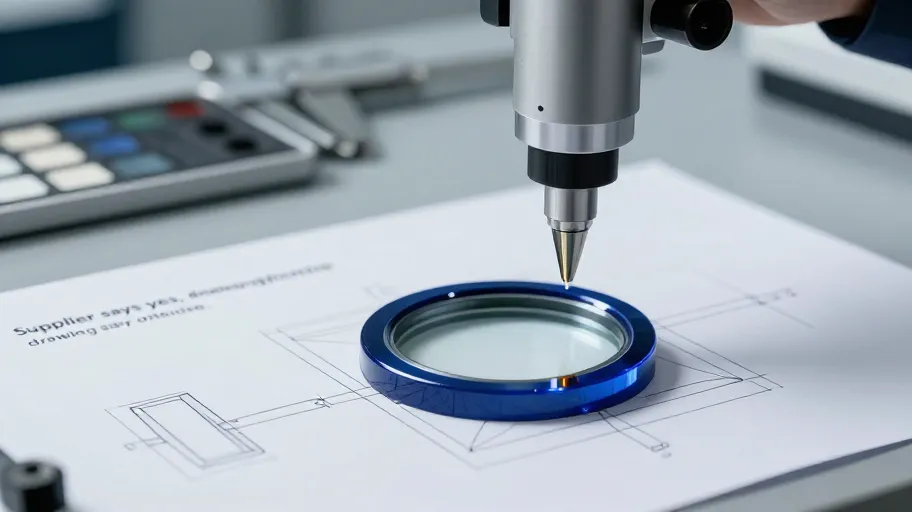
Why your sapphire crystal drawings get misread—and cost you six figures
When your Boston optical engineer reviews a surface roughness scan from a sapphire crystal China manufacture, they’re not seeing the same thing as the Shenzhen metrology lab—or the polishing line supervisor. That gap isn’t academic: per the 2025 CNMA Sapphire Quality Audit Report, 89% of rejected shipments trace to misinterpreted drawing callouts—not material flaws. ‘Ra ≤ 0.02 μm’ means different things without shared measurement protocols. ‘⌖ 0.005 mm’ measured on an optical comparator (not a CMM) fails ISO 10360-2—and derails FDA 510(k) clearance. This means your NPI launch delays by 4–11 weeks because of interpretive drift, not defective boules, because tolerance alignment stays ambiguous until it’s too late.
Sapphire Glass Supplier Sourcing Notes are your verification grammar
Sapphire Glass Supplier Sourcing Notes for Comparing Samples and Drawings aren’t checklists—they’re executable technical contracts co-developed with Tier-1 Shenzhen factories. They convert symbols into actions: when a drawing says ⌖ 0.005 mm, the note mandates CMM measurement at 0.1 μm resolution with ISO 10360-2 Annex B calibration—plus a vector deviation heatmap. For Ra ≤ 0.02 μm, it requires profilometer scans across ≥5 mm, λc = 0.8 mm cutoff, and raw data + timestamped calibration files. This means you eliminate rework cycles before they start—cutting cross-border validation time by up to 60%, because every measurement is pre-validated, not post-contested.
Vertical integration only helps if you can verify it
A true sapphire crystal factory in China controls the full chain: boule growth, orientation marking, slicing, lapping, polishing, and ISO Class 5 metrology—all under one roof. But that control is invisible without proof. Sourcing notes force transparency: requiring submission of the actual laser alignment log (not just a stamped certificate), thermal cycling reports with interferometric strain mapping referenced to the C-axis marker, and growth log-to-wafer traceability. This means you stop trusting capability—and start auditing it, because full-process control only delivers ROI when its evidence is portable, timestamped, and version-controlled across time zones.
The downstream payoff: speed, yield, and competitive edge
Teams using standardized sourcing notes see 42% faster first-pass yield in optical assembly, because metrology data arrives validated—not disputed. One medical device OEM cut sapphire window qualification from 11 weeks to 4.3 weeks, capturing Q1 surgical instrument demand ahead of two competitors. That speed means your R&D team spends less time reconciling units and more time optimizing transmission or edge durability, because technical truth travels with the part—not behind it. And that shift doesn’t just reduce risk: it compresses time-to-market, strengthens FDA/DO-160 audit readiness, and turns sapphire sourcing from a cost center into an innovation accelerator.
Your next step isn’t another RFQ—it’s a verification protocol
Stop asking suppliers ‘Can you meet the spec?’ Start verifying ‘Did you meet it—exactly as defined, with full traceability, and zero interpretive drift?’ Download our field-tested Sapphire Glass Supplier Sourcing Notes template—built with Shenzhen-based sapphire crystal factories and validated across medical, aerospace, and quantum sensor programs. It includes ISO/GB-aligned measurement protocols, version-controlled annotation fields, and audit-ready metadata capture. See how your next sapphire crystal PO shifts from trust-based negotiation to evidence-based qualification—in under 48 hours.