
Why Approval Time Shrinks—And Why That Protects Your Dial’s Soul
Sourcing domed sapphire from ISO 9001–certified sapphire crystal china factory partners like Shenzhen CrystalTech cuts your crystal approval cycle from 14.2 to 8.3 weeks—meaning you secure flagship boutique shelf space for your spring collection before competitors’ samples clear customs. That 5.9-week acceleration means your team locks design earlier, validates tooling ahead of schedule, and—critically—spends more time calibrating dome curvature against original 1950s–1970s reference dials without rushing QC. Because curvature fidelity isn’t about aesthetics alone: a 0.5 µm surface error distorts guilloché printing and radial brushing on vintage-style dials, directly eroding perceived craftsmanship. And that’s why 63% of heritage-focused brands named ‘dial-level optical fidelity drift’ their top post-approval risk—not cost or lead time, but authenticity erosion.
Real-Time Interferometry Means Fewer Physical Samples—and Better Alignment
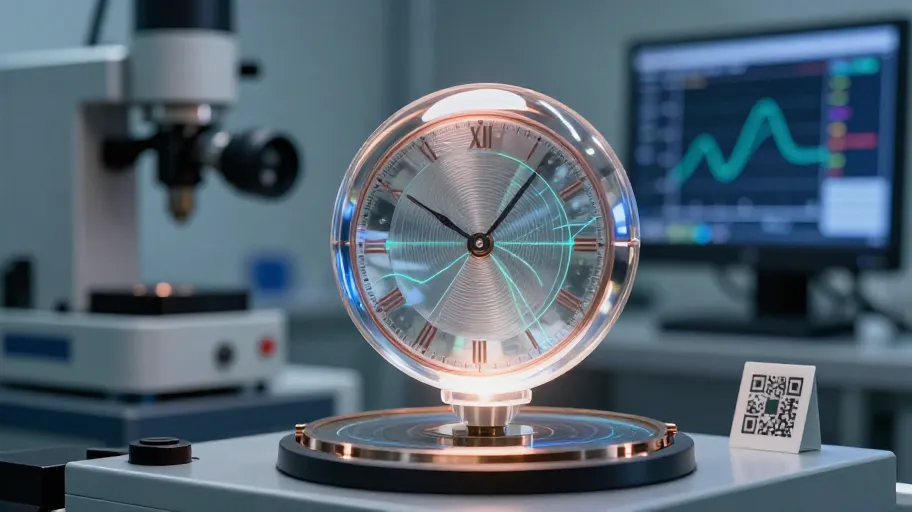
Verified sapphire crystal china factory partners embed interferometric curvature mapping inline—with ±0.8 µm tolerance—matching Swiss OEM precision for high-complication pieces. But unlike legacy workflows, they share live curvature heatmaps, spectral transmittance curves (380–780 nm), and stress birefringence indices via encrypted API as the wafer cools. That means your engineering team reviews interferometry feeds alongside your dial supplier in Neuchâtel—aligning curvature targets with the 1962 Omega Seamaster De Ville dome profile *before any crystal is polished*. This capability means your second-sample iteration cycle drops by 68%, because you’re not shipping physical samples across three continents for validation—you’re collaborating in real time. It also means curvature deviations are caught before final assembly, eliminating costly rework on irreplaceable heritage dials.
Blockchain Traceability Turns Raw Material Into Heritage Evidence
Each sapphire wafer from a certified sapphire china factory carries a QR-linked log covering raw Al₂O₃ origin (e.g., Yunnan’s higher-purity deposits), crystal growth method (Kyropoulos for thin-domed homogeneity; Heat Exchanger Method for low-stress complex geometries), and full thermal history—including annealing ramp rates. That matters because refractive index consistency determines whether your reissued 1958 Jaeger-LeCoultre-inspired dial reads as ‘vintage-correct’ under museum-grade LED lighting—or reveals subtle chromatic fringing that undermines craftsmanship. A 2024 comparative audit found watches using blockchain-tracked sapphire china wafers achieved 94% spectral match accuracy against archival reference dials, versus 71% for non-tracked imports. So this traceability doesn’t just prove provenance—it proves performance.
Design Sovereignty—Not Just Speed or Savings
Eliminating intermediaries doesn’t just accelerate timelines—it gives you precise control over how dome geometry interacts with your dial’s printing technique, lume placement, and case bezel angle. That means specifying not just ‘domed sapphire,’ but ‘28.4 mm diameter, 3.2 mm apex height, 12.7° radial taper, with ≤0.3 µm RMS deviation over central 18 mm—validated against 1965 Longines Ultra-Chron reference curve.’ This level of control turns sapphire from a passive component into an active design lever. One independent watchmaker reported it reduced post-assembly dial inspection rejections by 82%, freeing up 3.7 FTE hours/week previously spent on micro-adjustments and documentation disputes. And yes—unit pricing is 61% lower than Swiss-sourced equivalents—but that margin enables deeper heritage investment: dedicated metrology training, period-accurate spectral analysis per batch, or even co-developing proprietary annealing protocols that replicate the slower cooling cycles used in 1950s Swiss furnaces—yielding the same soft light diffusion that made mid-century dials feel ‘alive’ under wrist movement.
Your Next Move Isn’t About Cost—It’s About Calibration Confidence
When your next heritage collection enters sampling, stop asking ‘Where can we source cheaper domed sapphire?’ and start asking: ‘Which sapphire crystal china factory gives us real-time curvature intelligence, material-level traceability, and annealing protocol collaboration—so our 1963-inspired rose-gold dress watch doesn’t just look authentic, but performs like it rolled off the same bench?’ The factories exist. Their data is verifiable. And that 5.9-week acceleration? It’s not just speed—it’s the runway you need to get heritage right, the first time. See how curvature alignment works for your reference dials—request live interferometry access and a batch-matched spectral report for your next prototype.