
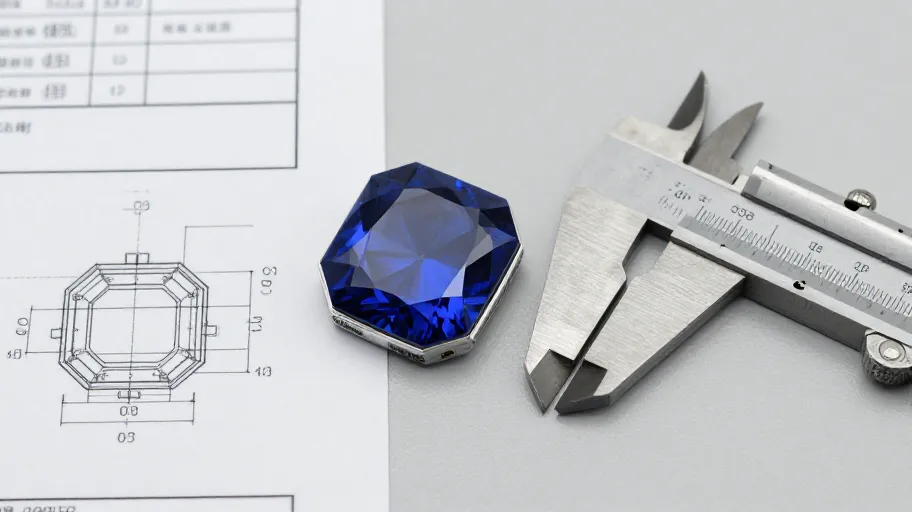
Buying a men sapphire watch crystal as a B2B component is not a catalogue decision — it is a specification, sampling and approval project. Your drawing must define shape, thickness profile, coating, edge finish and gasket interface; your supplier must confirm each item in writing; and you must approve a physical sample against documented criteria before production is released. Use a structured gate to keep the process auditable.
The S-S-A-A framework
Every custom sapphire crystal project moves through four gates:
- Specify — produce a drawing and technical package that leaves nothing to interpretation.
- Sample — request physical samples made to that package, and confirm the current sample policy, cost and shipping terms directly with the supplier.
- Assess — inspect samples against defined pass/fail criteria, not impressions.
- Approve — sign off a golden sample and a written confirmation of the released specification before mass production begins.
Skipping a gate is where sourcing disputes start. A beautiful sample means nothing if it was not made to your released drawing.
Specify: what your drawing must state
A sourcing-ready drawing for a men sapphire watch crystal should document, at minimum:
- Crystal geometry: flat, domed, or box; plano/plano, plano/curved profiles; maximum height of curvature reference.
- Diameter and thickness: nominal dimensions and how you want variation controlled — agree the tolerance class with the supplier in writing rather than assuming a number.
- Edge treatment: polished or bevelled edge, bevel angle reference, and the gasket seating surface, since waterproofing depends on this interface as much as on the case.
- Coating: whether anti-reflective coating is required, inner face only or both faces, and how coating adhesion and scratch behaviour will be verified.
- Markers and surface features: printed indices, logos, date-window cut-outs or apertures, and their positional references.
- Material confirmation: request the supplier's evidence base for the sapphire material itself and how consistency between sample lots and production lots is maintained.
Each of these is a question to resolve with your supplier. Do not accept an undocumented default — if a parameter matters to your product, it belongs on the released drawing.
Decision table: choosing your approval path
| Project situation | Recommended path | What to document | Risk if skipped |
|---|---|---|---|
| New case design, new crystal | Full S-S-A-A with golden sample | Released drawing, approved sample, written spec lock | Rework of case or crystal; disputed responsibility |
| Replacement crystal for existing case | Sample against measured case, not nominal | Case measurement record, gasket interface check | Fit failure at assembly |
| Second-source supplier for same part | Cross-measure both suppliers' samples side by side | Comparison record; which supplier's part is the reference | Silent spec drift between sources |
| Small prototype run | Reduced sampling, but full spec lock | Which parameters are provisional vs final | Spec changes discovered after scale-up |
This table is a planning aid, not a rulebook. Your project's risk profile — retail price point, water-resistance claims, service obligations — should drive how strict each gate is.
Sample and assess: concrete approval questions
When samples arrive, ask and record answers to these questions:
- Was this sample produced by the same process intended for mass production, or a separate sample line?
- Which parameters on the released drawing does the supplier consider verified by this sample, and which are still open?
- What inspection method was used for surface quality, and can the inspection criteria be shared?
- How will coating quality be checked — and what documentation accompanies each production batch?
- What is the escalation path if a production part differs from the approved golden sample?
- What is the current sample policy — cost, shipping responsibility, and whether fees relate to later orders? Confirm all of this directly with the supplier; none of it can be assumed.
- How are revisions controlled if you request a change after approval?
The last question matters more than buyers expect. A change request after golden-sample approval can silently invalidate earlier sign-offs. Make revision control part of the conversation from the start.
Pre-production release checklist
Before authorising production of a men sapphire watch crystal, confirm every line:
- Released drawing with revision number, dated and acknowledged by the supplier
- Every drawing parameter confirmed in writing — no verbal agreements
- Physical sample measured against the drawing by your team or your appointed inspector
- Coating specification confirmed, including which faces are coated
- Gasket interface and edge finish checked against the actual case
- Date-window or aperture positions verified on the sample
- Golden sample labelled, signed and held by both parties
- Sample policy, fees and shipping terms confirmed in writing with the supplier
- Revision control process agreed for post-approval changes
- Batch inspection and documentation arrangements confirmed
If a box cannot be ticked, that is a conversation to have before production, not after.
Choosing a supplier in Shenzhen or Hong Kong
Proximity to the Pearl River Delta watch supply chain is a practical advantage for buyers of custom sapphire components, but geography is not a qualification. Assess any supplier — including JadeZone Sapphire — the same way:
- Ask what evidence they can show for the parameters that matter to you, and judge their transparency as much as their answers.
- Verify their communication cadence: who answers technical questions, and how quickly revisions are documented.
- Compare their written responses to your checklist against other candidates on the same checklist.
- Confirm all commercial terms — pricing, sample arrangements, order quantities, delivery terms — directly and in writing for your specific project.
A supplier who documents answers carefully at the RFQ stage is showing you how they will behave during production.
FAQs
Do men's and unisex watch crystals need different specifications? Not inherently. Larger case diameters can change curvature, thickness and edge-load considerations, but specification should always follow the case design — not the product's marketing category. Specify by geometry and interface.
What tolerance should I put on the drawing? Do not copy a number from a general guide. Agree tolerance classes with the supplier against your case, gasket and assembly method, and record the agreed values on the released drawing.
Should AR coating be on one face or both? That is an optical and durability decision tied to your product's positioning. Ask the supplier how each option is produced and verified, how it affects handling during assembly, and decide based on documented evidence rather than preference.
Can I approve a sample remotely? Yes, if the measurement and inspection criteria are explicit. Many buyers appoint a third-party inspector or request documented measurement reports — agree with the supplier in advance which method constitutes formal approval.
What if the golden sample and production parts differ? That is why the escalation and revision questions belong in the pre-approval conversation. Define, in writing, what happens when a deviation is found: containment, re-inspection, and who decides acceptance.
Next step
[获取采购 Brief] — download the sourcing brief and use it as your RFQ template for your next men sapphire watch crystal project: specify, sample, assess, approve, with every gate documented.
Not ready to contact a supplier yet? Take the pre-production release checklist above into your next internal product meeting and mark which lines your current project can already satisfy. That alone will show you where your specification gaps are.