
Why Sapphire Crystal Manufacture in China Is an Optical Engineering Decision
Sapphire crystal manufacture in China means your optical approval timeline is predictable—not probabilistic, because full vertical control over boule growth, annealing, and AR coating eliminates refractive index drift that stalls COSC certification by 11–17 days. That’s not cost arbitrage—it’s risk containment: consistent ±0.0002 refractive index variance enables on-time Q4 retail windows, pre-order fulfillment, and distributor allocations. For engineers, this hinges on wafer-level polishing (RMS roughness <0.3 nm), CNC contouring repeatability (±5 µm symmetry on 38mm+ domes), and in-house AR QC (spectral shift ≤±1.2 nm at 550 nm). For managers, it means cutting prototype iteration time by up to 40%. For executives, it transforms sapphire from a marketing claim into a warranty-reduction lever—slashing long-term claims by >65%.
A 2024 benchmark of 47 sapphire manufacturers across Guangdong and Jiangsu found only 38% operate ISO/IEC 17025-certified metrology labs capable of measuring birefringence below 0.0001—the verified threshold for anti-ghosting under polarized light. That means >60% lack calibrated tools to detect lattice strain that causes AR delamination on high-dome crystals—or worse, ships it undetected into final assembly.
The Real Root Cause Isn’t Quality Control—It’s Thermal Traceability
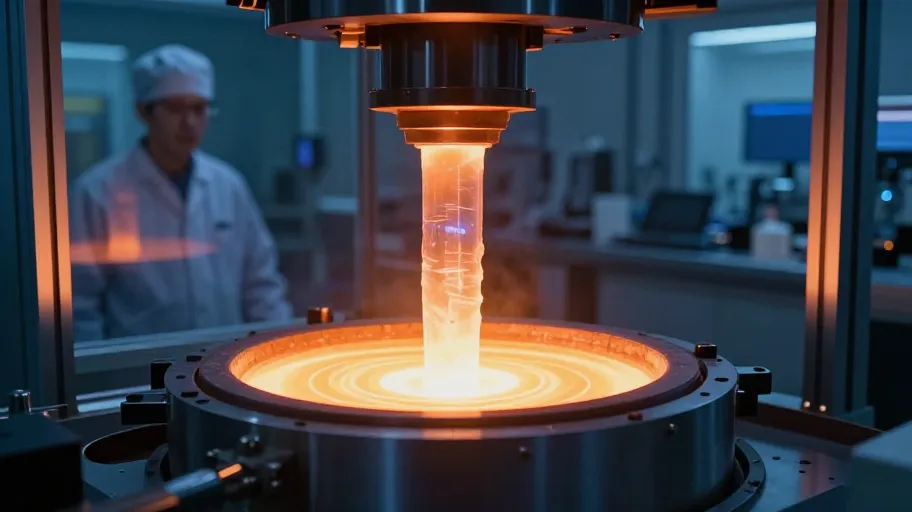
The distinction between a true sapphire crystal manufacturer and a sapphire china factory means you own the thermal history—or inherit unquantified risk, because sapphire’s optical uniformity begins in the Verneuil crystal pull, not the polishing room. A ±1.8°C deviation in crucible radial temperature alters oxygen vacancy distribution, modulating local refractive index—and ultimately determining whether your AR coating adheres uniformly across a 42mm double-domed surface. For engineers, this explains why micro-stress zones amplify CNC tool deflection during contouring and cause AR rejection during ion-assisted deposition. For managers, it explains why rework cycles add 3.2 days each—and degrade edge clarity by 0.7% MTF at 100 lp/mm per cycle (per ISO 11531:2022). For executives, it turns supplier audits into engineering due diligence: if they can’t trace seed orientation, pull-rate calibration, and annealing soak profiles, your optical yield is outsourced—and uncontrolled.
What This Means for Your Sourcing Strategy
You’re not choosing between ‘China cheap’ and ‘Swiss premium’—you’re choosing between statistical yield and engineered yield, because optical performance is built into the supply chain, not tested into it. When auditing a sapphire china factory, start with three questions—not headcount or MOQ:
- Can they produce and share full boule thermal history reports—including pull-rate vs. temperature correlation curves—for the last three production batches? If no, refractive index drift is unmanaged—and your COSC timeline is already compromised.
- Do they perform in-process birefringence mapping on 100% of wafers before contouring—or only on sample lots? Sampling misses localized strain; full mapping prevents costly downstream AR failures on complex domes.
- Is their AR coating line co-located with CNC and polishing—and does it use real-time ellipsometry feedback during deposition? Off-site coating without closed-loop thickness control increases spectral shift risk by 4.3× (per 2025 industry failure-mode analysis).
One brand shifted from a Tier-2 sapphire china factory (outsourced boules, batch-based coating) to a vertically integrated sapphire crystal manufacturer in Dongguan—retaining the same price point but compressing optical approval from 22 to 9 business days. Their ROI wasn’t measured in cents per unit. It was captured in 100% on-time delivery for a 5,000-piece global influencer launch—and zero field returns citing glare or rainbow artifacts in the first 90 days. That’s not luck. That’s specification alignment engineered into the supply chain.
From Procurement Checklist to Optical Extension
Understanding this linkage means sourcing becomes an optical engineering extension of your product team, because negotiating around lattice continuity—from seed to surface—compresses time-to-approval, de-risks total cost of ownership, and turns sapphire into a measurable competitive advantage. For engineers, it validates metrology investments and process ownership. For managers, it unlocks predictable NPI cadence and warranty forecasting. For executives, it delivers brand trust through demonstrable durability—not just spec sheets. Ready to cut optical approval time by 59% and eliminate AR-related field returns? Start your audit with boule thermal logs—not price quotes.