
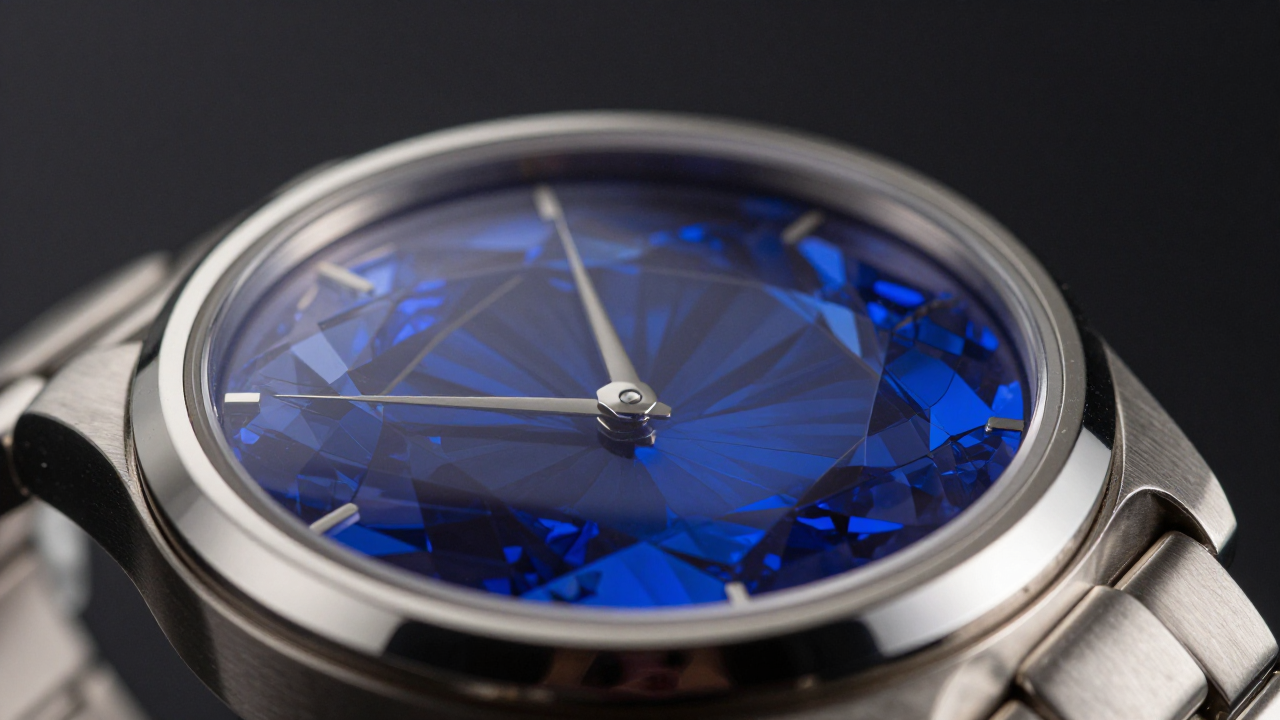
The most common mistake is ordering a sapphire watch crystal by diameter and thickness alone.…
Edge bevel, dome radius, and coating orientation decide whether the part survives a press — and none of them fit on a two-line purchase order. We learned that in February 2026 for about $1,000.
What Is the Most Common Mistake With Sapphire Watch Crystals?
That answer reads as obvious once it's written down. It is not obvious at 4 p.m. on a Friday when a purchase order gets copied from last year's model and the person copying it has a caliper, a spreadsheet, and a ship date. Bevel geometry only becomes visible when something cracks.
What Actually Went Wrong in Our $1,000 Loss?
In February 2026 we shipped 500 double-domed sapphire crystals for a 39 mm field watch, and 41 of them cracked within 48 hours of installation at the customer's assembly house in Portland, Oregon. The bevel on one lot ran 0.08 mm instead of the 0.15 mm spec, and the assembly house pressed them with a flat nylon die.
What we saw on the returned pieces
The cracks started at the edge, roughly 120 degrees apart, and propagated inward about 1.8 mm before stopping. That pattern is a point-load signature, not a handling signature — handling chips look like a single crescent at one spot. Two of the returns had chips under 0.1 mm that had clearly been there before pressing.
Why it happened
Our beveling wheel had wear on it. We were tracking wheel life in hours, not in pieces, which is the wrong unit for a consumable that degrades per contact. The wheel had roughly 30,000 pieces on it when that lot ran.
Then came the part that still bothers me. Our outgoing QC measured diameter at ±0.02 mm and thickness at ±0.01 mm, and it did not measure bevel at all. Nobody had written bevel onto the inspection sheet, because for years the bevel on our flat crystals was generous enough that it never mattered. When we moved that customer from flat to double-domed, the geometry changed and the inspection sheet didn't.
We first blamed the press operator. That was wrong, or at least half wrong. A 0.15 mm bevel on a 2.1 mm dome absorbs a small amount of misalignment during pressing. A 0.08 mm bevel does not. Either failure alone would probably have survived; the two together took out a third of the lot.
What it cost
The unit price of that crystal was $9.40. The failure cost 2.6 times the value of the entire 41-piece replacement order.
(One aside on why bevel tolerances are getting tighter across the category: Casio's CRW-002 ring watch, announced in early 2026 at $135 in silver and $155 in gold, shows the direction — once crystal diameters drop below 10 mm, a 0.05 mm edge deviation becomes half a percent of the part.)
What we changed
The bevel is now on the certificate of conformance, measured on a profile projector every 500 pieces, with a hard reject at 0.12 mm. We also started shipping a one-page press note with every domed order, specifying a concave die that matches the dome radius within 0.05 mm. Two customers have told us they ignore the note. That's their call; the note exists so the conversation after a failure starts from a document instead of a guess.
Why Does "It Fits" Not Mean "It Seals"?
A sapphire crystal does not flex, so every bit of water resistance comes from gasket compression. Mineral glass deflects roughly 0.02 to 0.05 mm under 10 bar of pressure and can absorb a slightly shallow groove. Sapphire deflects essentially zero, which means a groove that is 0.05 mm too deep shows up as a failed pressure test, not as a slow leak you notice later.
The practical number most case makers design to is 25% gasket compression, and that number assumes the crystal thickness is what the drawing says. We have seen watches rated to 100 m fog up in a 5 bar bench test because the crystal came in 0.08 mm thin. The gasket had preload on paper and none in the case.
Correct approach: specify gasket groove depth and crystal thickness as a paired tolerance, chamfer the crystal's lower edge so it doesn't shave the gasket during insertion, and pressure-test the assembled watch to ISO 22810 at the rated depth before it leaves the bench. Testing after assembly is not optional — the crystal and the gasket are one system.
How Much Does a Sapphire Watch Crystal Replacement Really Cost?
Replacement cost is not the unit price. For a small US brand, a full replacement cycle — part, freight, technician time, and the risk of a repeat failure — typically runs 4 to 7 times the crystal's unit price. The part is the cheap part.
Concrete numbers from our own order book: a 32 mm flat sapphire at 1.5 mm thickness with single-side AR lands around $6 to $12 at 500 pieces. A 34 mm double-domed with double-side AR runs $12 to $22. A technician's time to press, test, and re-case a watch is $35 to $60 in most US shops, and overnight freight on a small parcel is $30 to $80.
Here is where people underbid. A quote built on the $9 part and the $40 of labor comes to $49. The quote that survives reality includes a second press run and a launch delay, which is how a $9 crystal turns into a $25 problem per unit. We have watched two customers lose a retail window over a four-day freight gap. Neither of them had budgeted for the gap because the original quote had no line for it.
What Small Mistakes Do We Still See Every Week?
Coating side is the one that causes the most quiet damage. If you specify single-side AR and the coated face ends up on the outside, the coating scuffs within months and the crystal looks worse than uncoated mineral glass. Bare sapphire transmits about 85% to 86% of visible light; double-side AR takes it above 98%. Put the coating where the drawing says.
Cleaning is the second. Acetone on a coated crystal will attack the coating edge. Ultrasonic cleaning of loose crystals chips the bevels, because sapphire's hardness (Mohs 9, roughly 2,000 HV) means it will not scratch itself on the face but will absolutely chip itself at a 0.15 mm edge.
And packaging. We still get photos of crystals shipped loose in a zip bag, 200 pieces, edges against each other. Ship in trays, face up, one layer. It costs about $0.04 per unit and eliminates an entire category of incoming inspection disputes.
How Do You Vet a Supplier Before Wiring a Deposit?
Ask for a first-article inspection report that lists bevel angle, dome radius, and coating transmission alongside diameter and thickness. A supplier who can only quote diameter is almost always a trading company, and a trading company cannot tell you what its beveling wheel looked like last Tuesday.
The equipment question is a fast filter. A real factory measures bevel on a profile projector and transmission on a spectrophotometer. Ask what model they use. In our Shenzhen plant those two instruments sit next to the QA desk, and every lot gets both measurements logged before it leaves — that is the only reason our February failure got caught on lot two instead of lot six.
The Pre-Shipment Checklist We Now Use
Frequently Asked Questions
What is the most common mistake when buying a sapphire watch crystal?
Ordering by diameter and thickness only. Edge bevel, dome radius, and coating orientation determine whether the crystal survives installation and how it looks after a year. A purchase order without those three values leaves the factory to guess, and factories guess in the direction that costs them least.
How much does a sapphire watch crystal replacement cost?
The part runs $6 to $22 at 500 pieces depending on size, dome, and coating. A completed replacement cycle, including technician time and freight, usually lands at 4 to 7 times the unit price. Budget for a second press run and you will not be surprised by the invoice.
How can I tell if my watch has a sapphire crystal?
Check the caseback or spec sheet first — many brands mark it. Failing that, sapphire sits at Mohs 9 and resists steel, so a key rubbed on the face leaves no mark on sapphire but will mark mineral glass. The water-drop test is unreliable and tells you nothing about coating quality.
How long should a sapphire watch crystal last?
The face will outlast the movement in normal use; only diamond, silicon carbide, or sapphire itself scratches it. Edges are the weak point. A crystal that chips at the bevel can fail a pressure test years before the face shows any wear, so have water resistance checked every few years.
How do I choose a sapphire crystal supplier?
Ask for bevel, dome radius, and coating transmission on the inspection report, and ask what instruments they measure with. A supplier who cannot answer those questions is reselling. Request a first article before production, and confirm the press die spec in writing before the lot ships.