
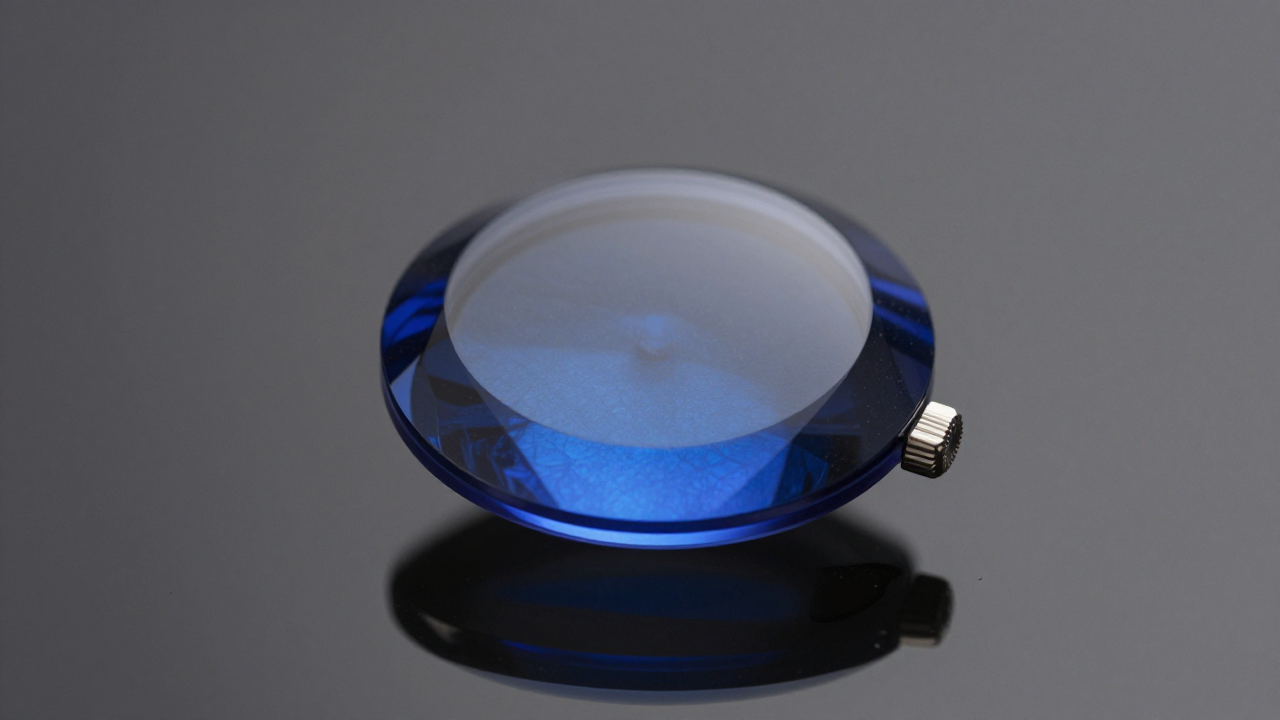
If a watch leaves the house more than three days a week, buy a sapphire watch crystal. Mineral glass fits sub-$200 fashion pieces and display-case watches.…
Acrylic still wins for vintage restorations and anything that gets slammed against doorframes. Price separates these three, not durability.
The Short Answer on Sapphire Watch Crystals
The bench belongs to a watchmaker on Jewelers Row in Chicago. February 2026, a Tuesday, 2:40 in the afternoon. He has 41 watches in a felt tray and he is not sorting them by brand. He is sorting by what failed.
Thirty-one came in with hairline scratches on mineral glass. Six arrived with shattered sapphire — five of those had chipped at the edge first, then cracked inward. Two had acrylic crystals worn into fog. The rest had dead movements and didn't matter.
"People think they're buying scratchproof," he said, tapping one of the broken sapphires. "They are. They're not buying drop-proof."
That gap between marketing and the repair tray is what this comparison is about.
What a Sapphire Watch Crystal Actually Is
A sapphire watch crystal is a disc of synthetic single-crystal corundum grown in a furnace, not dug out of the ground. It measures 9 on the Mohs scale and roughly 2,200 on Vickers; diamond is the only common material that will scratch it.
The growth happens by flame fusion at about 2,050°C. Corundum powder drops through an oxy-hydrogen flame, melts, and builds a boule that cools over several hours. Those boules get core-drilled into cylinders, sliced, lapped flat, edged on a CNC, then polished with cerium oxide slurry until the surface reads under 2 nm Ra. Anti-reflective coatings go on last, inside a vacuum chamber.
Two things buyers get wrong here. First, the material is not glass — refractive index runs about 1.77 against 1.52 for mineral glass, which is why an uncoated sapphire crystal reflects noticeably more light. Second, "hard" and "tough" are different properties. Sapphire's fracture toughness lands near 2 MPa·m^0.5, better than mineral glass at roughly 0.75 but nowhere close to polycarbonate. It resists abrasion brilliantly and absorbs impact poorly.
Drop a 40mm watch from 1.2 meters onto tile and the odds are decent the sapphire survives. Land it on a corner and the edge chips. From a chip, a crack has somewhere to start.
Sapphire vs Mineral vs Acrylic, Side by Side
Sapphire costs four to eight times more than mineral glass at the factory gate, resists scratches an order of magnitude longer, and loses to acrylic on impact. No single column wins.
The weight row surprises people. Sapphire runs about 60% heavier than mineral glass at identical dimensions, which shifts the center of gravity on a thin case. Not a dealbreaker. Worth knowing if you're chasing a 9mm case height.
The Dimension Most Buyers Never Test
The crystal almost never fails first. The coating stack and the polished edge do. A 96-hour ASTM B117 salt-fog run tells you more about a $6 crystal versus a $12 crystal than any hardness spec sheet.
Anti-reflective coatings are 4 to 8 dielectric layers, 300–600 nm thick, deposited under ion assistance. Uncoated sapphire transmits around 92% of visible light; a good double-side stack pushes that to 99% or better. The catch is durability. Coating on the outside of the crystal takes every sleeve cuff, sunscreen smear, and saltwater rinse. Adhesion failures show up as a rainbow haze, then as blotchy delamination.
We learned this the hard way. In June 2023, a dive-watch brand out of Clearwater, Florida took 8,000 units from us with external AR on the top surface. Six months of consumer saltwater use later, their return rate on coating complaints hit 4.2%. We rebuilt the spec with AR on the underside only and left the top surface uncoated. Complaints dropped under 0.5%, and nobody wrote in about glare.
(That's the trade-off nobody puts in a catalog: outer AR looks spectacular under showroom lighting and tired after two summers.)
Edge geometry is the second blind spot. A bevel between 0.15mm and 0.25mm survives handling and ultrasonic cleaning. Over-polish it and you get micro-chips that fail to show under a loupe but open up under ISO 1413 shock testing. A 0.05mm chip is enough to seed a crack. And the bottom face flatness — 0.03mm is where we hold it — decides whether the gasket actually seals at 10 ATM or just looks like it does.
Is a Sapphire Watch Crystal Worth the Extra Nine Dollars?
At the factory gate, the upgrade from mineral glass to sapphire runs about $6 to $9 per unit on a 30.5mm flat crystal. At the service counter, replacing a sapphire costs $150–$350 versus $40–$90 for mineral glass. One avoided replacement pays for the upgrade across an entire production run.
That math is why microbrands moved on sapphire faster than the legacy houses did. A $450 retail dive watch with a sapphire crystal and an NH35 movement became table stakes around 2021. By 2026 it's assumed.
Our Shenzhen operation has cut and polished watch crystals since 2010 — just over 300 people between the floor and QC — and the shift in order mix over the last five years is stark. Flat sapphire in 1.0mm and 1.2mm now dominates small-batch orders from US brands. Some of that is spec-sheet competition. Some of it is customers who got tired of polishing scratches out of mineral glass.
One cost detail worth flagging for 2026: landed cost is moving faster than FOB cost. Brands re-quoting this year are often shaving 0.2mm off crystal thickness or dropping a double-AR stack to hold retail price, and both moves carry a real performance cost that won't show up until the warranty window closes.
What the Repair Bench and the Factory Floor Show
In November 2023, a microbrand in Portland, Oregon shipped 2,200 dive watches and started getting returns with chipped crystal edges. The rate was 6%, which for sapphire is alarming. Root cause wasn't the crystal spec. It was the assembly line's ultrasonic cleaning baskets, where loose crystals tumbled against each other for four minutes per cycle. Switching to foam-nested trays dropped the reject rate to 0.3% on the next run. Same supplier, same spec, different handling.
The Chicago watchmaker's log tells a parallel story. Over 14 months he replaced 63 crystals. Forty-four were mineral glass, 11 were sapphire, eight were acrylic. Of the 11 sapphires, nine had a visible edge chip at the failure origin. Only two failed from a face-on impact. He now refuses to fit a sapphire crystal into a case where the bezel doesn't fully protect the edge — and he's right to.
Pick by Wearing Pattern, Not by Price Tag
If you wear the watch daily, work at a desk, and hate polishing compound, choose sapphire with single-side AR on the underside. It will outlive the movement.
If you're building a sub-$150 retail piece or a promotional run, choose hardened mineral glass. Sapphire on a $90 watch eats margin you need elsewhere.
If you restore vintage pieces or you're hard on your hands, choose acrylic — or a domed sapphire with a thick protective bezel and accept the chip risk.
If you're designing a dive watch rated to 200m, do not treat the crystal as a standalone line item. Specify edge bevel width, bottom-face flatness, and gasket durometer together, or the pressure test will find you.
If you're a brand doing 500 to 5,000 units a year, ask your supplier for salt-fog data on the coating before you ask for a hardness number. Hardness is a given. Coating is where suppliers differentiate.
Frequently Asked Questions
What is a sapphire watch crystal made of?
A sapphire watch crystal is synthetic single-crystal corundum, aluminum oxide grown in a furnace at roughly 2,050°C. It contains no mined gemstone material. Lab-grown corundum delivers the same 9 Mohs hardness as natural sapphire at a fraction of the cost, which is why nearly every watch above $300 uses it.
How much does it cost to replace a sapphire watch crystal?
US service centers charge $150 to $350 for a sapphire crystal replacement, depending on case design and whether the watch needs pressure testing afterward. Mineral glass replacement runs $40 to $90. At the factory level, a 30.5mm flat sapphire crystal costs $6.50 to $11.00 per unit at 1,000 pieces.
Can a sapphire watch crystal scratch or break?
Sapphire resists scratches from almost everything except diamond, which shares its 9 Mohs rating. It can break. Sapphire is hard but brittle, and roughly 80% of failures we see start as an edge chip from a corner impact rather than a face-on blow. A protective bezel reduces that risk substantially.
Is sapphire better than mineral glass for everyday wear?
For daily wear, sapphire wins on cost of ownership. Mineral glass scuffs within 6 to 18 months and clouds visibility; replacing it costs $40 to $90 each time. Sapphire's higher upfront cost is recovered after one avoided replacement, and it holds optical clarity far longer.
How do I choose between flat and domed sapphire crystals?
Flat crystals cost less, weigh less, and suit modern tool watches. Single-dome and box-dome crystals add depth and vintage character but raise unit cost and increase edge exposure. If the bezel sits below the dome apex, expect chips. Match dome height to bezel protection before matching it to aesthetics.