
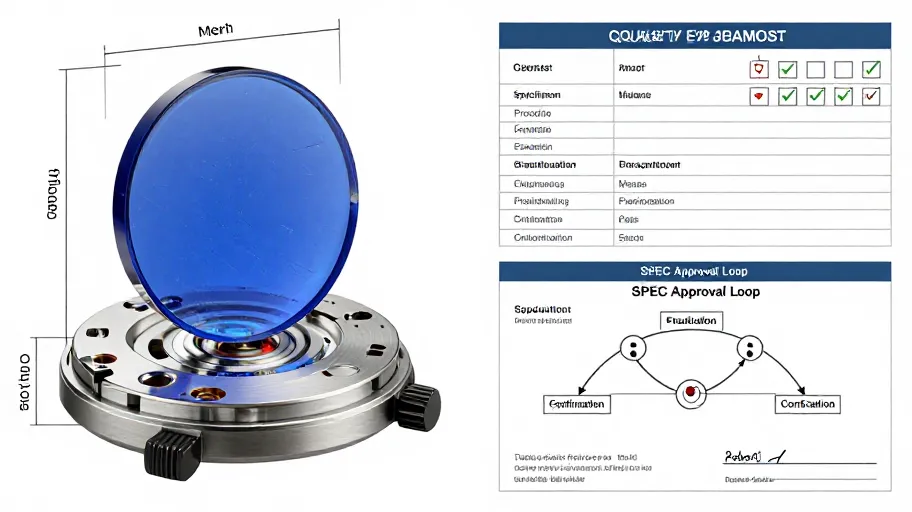
Selecting a men sapphire watch glass supplier is less about finding a single best option and more about running a disciplined specification, sampling and sign-off process. Use the SPEC Approval Loop — Specification, Prototype, Evaluation, Confirmation — to turn your drawings into an approved crystal before any volume commitment: define every measurable line item, prototype against those lines, evaluate against a written scorecard, and confirm with a documented sign-off.
This guide is written for buyers, product developers and sourcing managers commissioning custom or OEM sapphire crystals for men's watches. It assumes you already know sapphire is your material and are now deciding who should cut it and how to approve their work.
The SPEC Approval Loop
- Specification. Write down every measurable attribute of the crystal before contacting anyone. A spec that lives in an email thread is not a spec.
- Prototype. Have one or more suppliers produce parts against that written spec — not against a sketch or a conversation.
- Evaluation. Measure the prototypes against the spec on paper. Fit, optical clarity, edge finish and coating appearance are all scored, not "eyeballed".
- Confirmation. Record who approved what, against which revision of the drawing. This document is your reference for any later production discussion.
The loop can repeat. If the first prototype misses on a line item, revise the spec or the part and run the cycle again. The point is that nothing moves to volume discussion until the confirmation step is documented.
What to compare when evaluating a supplier
Rather than asking suppliers to "send your best quote", compare them line by line. The table below is a working scorecard you can adapt.
| Comparison line | What to ask for | How to score it |
|---|---|---|
| Drawing translation | Does the supplier quote directly from your drawing, or request clarifications? | A supplier that asks precise questions is easier to work with than one that quotes immediately and silently. |
| Material call-out | Confirmation that the part is synthetic sapphire, and hardness testing method if you require documented verification | Verify what evidence they can provide — do not accept the word "sapphire" alone if documentation matters to you. |
| Edge and profile work | How the proposed process achieves your shape (box, dome, flat, stepped) | Compare described process steps against your tolerance-critical surfaces. |
| Coating | Which anti-reflective layers are proposed, on which surfaces | Confirm coating specification in writing per surface, per your drawing. |
| Communication cadence | Who responds, in what language, and how revisions are handled | Score responsiveness during the quoting stage — it rarely improves later. |
| Approval route | What the supplier's own prototype and sign-off process looks like | Prefer suppliers with a defined approval route you can document. |
Note the deliberate absence of price, minimum order quantity and lead time from the table. Those matter, but they are project-specific and you should request current figures from each supplier directly — they vary by design, quantity and coating package, and a guide cannot state them for your part.
Turning your spec into a request
Before contacting a men sapphire watch glass supplier, assemble:
- A dimensioned drawing with critical tolerances marked as such. If you do not know which tolerances are critical, ask your case manufacturer — case and crystal must be specified together.
- Material call-out stating synthetic sapphire and any documentation requirement you have for verifying it.
- Coating call-out naming which surfaces receive anti-reflective treatment, if any, and any appearance requirement (for example, blue-tinted versus neutral reflection).
- Assembly context: gasket or adhesive mounting, expected fit method, and any hardware (retaining rings, caseback design) the crystal interacts with.
- A note on what you have not yet decided. Honest requests produce honest answers. If the coating choice is open, say so.
A supplier such as JadeZone Sapphire, which manufactures custom sapphire watch crystals and precision sapphire components from its Shenzhen and Hong Kong operations, works from customer drawings for OEM projects — but the quality of the answer you get depends on the quality of the request above.
Samples and prototypes: ask, do not assume
What you can control is the quality of the questions you ask:
- Is the prototype produced on the same process route proposed for volume production? If the route differs, ask where.
- Which revision of the drawing does the sample represent?
- What documentation accompanies the sample — a measurement report, a coating declaration, nothing?
- Are assembly trials expected at your side, and what mounting hardware does the supplier need to know about?
- If the sample requires a revision cycle, how are changes communicated and re-issued?
The approval gate: questions to put in writing
Before you confirm a crystal for production, put these questions to the supplier and record the answers:
- Which drawing revision is the approved reference, and who holds the master file?
- What measurement evidence will accompany each production batch, and against which spec lines?
- How are deviations from the approved sample handled — flagged before shipment, or after?
- What is the agreed process for re-running the prototype loop if a spec line fails in assembly?
- Who signs off on both sides, and in what format?
An approval that exists only in conversation is not an approval. Ask for a short written confirmation naming the part, the drawing revision and the approved attributes. Reputable suppliers will expect this; any that resist should give you pause.
FAQ
Do I need anti-reflective coating on a men's sapphire crystal? That is a design and positioning decision for your brand, not a given. Decide which surfaces (inner, outer, both) you want treated and specify it on the drawing. Then confirm in writing what coating the supplier proposes for each surface and how its appearance will be verified against an approved reference.
Can a supplier work from a photo of an existing crystal? A photo can start a conversation, but an approval should rest on a dimensioned drawing with marked tolerances. If you are reverse-engineering a crystal, expect a measurement-and-prototype cycle — the SPEC Approval Loop exists precisely for this.
What information must a supplier quote accurately? At minimum: the dimensioned drawing with critical tolerances, material call-out, coating call-out, mounting method, and your documentation requirements. Without these, any quotation is an estimate on assumptions you have not verified.
How many prototype rounds should I plan for? There is no fixed number; it depends on how complex your crystal is and how complete your initial spec is. Plan your project timeline so that more than one loop is possible, and treat the first prototype as an instrument for refining the spec, not merely a part.
What should be in the written approval? Part identifier, drawing revision, the approved attribute list (dimensions, coating, edge finish), the evidence each side agreed to provide, and named signatories. One page is enough; its absence is expensive.
Primary CTA
Ready to run the SPEC Approval Loop on your next crystal project? 获取采购 Brief — send us your drawing and requirement list, and JadeZone Sapphire will respond with a structured brief covering specification lines, prototype questions and the approval route for your men's sapphire watch glass project.
Low-friction checklist CTA
Not ready to send drawings yet? Start with our pre-request checklist: confirm you have a dimensioned drawing, a material call-out, a coating call-out, your mounting method, and your documentation requirements. Five boxes, ticked before your first supplier conversation, will make every quote you receive comparable.