
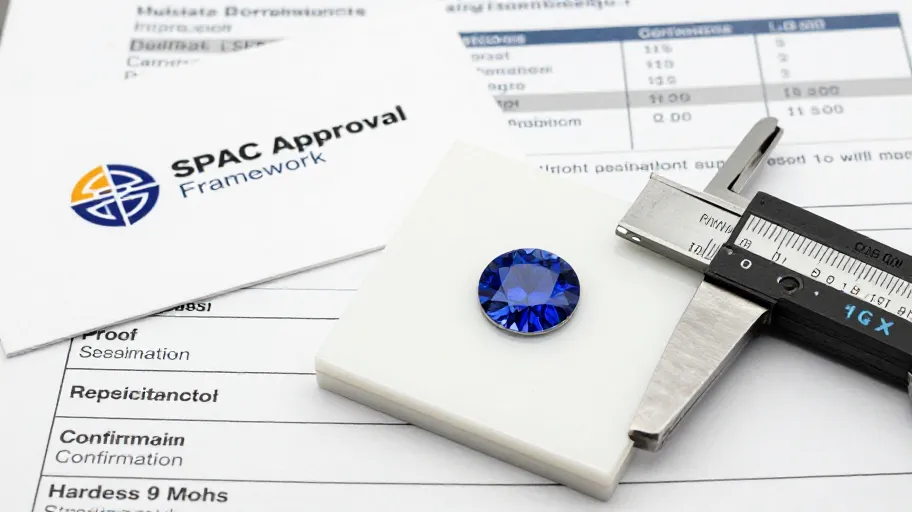
Sourcing a sapphire watch crystal is less about finding a single "best" vendor and more about running a disciplined approval process. This guide applies the SPAC Approval Framework — Specification, Proof, Alignment, Confirmation — so that watch brands, sourcing managers and watchmakers can brief a sapphire watch glass supplier usa buyers search for, compare candidates objectively, and sign off on samples with confidence before committing to production.
Why process beats price lists
Sapphire crystal is a hard, brittle material machined to tight requirements, and the cost of a wrong decision shows up late — in rejected batches, coating discrepancies or crystals that do not seat in the case. The buyers who avoid those outcomes tend to follow the same sequence: they write a complete specification, obtain and evaluate samples against it, align every open question in writing, and confirm approval formally. The framework below turns that sequence into four repeatable stages.
Stage 1 — Specification: write the drawing before you contact anyone
Before requesting quotes, assemble a specification package. A supplier cannot price accurately — or commit to the right process — from a photo or a diameter figure alone. At minimum, your spec should address:
- Crystal type: flat, domed, box-form, or with an integrated step or flange
- Diameter, thickness and edge profile requirements, expressed as drawing dimensions and tolerances you will accept
- Whether the crystal must suit a gasket, caseback press-fit, adhesive mount or bezel retention
- Coating requirements (for example anti-reflective treatment on one or both sides) — stated as a requirement to be confirmed, not assumed
- Printing or logo engraving on the crystal, if any
- Inspection criteria: what "acceptable" means, and who measures it
Turning each of these into a line on a drawing removes the most frequent source of supplier back-and-forth. If you are unsure which mounting method your case requires, say so explicitly and ask the supplier's engineering team to review the case drawing with you.
Stage 2 — Proof: the sample stage, and what to ask before it starts
Samples are the heart of the evaluation, but the commercial terms around samples vary by supplier and must be verified, not assumed. Before you request samples, put these questions in writing:
- What is the current sample policy — is a sample fee charged, and on what terms? Confirm directly with the supplier.
- Who arranges and pays for sample shipping, and under what incoterms or shipping arrangements? Ask; do not assume.
- How many sample pieces are provided per design, and are multiple design variants supported in one sampling round?
- What documentation accompanies samples — a dimensional report, coating notes, or other records? Request specifics.
- What is the process if a sample fails your acceptance criteria — revision, re-sampling, or a design change review?
A supplier that answers these clearly, in writing, is easier to work with later. A supplier that cannot describe its own sample policy is a signal worth noting in your evaluation — in either direction.
Stage 3 — Alignment: confirm tolerances, coatings and inspection in writing
Once samples arrive, alignment means closing every gap between what you specified, what was made and what will be measured in production. Practical alignment actions:
- Measure sample crystals against your drawing using the same instruments and reference points you expect production inspection to use.
- Compare coating appearance and any printing under controlled lighting, and agree on how it will be judged in future batches.
- Agree on the acceptance criteria for edge finish, dome geometry and fit in the case.
- Resolve any deviation now, in writing, with a revised drawing — never with a verbal agreement.
Stage 4 — Confirmation: written approval before mass production
The final stage converts alignment into a documented approval. Before authorizing production, confirm:
- The final, version-controlled drawing that production will follow
- The agreed inspection method and sampling approach
- The packaging and labelling requirements for shipments
- The communication channel and escalation contact for production questions
A short written approval record protects both parties and gives your team an audit trail if a later batch raises questions.
Decision table: evaluating a sapphire watch glass supplier
| Evaluation area | What to request | What to document before approving |
|---|---|---|
| Engineering response | Review of your drawing by the supplier's technical team | Confirmed feasibility comments in writing |
| Specification fit | Quotation referenced line-by-line to your drawing | Version-controlled final drawing |
| Sample terms | Current sample policy stated by the supplier | Written confirmation of fee, shipping and quantity terms |
| Quality control | Description of inspection method and equipment | Agreed acceptance criteria and measurement points |
| Communication | Named contact and response process | Escalation path agreed in advance |
| Production readiness | Confirmation the design can be produced as drawn | Signed approval record before mass production |
Use this table as a scorecard across multiple suppliers. The one that completes every row with documentation — not assurances — is the one to shortlist.
Working with a US search and an overseas manufacturer
FAQ
1. What information should I send when first contacting a sapphire crystal supplier? Send your drawing or sketch, the case reference it must fit, mounting method, coating requirements and your target quantity range. The more complete the spec, the faster and more accurate the supplier's response.
2. Do suppliers charge for sapphire crystal samples, and who pays shipping? Policies differ and change. Ask the supplier to state its current sample fee and shipping arrangement in writing before you commit. JadeZone Sapphire's current policy should be confirmed directly through the sourcing brief.
3. How do I know if a domed crystal design is feasible for my case? Provide the case drawing and the intended dome geometry, and ask the supplier's engineers to confirm feasibility, including how the crystal will seat and whether edge or flange changes are needed. Feasibility comments should come back in writing.
4. What acceptance criteria should I define before approving a sample? Define dimensional checkpoints, dome or flatness requirements, edge finish, coating appearance and any printing quality, plus the instruments and reference points used to measure each. Agree on these before mass production, not after.
5. Can I get multiple design variants sampled in one round? Ask. Whether several variants can be included in a single sampling round, and on what terms, depends on the supplier's current process — confirm it during the specification stage.
获取采购 Brief — Request the sourcing brief from JadeZone Sapphire. Send your drawing and requirements, and receive a structured brief covering specification review, current sample terms and the approval process for your custom sapphire watch crystals.
Pre-sample checklist (low-friction)
Before requesting samples from any supplier, tick these off:
- Final drawing with dimensions and tolerances you will accept
- Mounting method confirmed against the case drawing
- Coating and printing requirements stated
- Sample fee and shipping terms requested in writing
- Number of sample pieces and variants confirmed
- Acceptance criteria and measurement method drafted
- Named contact and escalation path identified
- Internal approver assigned for the sign-off record
Complete this checklist, then request the sourcing brief to move into the Specification and Proof stages with JadeZone Sapphire.