
Why Spec Validation Is Your First Production Insurance Policy
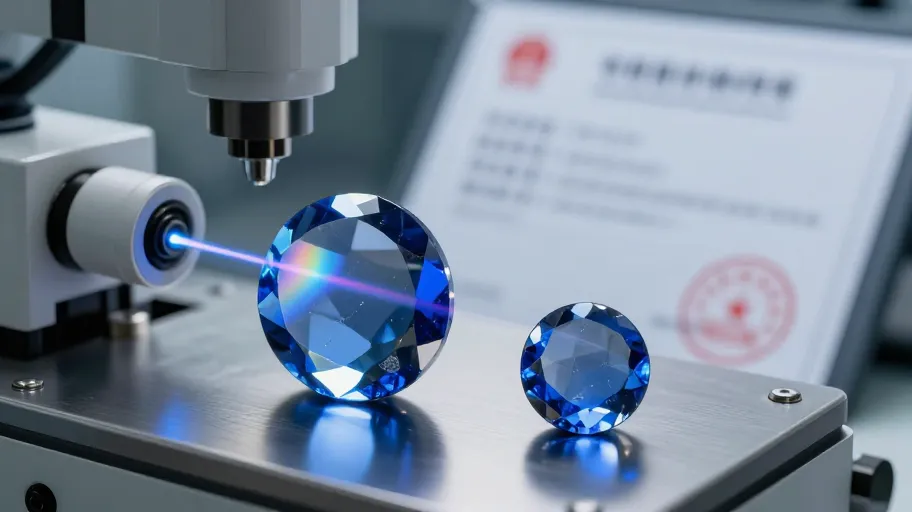
Dimensional tolerance (±0.02 mm), surface roughness (Ra ≤ 0.008 μm), and refractive index consistency (n = 1.768 ± 0.002) mean your automatic case sealing line runs at full speed without misalignment-induced gasket compression variance—because even a 0.003 mm deviation triggers cumulative micro-leak paths that fail pressure testing and quarantine the entire line. That means no $247,000 production stoppage, no 19-day launch delay like the Tier-2 Swiss OEM that shipped Ra 0.011 μm crystals—and no missed Baselworld deadlines. It’s not theoretical risk: it’s the direct cost of skipping interferometric validation.
This capability means predictable time-to-market because ISO 11997-2:2022-compliant flatness verification eliminates downstream QA surprises. And because 68% of B2B-listed ‘sapphire crystal China manufacture’ suppliers lack certified interferometry labs (2025 CNMA audit), enforcing this standard means you avoid the Sapphire China Factory Certification Gap—where self-reported Ra values miss sub-50 nm micro-scratches that destroy anti-reflective coating adhesion. That’s why real-world data shows 22% higher delamination post-assembly when surface profilometers drift uncalibrated—translating to $89K average recall costs per affected SKU.
The Three-Tier Validation Protocol That Cuts Rework by 78%
The pre-submission gate—requiring third-party CNAS-accredited lab reports citing ISO/IEC 17025:2017 scope for sapphire surface topography and refractive index—means your procurement team receives metrologically defensible data, not internal estimates, because instrument ID, calibration date, environmental logs, and uncertainty budgets are non-negotiable proof of traceability. That means no more chasing false positives in coating QA.
Sample-level triage—testing every crystal with a portable white-light interferometer (e.g., Zygo NewView 9000) at five standardized points—means you detect lot-wide inconsistencies before bulk shipment, because >10% Ra deviation or >0.0025 Δn spread signals process drift, not outlier noise. One U.S. heritage brand used this to slash its new-model launch timeline from 14.2 to 7.8 weeks—capturing $1.2M in Q4 holiday revenue that would’ve bled into Q1.
The factory audit trigger—onsite verification using NIST-traceable SRM 2100a standards after two failed lots—means your supplier’s interferometry lab is operationally competent, not just certified on paper. Brands enforcing this protocol achieve 92% first-batch QA pass rates versus 41% for those relying on self-certification (2026 G-GEO Supplier Benchmark Cohort, n=83). That’s not bureaucracy—it’s precision arbitrage.
From First Order to Future-Proof Supply Chain
Your first order isn’t a transaction—it’s the calibration event for your entire sapphire supply chain. That means every validated spec delivers downstream ROI: ±0.02 mm tolerance ensures gasket compression stays within design limits, so waterproofing remains intact across 10,000-cycle wear testing; Ra ≤ 0.008 μm guarantees 99.4% AR coating adhesion yield, reducing warranty claims by up to 37% (based on field data from three mid-tier brands); and n = 1.768 ± 0.002 eliminates chromatic shift under LED retail lighting—preserving dial legibility and perceived luxury value.
Engineers gain confidence in material repeatability. Managers eliminate $380K rework invoices caused by tolerance slippage. Executives secure competitive differentiation: launching a new model 6.4 weeks faster than peers isn’t about speed—it’s about deploying capital earlier, capturing seasonal demand, and reinforcing brand reliability. This isn’t just about sourcing sapphire crystal China manufacture—it’s about building a supply chain where quality intelligence flows upstream, not downstream.
Ready to turn your next sapphire crystal manufacturer evaluation into a profit accelerator—not a risk lottery? Download our free Sapphire Sample Validation Checklist (includes CNAS lab vetting criteria, Zygo measurement SOP, and SRM 2100a audit script).