
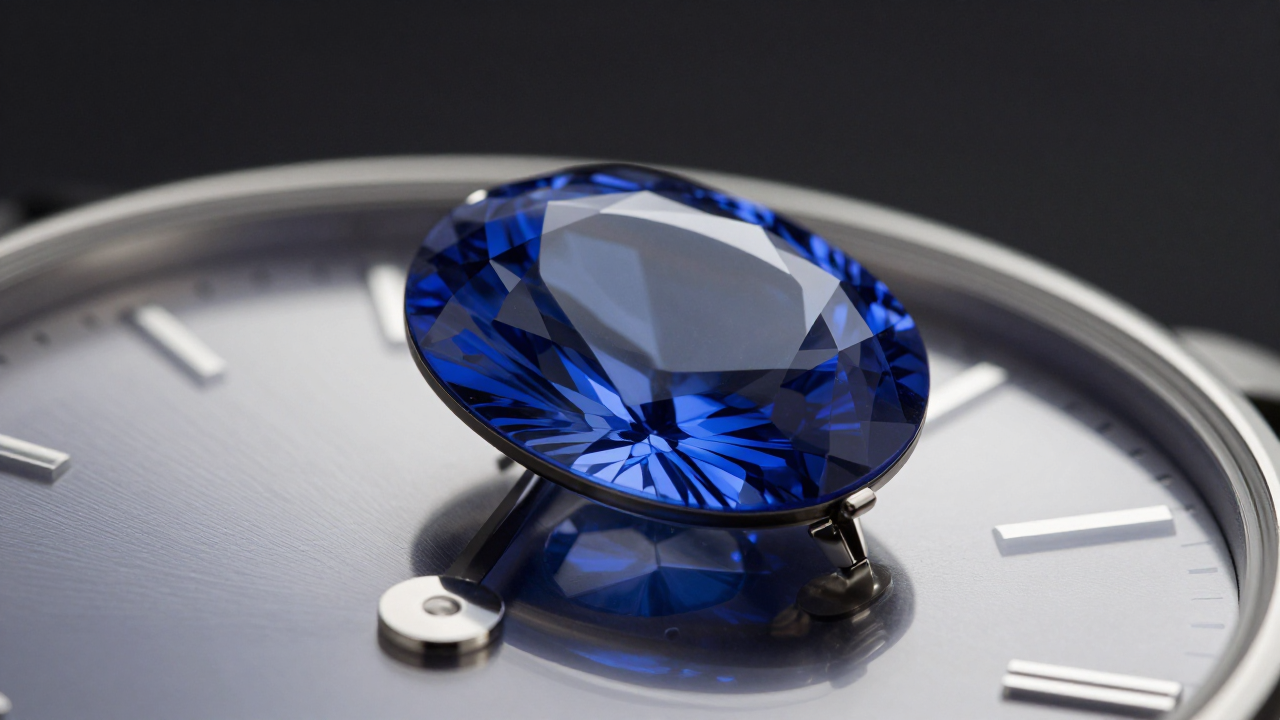
The biggest change this year is that synthetic sapphire stopped being a flagship-only spec. Volume orders for sapphire watch crystal now land from $400–$900 watches, not just five-figure references.…
Buyers moved the crystal out of the "nice to have" column and into the base bill of materials.
What Changed in 2026
Two of the three shifts below already happened and are now priced into quotes. The third is a forecast, and we'll give you the checkpoints to grade us on it later.
---
Synthetic Sapphire Moved Down-Market Fast
Synthetic sapphire now occupies the $400–$900 retail band that mineral glass owned through 2023, and the supply base that makes this possible is entirely Asian. The shift traces back to a single collapse: GT Advanced Technologies filed Chapter 11 on October 6, 2014, after its Mesa, Arizona sapphire plant failed to hit Apple's yield targets. That exit pushed boule capacity toward Kyocera, Monocrystal, Crystalwise and Hansol Technics, and the resulting oversupply never fully corrected.
What that means at the quoting stage: a 1.2 mm flat sapphire disc in 10,000-piece quantities now runs $4.20–$6.80 FOB Shenzhen. A 1.5 mm double-domed lens with anti-reflective coating on both faces runs $7.50–$11.00. In 2019 those same parts quoted 40–60% higher.
Hardness numbers get quoted constantly. Vickers hardness for synthetic sapphire sits at 1,800–2,200 HV against 550–650 HV for mineral glass. Mohs 9 versus Mohs 5.5. Useful, but buyers overweight it. A customer in August 2024 asked us to spec sapphire for a $189 field watch because "it scratches less." We talked them out of it — at that retail price, the crystal would have eaten 6% of landed cost to solve a problem the customer's return rate didn't show. They shipped glass-ceramic instead and the return rate held at 1.1%.
---
Is Sapphire Watch Crystal Still Worth the Premium?
Yes above roughly $350 retail, no below $150, and in between it depends almost entirely on case thickness and whether the watch has a rotating bezel. That's the honest decision rule, and it hasn't changed as much as the price has.
Three variables decide it. The first is crystal thickness — a 1.0 mm sapphire flat will chip at the edge long before it scratches, so a thin crystal buys you nothing over glass-ceramic. The second is case geometry: a domed crystal with a raised bezel survives drops far better than a flush flat one, because the bezel takes the impact. The third is service economics. Sapphire replacement on a Swiss movement runs $180–$400 at a US service center; on a Japanese quartz it's $60–$120. On a $200 watch, that second number is a write-off, and buyers know it.
Our own numbers, for what they're worth: in March 2025 we ran 4,800 double-domed 1.5 mm lenses for a Shenzhen smartwatch program and the edge-chip reject rate sat at 6.2%. We assumed it was laser cutting. It wasn't — it was 400-grit rough grinding leaving subsurface damage that only showed up after lapping. We moved to 800-grit and dropped coolant temperature 4°C. Rejects fell to 1.4% inside two weeks. Anyone quoting you a sub-2% chip rate on domed sapphire should be able to explain their grit sequence without looking it up.
---
Sustainability Now Shows Up on the Scorecard
Sustainability moved from a marketing slide to a scored line item in supplier audits during 2025, and energy per usable kilogram is the number buyers actually ask for. Sapphire growth is brutally power-hungry — the supplier energy disclosures we collected through 2025 cluster at 90–150 kWh per kilogram of usable crystal, depending on whether the grower runs Kyropoulos or edge-defined film-fed growth.
The geography matters more than the method. When European electricity prices spiked in 2022, two mid-size boule growers in Germany and Poland cut watch-grade output and never restarted at prior volumes. Capacity moved to China, Korea and Taiwan, where grid pricing was more stable. Buyers who signed multi-year crystal agreements in 2022 and 2023 are now locked into pricing that looks expensive against 2026 spot.
What a real audit looks like: one US brand we supply asked in January 2025 for kWh-per-kilogram, scrap-reclaim rate and the destination of our polishing slurry. We answered all three. The reclaim number was the one that moved the needle — we recover roughly 30% of cut sapphire as abrasive-grade material, which is not glamorous but keeps it out of a landfill.
Where we fall short, plainly: we don't yet have third-party verification of our energy figures. A signed internal statement is what most buyers accept in 2026. That will stop being enough, and we know it.
---
The Coating Stack Is Where the Differentiation Went
The sapphire substrate is close to a commodity now; the coating stack on top of it is where specs actually diverge, and buyers who compare only substrate miss the part that drives their returns. Bare sapphire reflects about 8% of light per surface. A good dual-side anti-reflective stack takes that under 0.5%, which is the difference a customer sees immediately in a showroom and can't articulate.
Read coating specs like a buyer, not a shopper. Ask for the reflectance curve across 400–700 nm, not a single headline number at 550 nm. Ask about the adhesion test method — tape pull, or the 121°C autoclave cycle. We learned that one the hard way. In 2021 we shipped 3,000 AR-coated sapphires to a German brand and the coating delaminated after roughly 200 hours of autoclave exposure. Root cause was a 12-minute gap between plasma cleaning and deposition on a Friday night shift. Nobody caught it because the tape-pull test passed. Autoclave didn't.
Oleophobic top coats now hold contact angles above 110° for 8,000–12,000 abrasion cycles on the better stacks; the cheap ones fall under 90° in 2,000. Laser-etched chamfers and sub-surface markers are the other quiet change — brands want the crystal to carry an authenticity mark that a counterfeiter can't print.
On the smart-feature side, sapphire is increasingly an optical window rather than a shield. Photodiode and SpO2 sensor ports under a sapphire window need 88%+ transmission in the 500–600 nm band with no coating on the inner face. That's a different part than a cosmetic crystal, and most watch crystal suppliers can't hold that tolerance across a production run.
---
Why We Think Sapphire Loses the Smartwatch
Our call: sapphire's share of smartwatch front crystals will fall, not rise, through 2027 — and the mainstream read that sapphire keeps gaining is wrong for this category. Scratch resistance is a 3-to-5-year problem. Smartwatches get replaced in 24–30 months. Drop survival is the failure mode users actually complain about.
The evidence is already on shelves. Corning launched Gorilla Glass Armor in January 2024 on the Galaxy S24 Ultra, a glass-ceramic that cuts reflectivity roughly 75% versus standard cover glass and holds up better in drop tests than sapphire of equivalent thickness. That's a phone, not a watch, but the material logic transfers directly: sapphire is hard and brittle, glass-ceramic is softer and tougher, and a wrist device hits concrete more often than it hits a scouring pad.
Here's how to grade us. Watch the 2027 teardowns of the top five smartwatch flagships. If three or more ship glass-ceramic rather than sapphire on base models, we called it right. If sapphire holds three of five, we were wrong, and we'll say so.
Where sapphire keeps winning without argument: mechanical watches above $350, anything marketed on longevity, and dive or field references where the crystal is the headline spec. Casio's 2026 G-Shock releases with blue sapphire accents make the point sideways — the sapphire there is bezel decoration, while the glass is still mineral. That's a brand pricing the word "sapphire," not the material's scratch performance. Buyers should read those press releases carefully.
---
Procurement Playbook for the Next 3, 6, and 12 Months
Re-quote everything now, because 2026 pricing is soft and won't stay soft. That's the short version.
Next 3 months. Pull your current crystal BOM and re-quote at 5,000 and 20,000 pieces with at least three suppliers across Shenzhen, Taipei and Seoul. Specify grit sequence, coating reflectance curve and adhesion test method in the RFQ, not the purchase order. If a supplier can't answer the grit question, you've found your risk. Lock 2026 volume at fixed price where you can. Jadezone Optical has been running sapphire out of Shenzhen since 2010 and we're quoting aggressively right now — but so is everyone, so make them compete.Five things in a supplier response that should make you walk:
---
Frequently Asked Questions
What is a sapphire watch crystal made of?
A sapphire watch crystal is made of synthetic corundum, grown from high-purity aluminum oxide at around 2,000°C and then cut, ground and polished. It shares the same crystal structure as natural sapphire but contains no gem-grade impurities. Hardness reaches Mohs 9, second only to diamond.
How much does a sapphire watch crystal cost?
At 10,000-piece volumes, flat sapphire discs run $4.20–$6.80 FOB Asia, and double-domed lenses with dual-side anti-reflective coating run $7.50–$11.00. Retail replacement at a US service center runs $180–$400 on Swiss movements and $60–$120 on Japanese quartz.
How do I tell whether a watch crystal is real sapphire?
Tap it with a coin — sapphire gives a sharp, high-pitched click; glass sounds duller. Better, use a thermal conductivity tester, since sapphire conducts heat roughly 20 times faster than glass. Printed "sapphire" text means nothing. Ask for the supplier's material certificate and Vickers reading.
Why do some watches still use mineral glass instead of sapphire?
Mineral glass costs roughly one-tenth as much and survives drops better because it is softer and less brittle. Below about $150 retail, sapphire's scratch advantage cannot justify its cost or its service price, so brands ship mineral glass or glass-ceramic instead.