
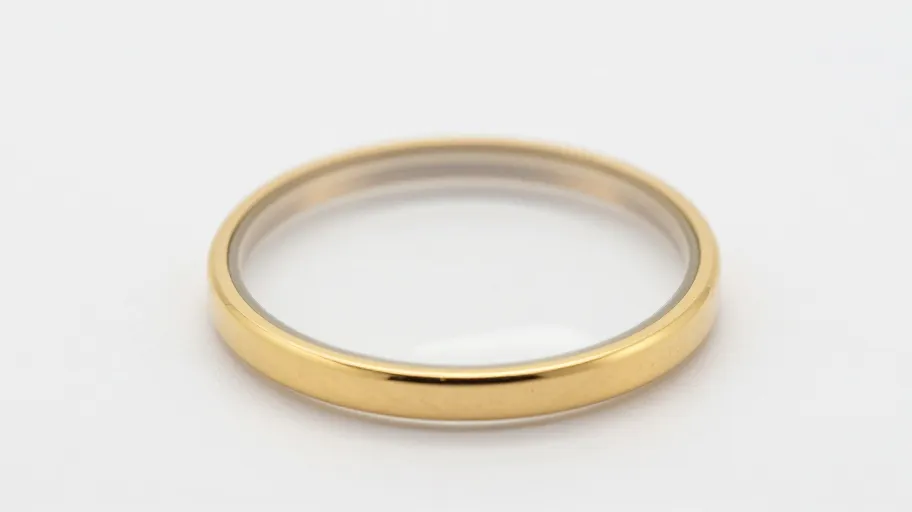
Selecting a gold sapphire watch crystal manufacturer for a private-label project is less about comparing quotations and more about controlling five variables: base material quality, gold colour definition, engineering ownership, process documentation and commercial terms. This article gives you a five-gate evaluation framework, the exact approval questions to ask, and a verification checklist you can apply to any shortlisted supplier before you commit.
Why gold-tone crystals need a stricter evaluation than clear crystals
A clear sapphire crystal hides fewer decisions. Once the shape and coating are agreed, the visual risk is comparatively low. A gold-tone crystal adds a colour layer that touches brand identity directly: it must sit beside your case metal, your indices and your dial furniture, and it must stay consistent from the approved sample through to every subsequent production run.
That consistency is only achievable if the colour is defined as a specification — a physical master standard, a documented measurement method and an agreed acceptance window — rather than as a photograph in an email. When you evaluate a gold sapphire watch crystal manufacturer, your central question is therefore not "can you make it gold?" but "how do you define, reproduce and verify the gold tone we approve?" Every gate below is built around that discipline.
The 5-Gate Crystal Sourcing Framework
Use these gates in order. A supplier that cannot pass an early gate rarely recovers at a later one, so score each gate independently before moving on.
| Gate | What you are evaluating | Key questions to ask | Red flags to watch for |
|---|---|---|---|
| 1. Material | Genuine sapphire vs alternative substrates; material documentation | Will you state the material in writing on the quotation and confirm what material documentation accompanies each batch? | Vague material descriptions; reluctance to put material identity in writing |
| 2. Coating & colour | How the gold tone and any anti-reflective coating are defined, applied and verified | How is the gold tone specified — physical master, measurement method, or visual approval only? What verification do you propose for coating adhesion and appearance before shipment? | Colour defined only by photos; no proposed method for verifying coating or tone |
| 3. Engineering & drawing | Who owns the drawing, how tolerances and edge work are specified | Will you review our drawing and return a marked-up version with your own tolerance and edge-work notes? Who owns the released drawing revision? | No drawing feedback offered; tolerance and fit details left entirely to the buyer |
| 4. Process control | Documentation, change control and communication during development | What documentation trail do you maintain from approved sample to production? How are changes to colour, coating or drawing communicated and re-approved? | Approvals handled verbally; no named engineering contact |
| 5. Commercial terms | Minimum order quantity, sample policy, tooling, lead time, payment and replacement terms | Please confirm in writing your current MOQ, sample policy including any fees and shipping responsibility, tooling ownership, lead time for our configuration, and how non-conforming units are handled | Terms that exist only in conversation; refusal to confirm any item in writing |
Score each gate as pass, conditional or fail, and record the supplier's written answer next to each question. That record becomes your comparison document — and, later, part of your supplier agreement.
Approval questions to put in writing before you commit
- Colour master: Will you produce a physical gold-tone master for our sign-off before any production, and will both parties hold a retained reference sample?
- Coating specification: Please describe your proposed anti-reflective coating configuration (inner, outer, both, or none) for this design and the verification method you apply to it.
- Drawing revision control: Which drawing revision number governs the order, and what is your procedure when a revision changes?
- Batch consistency: What method do you use to compare production batches against the approved master, and what documentation accompanies that comparison?
- Change notification: If any material, coating or process input changes, will you notify and seek re-approval before shipment?
- Non-conformance handling: How are units outside the agreed acceptance criteria identified, documented and resolved?
None of these questions presumes a particular answer — the point is to see how specifically and consistently each supplier can respond. A capable gold sapphire watch crystal manufacturer will answer with named methods, named documents and a named contact. A weak one will answer with reassurance.
Supplier verification checklist
Run this checklist for every shortlisted supplier and keep the completed sheet with your project file:
- Material identity confirmed in writing on the quotation
- Gold-tone definition method confirmed (master standard, measurement or stated approval process) — clarify which, and agree it before sampling
- Physical colour master produced and signed off by both parties
- Anti-reflective coating configuration agreed in writing with a stated verification method
- Drawing reviewed and marked up by the supplier; released revision number recorded
- Documentation trail from approved sample to production described by the supplier
- Named engineering contact and escalation contact provided
- MOQ, sample policy (including fees and shipping responsibility — confirm the current policy directly), tooling ownership and lead time confirmed in writing for this configuration
- Non-conformance and replacement handling described in writing
- All verbal commitments transferred into the written quotation before order placement
If any line cannot be completed, treat that as an open risk in your project plan rather than an assumption.
FAQ
How do I keep the gold tone consistent between the sample and later production runs? Insist on a physical colour master signed off by both parties, a retained reference sample, and a documented comparison method for each production batch. Ask the supplier to describe their comparison method before you approve the sample, not after.
Should I specify the anti-reflective coating before or after sampling? Before. Ask each shortlisted supplier to propose a coating configuration for your design — inner, outer, both, or none — together with the verification method they apply to it. Comparing written coating proposals is far more reliable than comparing finished samples with unknown coatings.
What engineering information should I provide to get an accurate response? Provide a dimensioned drawing of the crystal seat, the edge profile, the crystal shape, your target gold tone reference and the coating configuration. Ask the supplier to return a marked-up drawing with their own tolerance and edge-work notes; how they respond tells you a great deal about their engineering depth.
What terms should be fixed in writing before I place a private-label order? At minimum: material identity, MOQ, sample policy including any fees and who covers shipping (confirm the current policy directly with each supplier), tooling ownership, lead time for your specific configuration, drawing revision control, and the handling of non-conforming units.
How should I compare two suppliers that both look capable? Score both against the five gates using identical questions, record their written answers side by side, and weight the colour and coating gates most heavily for a gold-tone project. The supplier with the more specific, more documentable answers — not the faster reply — is the lower-risk choice.
Download the Supplier Scorecard
Put this framework to work: download the Supplier Scorecard and score each gold sapphire watch crystal manufacturer on your shortlist against the five gates, with the approval questions and checklist built in. [Download the Supplier Scorecard]
Before your next supplier call
Short on time? Print the verification checklist above, send it to your top two suppliers, and use their written responses to set the agenda for your first call. The supplier that engages with the checklist — rather than around it — has already told you something useful.