
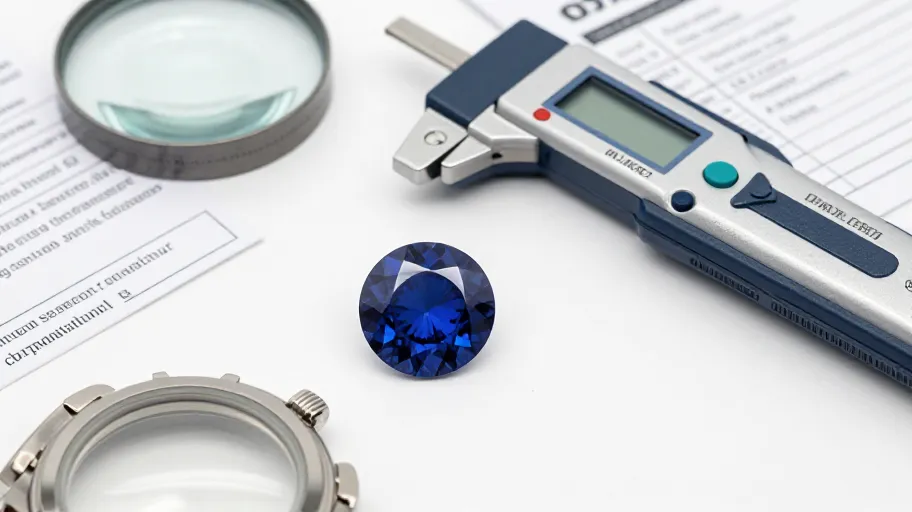
Verifying that a watch crystal is genuine sapphire is not a single quick test — it is a documented sequence of specification, inspection and testing agreed between buyer and supplier before any production order is placed. This guide walks sourcing managers and product developers through a practical S.I.T. Framework (Spec — Inspect — Test) so that "how to tell if watch crystal is sapphire" becomes a repeatable approval step in your sourcing file rather than a judgement call made from a photograph.
Why verification belongs in your sourcing file, not in your head
In consumer content, the question "is my crystal sapphire?" is answered with folk methods — a water-drop test, a scratch attempt, a fingerprint comparison. For a B2B buyer, none of that is sufficient. You are approving a supplier for a production run where every unit must match a drawing, so the question shifts: what evidence do I need, and who produces it, before I approve?
That reframing protects you in three ways. First, it prevents a single impressive sample from standing in for an entire run. Second, it gives your supplier a clear, written definition of acceptance, which reduces disputes later. Third, it creates a record your own QC team can execute without depending on the supplier's self-assessment.
The S.I.T. Framework: Spec — Inspect — Test
Spec. Before anything is made or shipped, define in writing what you are buying: crystal shape and dimensions as a drawing, edge finishing, coating requirements, marking or logo requirements, and the acceptance criteria you will use. A specification that exists only as an email thread is not a specification. This is the stage where unknowns — the supplier's minimum order quantity, sample conditions, tooling requirements and scheduling — should be converted into explicit questions (see the question list below). Do not assume any of these; confirm each directly with the supplier.
Inspect. When samples arrive, inspect them against the spec before any functional testing. This includes visual review under magnification, dimensional comparison against your drawing, and checking that any requested documentation accompanies the parts. If documentation such as material declarations is important to your programme, request it in the Spec stage — never after the parts arrive.
Test. Agree with the supplier which verification methods will be used, who performs them, and what evidence will be issued. Some tests are simple enough to run in-house; others require equipment that only a lab or the supplier holds. The decision table below helps you choose.
Decision table: verification methods and what they actually prove
| Method | What it can support | What it cannot prove on its own | Best used by |
|---|---|---|---|
| Thermal-conductivity feel (diamond tester or heat-dissipation check) | Sapphire conducts heat far better than mineral or acrylic glass, so a dissipation test can support an identification judgement | Not a formal material certification; result depends on instrument and technique | Buyer QC as a first-line check |
| Scratch resistance check | Sapphire is far harder than mineral glass, so surface behaviour differs | A single scratch trial can damage a sample and proves nothing about the rest of the run | Only on sacrificial samples, with supplier agreement |
| Density / weight comparison against drawing | A consistency check across a batch | Cannot distinguish coatings or identify subtle substitutions | Buyer QC as a batch consistency check |
| Optical inspection under magnification | Coating presence, edge quality, inclusions or flaws | Material identity | Both parties, at incoming inspection |
| Supplier-issued material declaration or test report for the supplied batch | Documented evidence tied to a specific lot | Only as strong as the issuing party and the agreed scope — request and review the scope before relying on it | Sourcing manager as part of the approval file |
| Independent third-party laboratory testing | Independent evidence, where the parties agree to it and define scope | Adds cost and time; scope must be defined in advance | Higher-risk or higher-value programmes, by mutual agreement |
Two cautions. First, no single method above is sufficient alone; combine at least one physical check with documented evidence. Second, all of these checks tell you about the parts you tested. Extending that result to a production run requires a sampling plan agreed with the supplier — which is exactly the kind of condition you should confirm directly rather than assume.
Turning unknowns into concrete approval questions
Because every supplier's conditions differ, the most useful thing this guide can give you is the question list. Put these to JadeZone Sapphire — or any supplier — before approving samples, and record the answers in your sourcing file:
On specification
- Can the supplier work from your drawing, and what drawing information do they need (dimensions, radii, edge treatment, coating spec, markings)?
- How will dimensional conformity to the drawing be checked, and by whom?
- What material documentation can be issued for the supplied parts, and what exactly does it cover?
On samples
- What is the current sample policy — quantity, conditions and any applicable arrangements? Confirm directly; do not rely on assumptions or second-hand accounts.
- Who bears sample and shipping costs under the current policy? Ask rather than assume.
- Can the sample you receive be accompanied by the same documentation you would require at production?
On testing and approval
- Which verification methods is the supplier willing to support, and at which stage?
- Will the supplier support third-party testing if your programme requires it, and how would that be arranged?
- What is the agreed sampling plan linking approved samples to production output?
On production
- What are the current MOQ and lead-time conditions for your specific project? These depend on the drawing, so ask per project.
- How are non-conforming parts handled under the supplier's current quality process?
Note what this list deliberately does not do: it does not state any of these conditions for you. Policies on samples, MOQ, scheduling and documentation are supplier-specific and changeable; the only reliable source is the supplier's current confirmation in writing.
Sample-approval checklist
Use this checklist before signing off on any sapphire crystal supplier for a run:
- Written specification exists: drawing, edge finishing, coating requirement, markings.
- Acceptance criteria agreed and recorded, including who inspects and at which stage.
- Sample received matches the drawing dimensionally — checked, not assumed.
- At least one physical identification check performed on a sacrificial or agreed sample.
- Material documentation requested, received, and its scope reviewed.
- Verification methods for production agreed in writing.
- Sampling plan linking samples to production agreed in writing.
- Current MOQ, lead time and sample conditions confirmed directly with the supplier and recorded.
- Handling process for non-conforming parts understood and documented.
- Approval decision and evidence filed where your QC team can find it.
A file with all ten boxes ticked is worth more than any verbal assurance. It is also the artefact that makes future reorders faster, because the acceptance definition already exists.
FAQ
1. Can I tell sapphire from mineral glass without equipment? Physical differences exist — thermal dissipation, hardness — but they are unreliable without instruments and can damage parts. For sourcing decisions, treat informal tests as supporting evidence only, and rely on agreed inspection plus documentation.
2. Is a diamond tester reliable for sapphire crystals? Sapphire's thermal conductivity is much higher than mineral glass or acrylic, so a thermal-conductivity instrument can support an identification judgement. But the result depends on the instrument and technique, and it is not a material certification. Pair it with documentation from the supplier.
3. What documentation should I ask a supplier to provide with samples? Ask what material documentation the supplier can issue and what scope it covers — then review that scope before relying on it. If your programme needs independent verification, raise third-party testing at the Spec stage so both parties agree on scope and arrangement in advance.
4. Does passing one sample mean the whole production run will match? No. A sample result applies to the parts tested. Bridging that gap requires an agreed sampling plan and inspection points between sample approval and shipment — both of which should be written into your sourcing file.
5. Who pays for samples, tests and shipping? That depends entirely on the supplier's current policy and your project. JadeZone Sapphire's current sample and shipping arrangements must be confirmed directly — ask as part of your sourcing brief request rather than assuming any arrangement.
Work with JadeZone Sapphire
JadeZone Sapphire is a B2B manufacturer of custom sapphire watch crystals and precision sapphire components, operating from Shenzhen and Hong Kong and serving watch brands, component buyers and watchmakers.
获取采购 Brief — send us your crystal drawing and requirements, and we will respond with the current conditions for your specific project: specification review, sample arrangements, verification support and production terms, all confirmed in writing so your approval file starts complete. [获取采购 Brief →]
Prefer to start smaller? Download the one-page verification checklist above — the ten-box sample-approval list — and use it in your next supplier review, whether or not the supplier is us. [Get the checklist →]