
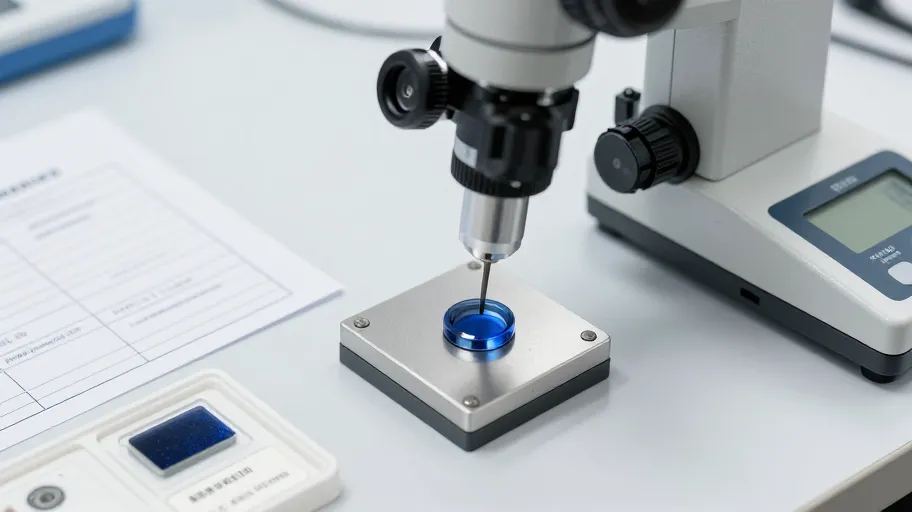
How to test for sapphire crystal? At the sourcing stage, the answer is less about a single clever trick and more about a structured process: Specify the acceptance criteria, Test the sample with methods proportionate to the risk, Document the results in writing, and Approve against that record. Call it the Four-Step Verification Framework. This guide walks through each step so that your sample approval becomes an auditable decision rather than a handshake — and ends with the approval questions you should send to any supplier, including JadeZone Sapphire, before committing to a custom or OEM crystal order.
Why verification belongs at the sourcing stage
Most verification problems in watch components are not caused by bad testing methods. They are caused by testing that happens too late, or by results that exist only as a verbal claim. If a sample is approved on the strength of "it's sapphire, trust us," then every subsequent batch inherits an unverifiable premise.
A disciplined buyer treats the first sample round as the point where evidence is created. What you test, who tests it, what result counts as a pass, and who signs off — these four decisions cost almost nothing at sample stage and are extremely expensive to retrofit after tooling or volume production begins. That is the whole rationale behind the framework below.
The Four-Step Verification Framework
Step 1 — Specify. Before any test, define in writing what you are buying: material (synthetic sapphire, i.e. single-crystal aluminium oxide), crystal shape and dimensions, edge treatment, whether an anti-reflective coating is required and on which surfaces, and any optical or cosmetic acceptance criteria you will inspect against. A test is only meaningful against a stated criterion. "Sapphire crystal" without a specification is a marketing phrase, not an acceptance condition.
Step 2 — Test. Match the method to the stage. A bench check that costs a few minutes is appropriate for a first physical sample; documented instrument-based testing is appropriate before approving a production batch. The decision table below maps methods to stages.
Step 3 — Document. A test that leaves no record cannot be enforced. Record the method, the sample identifier, the result, the date, and who performed it. If your supplier provides any test report, file it with the sample it refers to and reference that sample ID in your purchase documentation.
Step 4 — Approve. Approval should be a written statement that the sample passes your stated specification, based on the documented tests. This signed record — not the sample itself — is what you reference when subsequent batches are delivered.
Decision table: matching the test method to the sample stage
| Stage | Risk if you skip testing | Proportionate method | What it can and cannot tell you |
|---|---|---|---|
| First physical sample arrives | You cannot tell sapphire from mineral glass or from glass with a hard coating | Simple bench checks: scratch behaviour against known references, thermal contrast check, weight in hand against a comparable part | Indicative only. Bench checks can screen out obvious mismatches but cannot prove material identity |
| Shortlisting suppliers | Competing claims are hard to compare | Ask each supplier to state, in writing, the material specification for the quoted part and whether any material test report can be supplied for your project | Shows how each supplier documents claims; it does not itself verify the material |
| Pre-production approval | A wrong material is locked into tooling | Require documented verification appropriate to your project — for example a material test report for the sample lot, referenced to a sample ID you hold | Gives you an enforceable record; confirm with the supplier what documentation they can provide and what it covers |
| Incoming batch inspection | Subsequent batches may differ from the approved sample | Agree an inspection plan: how samples are drawn, what is checked, and what documentation accompanies each batch | Prevents drift between approved sample and delivered batches; the plan itself must be agreed with the supplier |
Note the honest limits: no bench test in this table is a substitute for documented material verification. They are screening tools that make you a more credible counterpart when you ask a supplier for formal evidence.
Practical bench checks and their limits
Buyers without lab access can still do useful screening work. Each check below has a real value and a real limit; treat them as filters, not proof.
Scratch comparison against a known reference. Sapphire is a very hard material, so it resists scratching from steel implements far better than mineral glass. Scratching an inconspicuous area of the sample with a steel tool and comparing behaviour against a known mineral-glass reference can screen out soft materials. Limit: a hard-coated glass can also resist a light scratch test, and aggressive testing may damage a sample you need to return or archive. Apply lightly, and never on the optical centre of a crystal you intend to keep.
Thermal contrast check. Sapphire conducts heat noticeably, so touching the crystal to warm skin or a warm surface produces a distinctive, fast-warming sensation compared with glass. Limit: subjective, depends on ambient conditions, and unreliable on small or thick parts. Use it as a cross-check, never as the sole basis for approval.
Coating inspection. If your specification requires an anti-reflective coating, verify which surfaces carry it and how it appears under light — residual reflection colour and edge behaviour are visible under a lamp and loupe. Limit: this confirms coating presence and appearance against your visual criterion; it does not quantify coating performance. If performance figures matter to your product, ask the supplier what test evidence they can provide for the coating on your parts, and confirm the current policy directly with them.
Visual and dimensional inspection against drawing. Compare the sample to your technical drawing: shape, edge profile, and seat geometry. Limit: confirms conformance to drawing, not material identity — which is precisely why material verification and dimensional inspection are separate line items in a good approval record.
When to require documented testing
Bench checks are proportionate for a first sample. Before production approval, escalate. The appropriate level of documentation is project-specific, so rather than asserting what any supplier provides, here is what to ask for and to confirm:
- Whether the supplier can provide a material test report or certificate for the specific sample lot you will approve, and what that document states.
- Whether the documentation can be referenced to a sample ID that you retain, so the report and the physical sample are linked.
- What the supplier's own incoming or outgoing quality checks cover for your part type, and what evidence of those checks accompanies deliveries.
- Whether batch-level documentation is included in the order terms, and under what conditions it is provided.
JadeZone Sapphire, as a custom sapphire watch crystal and precision sapphire component manufacturer operating from Shenzhen and Hong Kong, can discuss what documentation it can support for your project. Confirm the current scope, format and terms of any documentation directly with the supplier — do not assume it from this article.
Concrete approval questions to put in writing
Use these as the written backbone of your sample approval. Send them before the sample round, so the answers become part of the specification.
- What is the stated material specification for the quoted crystal, and can it be supplied in writing?
- Which test methods will be used to verify the material for this project, and what report will I receive?
- Can the test report be linked to a sample ID that I keep in my own records?
- If an anti-reflective coating is specified, on which surfaces, and what evidence can be supplied for the coating on my parts?
- What does the pre-production approval package for this project contain, document by document?
- How will batch conformance to the approved sample be checked and recorded on subsequent deliveries?
- Who on each side signs the approval, and what happens if a later batch is found non-conforming against the documented record?
Question seven is the one buyers forget. An approval process without a defined non-conformance path is only half a process.
FAQ
Does the scratch test prove a crystal is sapphire? No. A scratch check is a screening tool: it can suggest that a material is very hard, and it can rule out obviously soft glass. It cannot distinguish sapphire from other hard materials or from hard-coated glass. Treat a positive scratch result as a reason to request documented verification, not as the verification itself.
What should a written sample approval contain? At minimum: the specification it was approved against, the test methods used, the results, the sample identifier, the date, and the signatory on each side. If any supplier documentation exists, reference it by document number or lot. The approval record should be detailed enough that a colleague could audit it without you in the room.
How do I verify an anti-reflective coating on a sample? Start with visual inspection against your stated criterion: which surfaces show the coating, how residual reflections appear under controlled light, and edge behaviour under magnification. If your product needs quantified optical performance, ask the supplier directly what test evidence they can provide for coating performance on parts like yours, and confirm what is included for your project.
Should I rely on the supplier's own quality inspection, or test independently? The two are complementary, not alternatives. Ask the supplier to describe their quality inspection for your part type and to state in writing what documentation accompanies it. Then decide, based on your own risk tolerance and product tier, whether additional verification on your side is warranted for pre-production and incoming batches. What you require should be written into the order terms, not assumed.
What happens if a later batch differs from the approved sample? That depends on the terms you agreed, which is why Step 4 matters. If your approval record defines conformance criteria and a non-conformance path, you have a basis for discussion. If it does not, resolution becomes a negotiation with no fixed reference. Define the path before approval, not after a problem.
Ready to structure your approval process?
JadeZone Sapphire manufactures custom sapphire watch crystals and precision sapphire components for watch brands and component buyers, with operations in Shenzhen and Hong Kong. 获取采购 Brief: send us your crystal specification and project requirements, and we will respond with how we can support your specification, sampling and documentation process — including the current terms you should confirm before approving any sample.
Before your next supplier call, run this checklist:
- Written material specification for the quoted part
- Test method and documentation scope agreed in advance
- Sample ID system so reports link to retained samples
- Coating requirement defined per surface, if applicable
- Batch conformance and non-conformance path defined
- Named signatories on both sides of the approval record