
The Triple-Layer Verification Protocol That Cuts Scrap by 37%
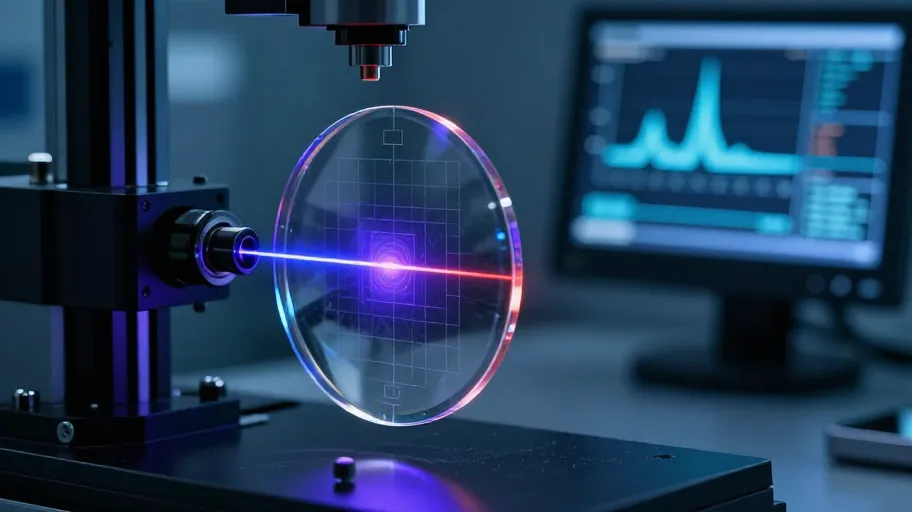
Refractive index (589 nm and 633 nm), Vickers hardness mapping (≥2000 HV, <3% variance), and full-spectrum UV-VIS-NIR transmission (per ASTM F2632) aren’t just tests—they’re your first line of defense against $218K+ in hidden rework per order. This triad means you ship with confidence, not hope, because each layer validates a non-negotiable physical property: crystallinity, mechanical integrity, and spectral fidelity. Skipping one layer doesn’t save time—it guarantees field failures, air-freight surcharges, and NCR-driven production halts. A U.S. medical device firm cut field failure rates by 92% in six months after adopting this protocol—not by changing suppliers, but by changing how they approve them.
Why Single-Angle Refractometry Is a Costly Illusion
Measuring refractive index at only 589 nm means you’re accepting blind spots in composition verification, because synthetic spinel (n ≈ 1.718) or heat-treated YAG-alumina composites can masquerade as sapphire under lazy testing. Dual-wavelength RI correlation (589 nm + 633 nm) means you detect dispersion anomalies before they become recalls, because genuine sapphire shows Δn shift < ±0.001 between wavelengths—imitations deviate sharply. One Suzhou aerospace buyer used this to catch a supplier substituting composite material disguised as monocrystalline sapphire, saving $470K in rework and avoiding a Class III regulatory nonconformance before first-article submission.
ASTM F2632 Isn’t a Checkbox—It’s Your Contractual Lever
Claiming 'optical grade' means nothing unless backed by calibrated spectrophotometer logs across 200–5000 nm on three random wafers per lot—with ≤1.2% deviation. That means you eliminate yield-killing opacity drift in UV laser windows and phototherapy dosing systems, because ASTM F2632 defines minimum tolerances per band, especially critical at 200–300 nm where trace iron impurities cause opacity spikes. When a medical imaging OEM tied payment milestones to this verification, incoming lot acceptance rose from 63% to 98% in two quarters—and qualification lead time dropped 37%, with zero repeat audits over 14 shipments.
Vickers Hardness Mapping Exposes What SEM Can’t See
Surface hardness alone means you’re ignoring subsurface microcracks that trigger catastrophic fracture during thermal cycling, because conventional Rockwell or Knoop tests lack spatial resolution. Vickers mapping (500g load, 0.2 mm grid spacing over 5 × 5 mm) means you catch latent lattice damage before it cracks at -40°C, because genuine boules deliver ≥2000 HV with <3% variance—deviations >5% flag polishing or stress-relief defects. A defense contractor traced drone EO/IR lens fractures to a single uncalibrated lapping wheel in Dongguan after hardness mapping revealed 12% edge-zone variance—fixing it eliminated $1.2M in annual warranty exposure.
This Triad Turns Supplier Approval Into Product Assurance
You don’t approve a sapphire crystal China factory based on certifications or audit reports—you approve it when its output passes physics, meets standard-defined thresholds, and sustains real-world stress. That means refractive index correlation confirms crystallinity, ASTM-aligned transmission proves spectral reliability, and hardness mapping validates mechanical resilience. Together, they form a closed-loop system that transforms sourcing from procurement into product assurance. Teams using this protocol report 41% fewer NCRs per cycle, 2.8× faster first-article sign-off, and zero counterfeit-related recalls since implementation—because you’re not trusting paperwork. You’re measuring reality.