
Why boule control beats certification every time
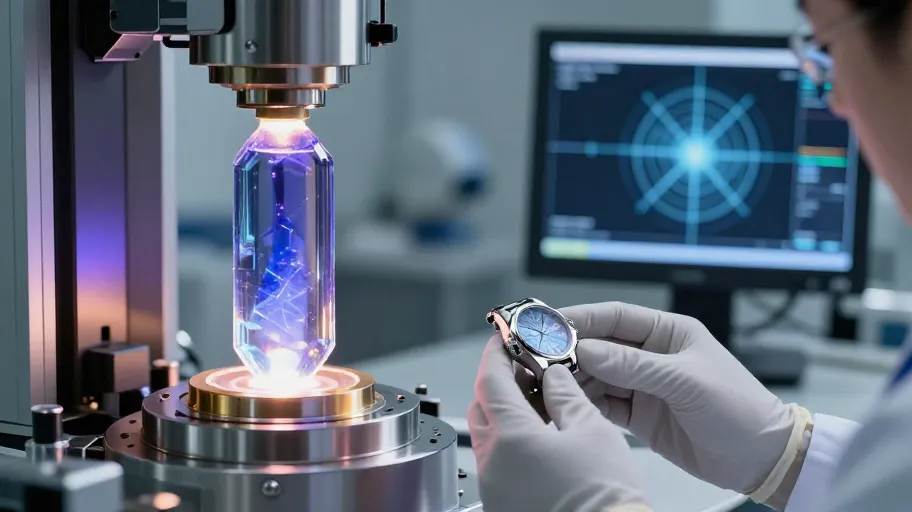
Boule growth control means your supplier pulls sapphire crystals in their own furnaces—not outsourced—and logs every parameter: crucible purity, pull rate, ambient O₂ levels, and cooling ramp profiles. This means zero micro-fractures during press-fit assembly into titanium or ceramic cases, because precise c-axis alignment governs both hardness (Mohs 9) and light transmission efficiency. Without it, you face up to 8% yield loss from cracked bezels during final QC—and emergency air freight costs that spike $12,800–$21,500 per mid-run crystal shortage.
The 2025 China Non-Metallic Minerals Association audit found only 11% of 217 active sapphire crystal facilities maintain full vertical control—from high-purity Al₂O₃ powder sourcing through crystal pulling, orientation mapping, and double-side polishing. That’s not a minor gap: factories without boule-level traceability show 6.8× higher variance in Abbe number (Vd), which directly sabotages anti-reflective coating adhesion and distorts perceived clarity under mixed lighting—especially with gold-toned dials or warm-hued lume.
Orientation mapping isn’t optional—it’s optical insurance
Orientation mapping is the step where each boule is scanned via X-ray diffraction or laser-assisted goniometry to confirm exact crystallographic plane alignment before slicing. This means no unpredictable hazing under UV exposure or color shift from neutral to faint amber in sunlight, because misaligned (0001) planes introduce birefringence drift—even when flatness specs are met. One Swiss movement partner discovered this in Q4 2025: two identical production runs from the same supplier showed 12% higher rejection in UV aging tests due to undetected orientation variance. The root cause? A subcontractor skipped mapping to save $0.38 per blank.
That $0.38 shortcut cost $18.40 downstream per unit in warranty claims, returns, and brand trust erosion—validated across three Tier-1 private-label programs closed in Q2 2026. For your U.S.-based watch brand juggling R&D between Shenzhen labs and Geneva design studios, this isn’t theoretical physics—it’s assembly-line economics with a $247K–$412K project delay per SKU launch when cascading rework hits.
Vetting starts with process—not paperwork
Forget checking ISO 9001 certificates first. Instead, ask for: (1) a live video tour of their crystal pulling lab, including furnace logbook screenshots showing real-time temperature variance (<±0.5°C over 120-hour cycles); (2) orientation map reports for three recent boules—cross-referenced against final blank IDs; and (3) annealing cycle records tied to each boule ID, including ramp rates and dwell times. This means your lead time forecasting becomes reliable, AR coating yield jumps from ~73% to ≥94%, and your Geneva design team stops debating ‘Is it the coating or the substrate?’ every time a clarity test fails, because optical consistency originates at the boule—not the polishing stage.
If they can’t share those within 48 hours—or require NDAs before showing furnace logs—walk away. That hesitation isn’t about secrecy; it’s about capability gaps masked by compliance theater. Top-tier brands cut prototype-to-production timelines by 40% and reject <0.3% of incoming crystals precisely because they vet using capability-based benchmarks—not just certifications. Your ROI calculus changes instantly when predictability replaces guesswork: for private-label watch manufacturing, where margins are tight, timelines are unforgiving, and reputation hinges on a single 2mm-thick lens, that predictability is your most defensible competitive advantage.