
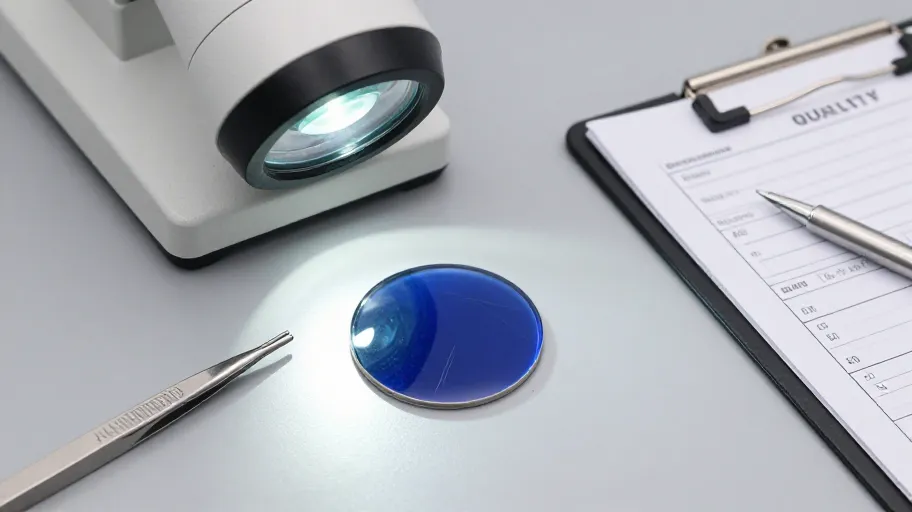
The practical answer is to treat any scratch report as evidence to be documented rather than a conclusion. Record where the part was scratched, by what contact, at what stage of the product's life, and against which acceptance criteria the part was originally approved. That record determines whether repair is even a candidate — and it is exactly the record a crystal supplier will ask you for when you raise a replacement request.
The Spec–Sample–Approval (SSA) framework
A disciplined approach to scratch decisions and replacement sourcing has three stages:
- Spec. Convert the damaged part and the original drawing into a written specification: shape, dimensions, edge treatment, coating expectations, and the optical standard the part must meet. If the original spec was never written down, this is the moment to write it.
- Sample. Ask a candidate supplier to produce a physical sample against that specification. Do not approve anything on drawings or renderings alone; the whole point of a sample is to see how edges, coatings and clarity behave in the hand and under inspection.
- Approval. Agree in advance what "acceptable" means — inspection method, lighting, magnification, defect definitions — and document the result. Approval criteria agreed after seeing a sample are not criteria; they are negotiations.
This framework applies whether the part is a single replacement for a repair job or a production run of OEM crystals.
Decision table: repair or replace?
Use this table to structure the internal conversation before you contact a supplier. Where any row is unclear, treat that as a question for the supplier or the watchmaker performing the assessment — not as an assumption.
| Situation | More likely direction | Reasoning to document |
|---|---|---|
| Scratch affects optical clarity in the visible field | Replace | Polishing may alter geometry or coatings; a replacement restores the approved spec exactly. |
| Scratch is at the edge or under a bezel, out of view | Evaluate case by case | Confirm with the watchmaker whether the result meets your optical acceptance criteria after any rework. |
| Crystal is a current production SKU | Replace with a spec'd part | You need repeatable, documented supply, not one-off correction. |
| Crystal is an out-of-production or legacy part | Evaluate both paths | A repair may be the only short-term option while a replacement specification is developed. |
| Scratch occurred in transit or assembly | Investigate handling first | A replacement that suffers the same handling will fail the same way. |
| The original specification was never documented | Replace — but spec first | Repair without a written spec makes approval subjective and repeat failures likely. |
Note that polishing or reworking a sapphire crystal is a specialist task, and the feasibility of any repair depends on the specific part and damage. No general answer in this article replaces inspection of the actual component.
Specifying a replacement crystal: what to document
When scratch repair is ruled out, the replacement request should arrive at the supplier as a specification, not a photograph. At minimum, prepare:
- Geometry and dimensions: shape, diameter or outline, thickness, and any curvature or box profile. Where you do not have numbers, say so explicitly and ask the supplier what measurement they need from you.
- Edge treatment: flat, ground, polished or coated edge, and how the crystal seats in the case.
- Coating status: whether the original part was coated, what the coating was intended to do, and what the replacement must achieve. Confirm coating expectations with the supplier directly; do not assume a like-for-like coating exists.
- Optical acceptance criteria: what you will inspect for, and how.
- Quantity and staging: one sample, a pre-production quantity, or full production — and how those stages connect.
Two policy questions must always be asked in writing, because they vary by supplier and cannot be assumed: the supplier's current sample policy (including any fees and who arranges shipping) and their current production terms for your quantity. Get the answer for your project, in your timeframe, from the supplier itself.
Sample review: approval questions to put to any supplier
Before you approve a sapphire crystal sample for production, put these questions in writing:
- Which of our specification points does this sample fully meet, and which are provisional?
- What inspection method and criteria do you propose for optical clarity, and can we agree them before production?
- If coatings are part of the spec, how will the sample's coating be compared against the production parts?
- What documentation will accompany production units so we can verify they match the approved sample?
- What is your current process if a production batch does not match the approved sample?
Suppliers differ in how they handle each of these. The value of asking is not the answer to any single question — it is that a supplier who answers all five clearly, in writing, is demonstrating the process discipline you need for repeatable supply.
Frequently asked questions
Can steel scratch a sapphire crystal? Sapphire is a very hard material, and ordinary steel contact is not the risk it is with softer cover materials. However, hardness alone does not make a crystal immune to all damage, and any scratch report should be investigated for its actual cause rather than assumed. For buyer purposes, treat the cause as a fact to document, and confirm material behaviour questions with your supplier and your own inspection.
Is it worth repairing a scratched sapphire crystal, or should we replace it?
What should we ask a supplier before requesting a sample? Ask about their current sample policy — including any fee and who arranges shipping — their production terms for your quantity, and what specification information they need from you. Policies vary by supplier and project; confirm all of them directly rather than relying on general guidance.
What if we do not have the original crystal specifications? Start from the physical part: have it measured by whoever fits your crystals — a watchmaker, an assembly partner or the supplier's engineering contact. State clearly which values are measured and which are requirements, and ask the supplier to flag any specification point that cannot be met as drawn before sampling begins.
How do we prevent the same scratches recurring? Document the failure: where it occurred, what contact caused it, and which handling or packaging stage was involved. Bring that record to the supplier conversation. A replacement crystal approved without an understanding of the failure cause is a spec, but not yet a solution.
Get the sourcing brief
If you are evaluating a scratched crystal, specifying a replacement, or preparing an OEM crystal project, the fastest next step is a structured brief. 获取采购 Brief from JadeZone Sapphire: send your part geometry, quantity intention and open questions, and our team will confirm what we can support and what the current sample and production policies are for your specific project. Every policy point discussed above — samples, fees, shipping, lead times — is confirmed per project, in writing, not assumed.
Low-friction next step: before you contact any supplier, complete this five-minute checklist:
- Photograph the damaged crystal under the lighting you use for inspection
- Record the contact event that caused the scratch, as far as it is known
- Measure (or have measured) the part's key dimensions
- Write down your optical acceptance criteria, even in simple terms
- List the questions above you most need answered in writing
Bring the completed checklist to your 采购 Brief request, and the first conversation will start from facts instead of guesses.