
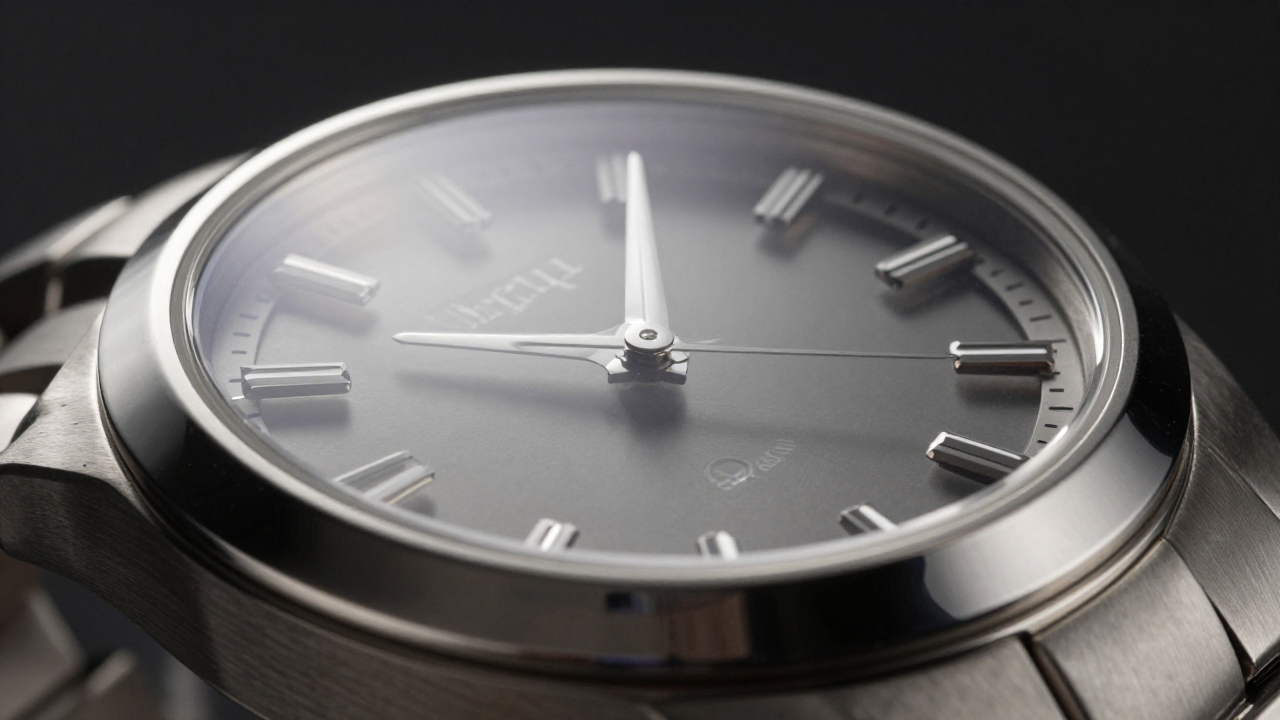
A sapphire watch crystal is a lens machined from lab-grown corundum (Al₂O₃) with a Mohs hardness of 9 and roughly 2,000 HV on the Vickers scale.…
Sapphire watch crystal ignores steel keys, brick walls and desk edges that leave visible tracks on mineral glass (Mohs 5.5) and gouge acrylic (Mohs 2–3).
What Is a Sapphire Watch Crystal and Why Does It Outperform Mineral Glass and Acrylic?
Nobody mines these. Every crystal on the market is synthetic, grown in a furnace from alumina powder at about 2,050 °C over 8 to 12 days, then sliced into wafers with a diamond saw and lapped and polished through 6 to 9 stages. The Kyropoulos method produces the cleanest boules; the older Verneuil flame-fusion process is cheaper and leaves more bubbles, which you will see as a faint internal speckle under a loupe. Ask your supplier which growth method they use, because the price difference between the two is real and so is the visual difference.
The refractive index matters more than most buyers realize. Sapphire sits at 1.77 versus 1.52 for mineral glass, which means anti-reflective coatings bond to a denser substrate and cut glare more effectively. A 1.2 mm sapphire with a good inner AR coating reads clearer than a 1.5 mm mineral glass with the same coating.
Where sapphire loses is impact, and this is the part the marketing copy skips. Hardness is not toughness. A dropped watch almost never lands flat on the crystal face; it lands on the bezel edge, and a 1.5 mm sapphire that takes a point load on a 2 mm² corner will chip. On a $900 field watch, that chip is a $200 problem.
How Do You Choose the Right Sapphire Watch Crystal for Your Timepiece?
Five numbers decide whether a replacement sapphire fits: outside diameter to ±0.05 mm, thickness between 1.0 and 2.0 mm, profile (flat, single dome or box), edge finish (fire-polished or diamond-cut chamfer), and coating (inner AR only versus double AR). Miss the diameter by 0.1 mm and the case fails a 5 bar pressure test regardless of how good the sapphire is.
Diameter and tolerance. We used to quote ±0.1 mm outside diameter on rectangular crystals. After roughly a dozen leaking casebacks came back through one distributor in 2022, we tightened the spec to ±0.05 mm and stopped losing sleep. If a supplier cannot state a tolerance in writing, that is the whole answer. Profile. Flat crystals are the cheapest and the most pressure-stable. Single-dome catches light at an angle and looks better on vintage-inspired cases. Box crystals (2.5D) give that slab-sided look on a Cartier Tank or a Nomos, but the vertical wall is thin and chips easily. Square and oblong crystals behave differently from round ones because the corner radius carries the stress; specify a 0.2 mm chamfer minimum at each corner or you are buying future returns. Coating. Inner AR only is what I recommend for anything worn daily. Double AR (inside and outside) looks stunning in a showroom and then the outer layer, which is softer than the sapphire beneath it, scuffs at Mohs 6 and shows the damage as a purple-green haze you cannot polish out. In February 2024 a mod shop in Austin, Texas, ordered 500 box-profile sapphires with external AR for a 36 mm field watch run. About 60 came back within two months with a hazy halo on the outer surface. The sapphire was fine. The customer had been wiping the crystal with an ammonia glass cleaner. Edge finish. Fire-polished edges are smooth and cheap. Diamond-cut chamfers give a crisp optical line but must be inspected for micro-chips at 10x. Ask for a photo of the actual lot, not a stock image.Which profile fits which watch
How Much Does a Sapphire Watch Crystal Replacement Cost in the US in 2026?
Expect $150–$400 at an independent US watchmaker for a standard round sapphire on a mid-range Swiss or Japanese watch, and $400–$650 through an authorized service center for a branded crystal with pressure testing. An aftermarket sapphire fitted to a Seiko or a microbrand typically runs $60–$150.
Shape is the biggest hidden multiplier. A round blank is a commodity. A 26.0 × 32.0 mm rectangular crystal with a 2.5D profile and radiused corners needs a dedicated fixture, and most factories in Shenzhen will quote a 100–300 piece minimum plus tooling for a shape they do not already run. If a repair shop tells you a one-off custom rectangular crystal costs $60 installed, ask where the crystal came from.
Gasket replacement is not optional. Nitrile and silicone I-ring gaskets harden in 3 to 5 years, and reusing a 6-year-old gasket with a brand-new crystal is the most common cause of fogging we hear about. Any quote that does not itemize a new gasket and a 5 bar (50 m) pressure test per ISO 22810:2010 is incomplete.
Why Is Sapphire More Expensive Than Mineral Glass or Acrylic?
A raw sapphire blank costs $8–$25 versus $0.80–$2.50 for mineral glass, because the corundum boule takes 8–12 days of furnace time and every finishing step runs on diamond abrasives. Grinding and polishing sapphire is 5 to 8 times slower than finishing mineral glass on the same line.
The $350 repair bill is not mostly crystal. On a typical independent watchmaker invoice, the sapphire accounts for maybe 30% of the total; labor, a new gasket, caseback resealing and pressure testing make up the rest. Authorized service centers add brand markup on top because the crystal has to match the reference exactly.
There is also a specification trap. "Sapphire crystal" on a $180 AliExpress listing and "sapphire crystal, Kyropoulos-grown, 1.5 mm, inner AR, MIL-C-48497A tape-test passed" on a factory spec sheet describe different products. The adhesion test in MIL-C-48497A (a tape pull plus abrasion check) is the one I would ask any coating supplier to run on a sample lot before you commit to 5,000 pieces. Cheap coating fails that test quietly, in the field, six months later.
When Should You Replace a Sapphire Watch Crystal?
Replace sapphire watch crystal when the edge has chipped, when a crack reaches the gasket seat, or when the AR coating has hazed beyond cleaning — not for surface marks, which sapphire rarely takes. Every replacement needs a 5 bar pressure test before the watch goes back on a wrist.
Three failure modes cover almost every case I have seen since 2010. Edge chips from impact come first, and they matter because a chipped corner can lift the crystal off its gasket by a few hundredths of a millimeter. Cracks that run to the case edge are an automatic replacement; a hairline in the middle that stops short of the seal can sometimes wait, but water ingress through a cracked crystal destroys a movement in one shower. Coating haze is the third, and it is cosmetic until it is not, because people scrub harder to see through it and eventually scratch the sapphire itself.
Dullness is usually not the crystal. Eight out of ten "my sapphire looks cloudy" emails turn out to be dirt on the underside of the crystal, condensation from a failed gasket, or a scratched external AR layer. Clean the underside before you spend $300.
Frequently Asked Questions
How can I tell if my watch has a sapphire crystal?
Breathe on the crystal. Sapphire disperses fog in 1–2 seconds; mineral glass holds it for 4–6 seconds and acrylic longer. A warm, glassy feel and a slightly cool tap sound are secondary clues. The only reliable method is the case reference number and the manufacturer's spec sheet.
Do sapphire watch crystals scratch or shatter?
Sapphire resists scratches from anything below Mohs 9, which includes steel tools, keys and concrete. Sapphire can shatter or chip under point impact, especially at the edge. A 1.5 mm crystal dropped onto tile from waist height often survives the face and fails at the corner.
Can scratches be polished out of a sapphire crystal?
No, not in practice. Removing a scratch from sapphire requires diamond abrasive and re-polishing the entire surface, which changes the optical geometry and costs more than a new crystal. Acrylic polishes easily and mineral glass can be re-lapped; sapphire gets replaced.
How long does a sapphire crystal replacement take?
An independent watchmaker with the crystal in stock turns it around in 1–3 days. An authorized service center typically takes 3–6 weeks because the watch enters a queue. A custom rectangular or box-profile crystal made to order adds 15–25 days of production plus shipping from Asia.