
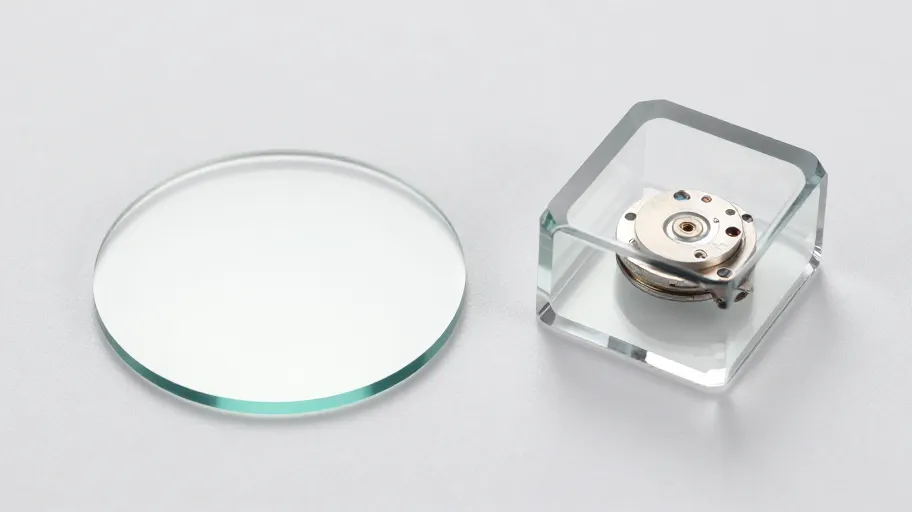
Is crystal sapphire expensive? It is priced above mineral glass and acrylic, but whether it is expensive for your project depends on four levers you control: the geometry of the crystal, the coating specification, the level of finishing, and the volume you commit to. A flat, uncoated round crystal in a straightforward batch is a fundamentally different cost object from a box-shaped, double-domed, multi-layer coated crystal in a small run. This guide gives you a framework to break any sapphire crystal quote into comparable parts, plus the questions to ask before you approve a sample.
Why sapphire commands a premium
Synthetic sapphire (corundum) is one of the hardest transparent materials available, which is precisely why watch brands specify it: it resists scratching in daily wear far better than softer glass alternatives. That same hardness is what makes it costly to work. Cutting, grinding and polishing sapphire requires diamond tooling and longer machining cycles than mineral glass, and every additional feature — curvature, edge shaping, holes, engraving — adds controlled, expensive processing time.
So the honest answer to "is crystal sapphire expensive?" is: it is expensive relative to alternatives, and highly variable within itself. Two sapphire crystals of the same diameter can differ substantially in cost once geometry, coating and finishing are specified. Your job as a buyer is not to find "cheap sapphire" but to make quotes comparable — and then to trade off levers deliberately.
The Four Cost Levers framework
Use these four levers to decompose any quotation and to identify where your budget is actually being spent.
| Lever | What it covers | Cost direction | Trade-off to consider |
|---|---|---|---|
| Geometry | Shape (round, barrel, box, rectangular), doming, curvature, thickness, holes and cut-outs | Complex shapes and domed profiles require more machining steps than flat discs | Does the design genuinely need a box or double-dome profile, or can a flat crystal meet the brief? |
| Coating | Anti-reflective (AR) coating: single-side, double-side, layers | Each additional coated surface and layer adds process steps and inspection burden | Is double-side AR necessary for this price point, or is single-side sufficient? |
| Finishing | Edge polishing, frost vs. polished edges, cosmetic grade, inspection criteria | Tighter cosmetic standards increase inspection and rejection handling | Define "acceptable" in writing; undocumented standards are where disputes arise |
| Volume | Order quantity, tooling amortisation, repeat-order continuity | Small custom runs carry proportionally higher setup and tooling burden per unit | Can you consolidate variants or commit to repeat volumes to improve unit economics? |
Ask every prospective supplier to quote against this structure. If two quotes list different scopes — one with double-side AR, one without — you are not comparing prices; you are comparing different products.
Specs: define these before you ask for a price
The fastest way to inflate a sapphire crystal project is to request a quote on a vague specification. Before approaching any supplier, document:
- Diameter and shape — including whether dimensions reference the crystal, the gasket seat or the case opening.
- Profile — flat, single-dome, double-dome, box; with doming referenced to a drawing rather than a description.
- Thickness — and whether it is driven by the case design, water-resistance targets or aesthetics.
- Coating specification — single- or double-side AR, and how residual reflection is to be evaluated.
- Edge treatment — frosted or polished, and the cosmetic criteria for the visible area.
- Movement-date window or holes, if applicable.
- Fit interface — gasket type and seating, since crystal and sealing hardware should be specified together.
You do not need final drawings to open a conversation, but you should know which of these are fixed and which are open to the supplier's recommendation. A supplier who can propose spec alternatives with cost implications stated is more useful than one who simply prices what you typed.
Samples and approval: the questions to ask
Sample policy and approval terms vary between suppliers, and no assumption you make today should survive into a purchase order unconfirmed. Before you commit to any supplier — including JadeZone Sapphire — put these questions in writing:
- What are the sample's commercial terms — any fee, who arranges shipping, and on what basis? Do not rely on assumptions; ask for the current policy in writing.
- How will the sample be evaluated — against what inspection criteria, and who signs off?
- How is consistency between the approved sample and production guaranteed — what documentation links the two?
- What happens if the first sample misses the spec — what is the revision process, and what communication cadence should you expect?
- What production documentation accompanies the order — drawings, coating spec, cosmetic standard, acceptance criteria?
Question 4 is the one buyers most frequently skip, and the one that causes the most friction. An approved sample that is not tied to a documented production specification is an approval in name only. Insist that the drawing revision, coating spec and cosmetic criteria are named in the approval record.
CTA — primary
Ready to move from questions to a comparable quotation? 获取采购 Brief: send us your geometry, coating, finishing and volume parameters, and we will respond with a scope-matched quotation and the confirmations you need on samples and approval — so your next sapphire crystal decision is made on documented terms.
Sourcing checklist (low-friction CTA)
Before you request any sapphire crystal quotation, complete this:
- Drawing or sketch with dimensions and profile reference
- Coating decision recorded (single-side / double-side AR / none)
- Edge and cosmetic criteria written down, not implied
- Target volume stated, including repeat-order intent
- Fit interface noted (gasket, case seat)
- Sample policy, fee and shipping terms requested in writing from each supplier
- Approval criteria agreed before the sample is produced
Save this checklist and reuse it for every crystal project. Consistency in your briefs is what makes supplier quotes comparable.
FAQ
Is sapphire crystal more expensive than mineral glass? Yes — sapphire is a harder material that requires more demanding cutting, grinding and polishing processes, so it is priced above mineral glass alternatives. How much more depends on your geometry, coating and finishing specifications, which is why the Four Cost Levers framework matters: compare quotes at the same specification level before judging the price.
What specification choices most affect the price of a custom sapphire crystal? Geometry and coating. Complex profiles such as box or double-domed crystals require more machining than flat discs, and each additional AR-coated surface adds process and inspection steps. Finishing standards and order volume complete the picture. Ask suppliers to itemise these levers so you can see where the cost sits.
Do I need anti-reflective coating, and does it change the cost? AR coating improves legibility and reduces reflection, but it adds process steps, and the cost depends on whether one or both faces are coated. For high-legibility dress and dive pieces, buyers frequently specify double-side AR; for others, single-side is sufficient. Decide based on your product brief, and confirm the coating spec is stated in both the quotation and the approval documentation.
How should I evaluate a sapphire crystal sample before approving production? Judge it against written criteria agreed in advance: dimensional conformance to drawing, coating appearance under defined lighting, edge finish, and cosmetic standards for the visible area. Ask the supplier how the approved sample will be linked to the production specification, and require that linkage in writing. Approval without documentation is where specification drift begins.
What should a sourcing brief for custom sapphire crystals contain? At minimum: dimensions and profile, thickness, coating specification, edge treatment, cosmetic criteria, target volume and fit interface — plus your questions on sample terms and production documentation. A complete brief lets each supplier price the same scope, which is the only way to compare quotations fairly.
CTA — primary (repeat)
获取采购 Brief and turn the framework above into a project: submit your geometry, coating, finishing and volume parameters, and we will come back with a scope-matched quotation and written confirmations on sample and approval terms.