
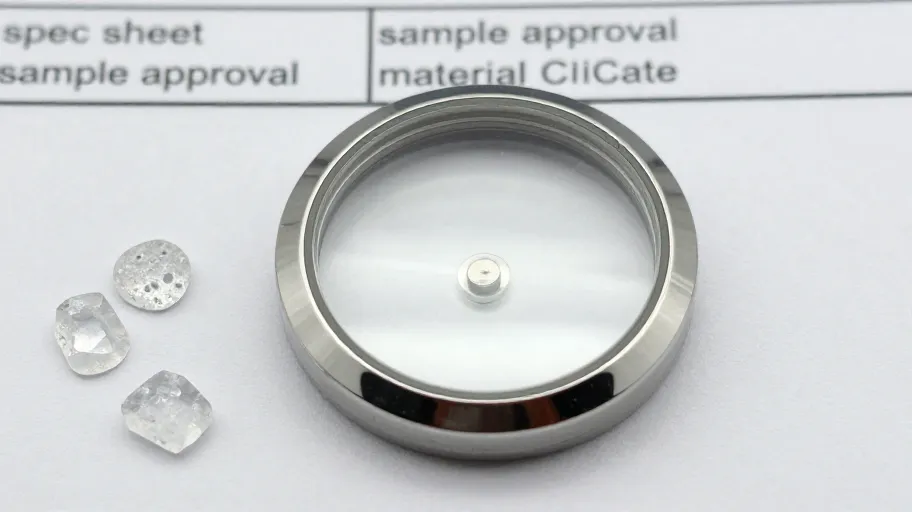
Is sapphire crystal good for watches? For most brands producing mid-range to flagship timepieces, yes: its combination of scratch resistance, optical clarity and finishing flexibility makes it the reference cover material. The real sourcing question is not whether sapphire is good, but whether your supplier can document, sample and approve the exact crystal your design needs.
Why this question reaches your desk
"Is sapphire crystal good for watches?" looks like a consumer query, but it sits behind a commercial decision every brand makes: which cover material justifies its cost in your bill of materials, and how you de-risk that decision before tooling and production. A buyer who can answer it with a documented specification — not a marketing claim — negotiates better, samples faster and approves with fewer surprises.
This guide covers the material decision briefly, then spends most of its length where B2B value actually lies: turning "sapphire crystal" into a spec sheet, a sampling plan and a sign-off record.
The Crystal Approval Ladder
We recommend running every crystal procurement through five rungs. Each rung converts one open question into one documented approval item. You only climb to the next rung once the current one is signed off.
- Material — confirm sapphire is the right material class for this model, versus mineral glass or acrylic.
- Geometry — define shape, dome profile, edge treatment and mounting dimensions.
- Coating — decide on anti-reflective treatment and any other optical requirement, and how it will be verified.
- Sampling — procure samples that test geometry and finishing on real cases, not on drawings alone.
- Sign-off — agree in writing what "acceptable" means: inspection criteria, measurement method and who judges.
The ladder matters because most crystal disputes trace back to a rung that was skipped — a dome described adjectivally instead of dimensionally, or a coating approved by eye instead of by method.
Decision table: is sapphire right for this model?
| Watch segment / positioning | Primary requirement | Material consideration | Sapphire fit |
|---|---|---|---|
| Entry, high-volume | Unit cost control | Mineral glass or acrylic may meet the brief | Compare — verify total cost against your positioning promise |
| Mid-range, everyday wear | Scratch resistance perceived as quality | Sapphire addresses the most common consumer complaint | Strong fit |
| Dress watch, thin case | Optical clarity at low thickness | Coating and edge finishing become decisive | Strong fit, geometry detail critical |
| Dive or sports watch | Impact and pressure integrity | Crystal retention, gasket interface and case design dominate | Strong fit, engineering-led approval required |
| Flagship / complication | Finishing and optical perfection justify premium | Domed profiles, box crystals and coating quality carry the positioning | Strong fit, longest approval path |
The honest caveat: sapphire is harder than nearly any alternative, but hardness is not the same as toughness, and fit, coating and finishing quality determine whether the material's promise survives into the finished watch. Those are supplier-dependent — verify them through sampling, not through datasheets alone.
Rung two: specifying geometry, including domed profiles
"Domed sapphire crystal" is a phrase buyers use and factories interpret differently. Before requesting a quotation, put geometry into language both sides can measure:
- Shape: round, rectangular, barrel, or a custom outline; flat, single-domed, double-domed or box profile.
- Dome description: state whether the dome is a section of a sphere, an aspheric profile, or a cylindrical curve — and ask the supplier which geometry definitions they work to.
- Mounting: press-fit into a gasket, glued into a bezel, or retained by a flange; state the seat diameter, edge treatment and any retained flange as project-specific questions for the supplier to confirm against your case drawing.
- Edge work: polished edge, ground edge, or coated flange — and how each will be inspected.
- Print or date window: whether any printing, aperture or laser feature sits on the crystal, and its approval method.
If your drawings do not yet carry these fields, that is the first gap to close — before any supplier conversation. A crystal specified only as "domed sapphire, round" invites interpretation at every later stage.
Rungs three to five: coating, sampling and sign-off
Coating. Decide whether you want anti-reflective treatment on the inner surface, both surfaces, or none. Each choice affects optical behaviour, cleaning during assembly and inspection criteria. Ask each candidate supplier how their AR specification is defined and verified, and confirm what evidence they can provide for the coating performance on your specific parts.
Sampling. Treat samples as an engineering instrument, not a gift. Their job is to answer questions your drawings cannot:
- Does the dome profile sit correctly in your case, at the intended height above the bezel?
- Does the edge seat into your gasket without visible gaps under inspection?
- Does the coating look correct under your lighting conditions and under a loupe?
Sampling policy — whether samples carry a fee, who arranges shipping, and what lead times apply — varies by supplier and project. Confirm the current policy directly with each supplier before you build a sampling schedule around assumptions.
Sign-off. Before mass production, agree in writing:
- Which dimensions are measured, with which instrument, and by whom?
- What optical inspection method defines an acceptable coating?
- What is the approved reference sample, and where does it physically live during production?
A one-page sign-off record covering these points is the cheapest insurance in crystal procurement.
Concrete approval questions to put to any supplier
Before you shortlist, send every candidate the same questions and compare answers side by side:
- Which dome geometry definitions do you work to, and can you quote against our profile description?
- What measurement capability do you apply to seat diameter, thickness and dome height, and can you share the measurement method — not just results?
- How is your AR coating specified and verified on production parts?
- What does your sampling workflow look like for a custom domed crystal, and what is your current sample policy for our project profile?
- What information do you need from us — drawings, case samples, gasket specs — to quote accurately?
Suppliers who answer with method and documentation, rather than reassurance, are the ones worth climbing the ladder with.
Checklist: your crystal sourcing brief
- Model name and positioning segment
- Material decision confirmed (sapphire vs alternatives, with reasoning)
- Crystal shape and dome profile described dimensionally
- Mounting method and case interface drawing attached
- Coating requirement stated (none / inner / both surfaces) and verification method
- Print, aperture or date-window features defined
- Sampling intent stated: what the sample must prove
- Sign-off criteria drafted: dimensions, optics, reference sample custody
- Open questions listed explicitly for the supplier to answer
FAQ
Is sapphire crystal actually better than mineral glass for a watch? Sapphire is significantly harder than mineral glass, which is why it resists the scratches that mineral glass accumulates in daily wear. Whether it is "better" for your model depends on positioning, bill-of-materials budget and the durability promise your brand makes. Verify the trade-off against your own cost structure rather than accepting a generic ranking.
What is a domed sapphire crystal, and when should I specify one? A domed crystal has a curved rather than flat upper surface, ranging from a gentle single dome to pronounced box profiles. Brands specify domes for vintage-inspired designs, for visual depth, and to reduce reflections at oblique angles. Specify one when the geometry serves the design — and describe it dimensionally, because "domed" alone is not a specification.
Do I need anti-reflective coating on a sapphire crystal? Sapphire's reflectivity can make an uncoated crystal read as glassy-dark in some light. Whether to coat, and on which surfaces, depends on dial design and assembly considerations. Decide it as a specification item with a defined verification method, and ask each supplier how they define and confirm their coating outcome on production parts.
What should I send a supplier to get an accurate crystal quotation? At minimum: a case drawing with the crystal seat, the intended mounting method, dome profile description, coating requirement and target quantities. Suppliers may ask for more — a case sample, a gasket spec or a reference crystal. Confirm each supplier's required inputs directly rather than assuming a universal list.
How many sample rounds should I budget for before approving production?
Ready to scope your crystal programme? 获取采购 Brief — send us your model profile and open questions, and we will respond with the specification fields, sampling considerations and approval criteria your project needs. All commercial terms are confirmed project by project; nothing on this page substitutes for that conversation.
Not ready to talk? Download our low-friction crystal specification checklist — the same five-rung framework above, formatted as a one-page document you can circulate internally. Confirm current availability directly with our team.