
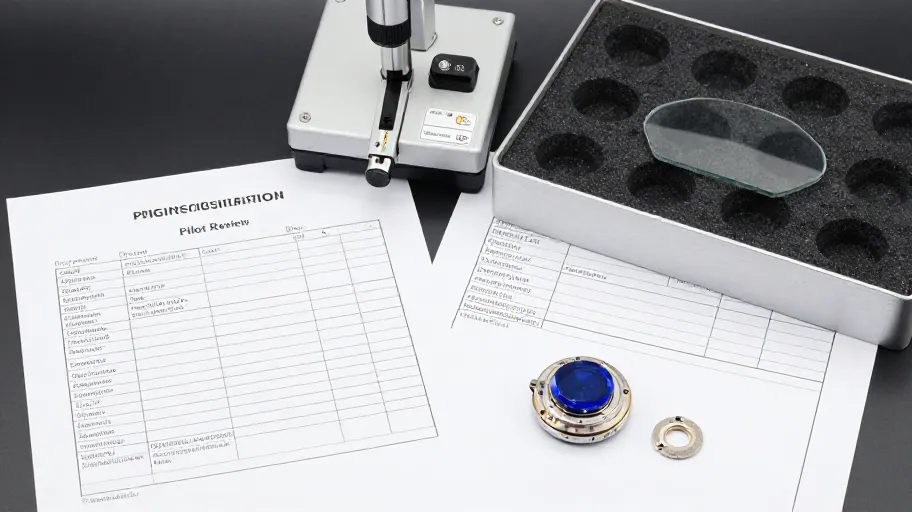
Sourcing custom sapphire parts for a US-bound watch program succeeds or fails at the approval stage, not the production stage. The buyers who avoid rework are those who treat specification, sampling, pilot review and production authorisation as four separate, documented gates — and who confirm MOQ, sample policy, pricing and lead time directly with the supplier before committing to either.
Why sourcing custom sapphire parts stalls — and where to focus
Most delays in a custom sapphire crystal project are not manufacturing failures. They are approval failures: a drawing that left out a bezel-seat dimension, an anti-reflective coating judged on an uncontrolled screen, a sample signed off verbally and then disputed two revisions later. For a sourcing manager buying from Shenzhen or Hong Kong, the distance compounds this — every unclear parameter becomes a shipping cycle of questions.
The practical answer is to run the project through a simple, repeatable gate structure. At JadeZone Sapphire we recommend the S-A-P-A sourcing gate: Specify, Approve via samples, Pilot, Authorise. Each gate has defined inputs, defined questions and a written sign-off. The framework does not replace your supplier's process — it gives your team a common language for deciding when a project is genuinely ready to move forward.
The S-A-P-A sourcing gate
| Gate | What you submit or do | What you must confirm directly with the supplier | Sign-off owner |
|---|---|---|---|
| 1. Specify | Complete drawing package: outer diameter, height, dome profile, edge geometry, bezel-seat detail, coating zones, packaging intent | Current MOQ, quotation basis, drawing file formats accepted, whether engineering review is offered | Product developer |
| 2. Approve via samples | Request sample parts against the approved drawing | Current sample policy, sample lead time, who arranges and pays for shipping, how revisions are handled | QC / engineering |
| 3. Pilot | Place a pilot order against the same drawing revision | Pilot quantity options, inspection and acceptance criteria, packaging specification | Sourcing manager |
| 4. Authorise | Approve mass production only with all gates documented | Production schedule commitment, communication cadence, change-request procedure | Sourcing manager with brand sign-off |
Note that nothing in this framework asks you to assume a supplier's terms. Every commercial and policy item — MOQ, sample fees if any, shipping responsibility, schedules — is a question to put to JadeZone Sapphire and to any other supplier you are comparing. Confirm the current policy in writing before each gate.
Specification: what to prepare before you request a quote
A quote for custom sapphire parts is only as good as the drawing behind it. Before contacting any supplier, assemble:
- A dimensioned drawing (PDF plus native CAD if available) covering diameter, height, curvature, edge profile and any stepped or gasketed seat.
- Material callouts: synthetic sapphire, and whether you require coated or uncoated faces.
- Coating zones: which surfaces receive anti-reflective treatment and which remain bare.
- Cosmetic grading intent: what you consider acceptable under inspection — even if the supplier's inspection standard is a question you must confirm with them.
- Packaging and protection requirements for transit.
- Target volumes, even as a range, so the supplier can respond meaningfully.
If your drawing is incomplete, say so explicitly and ask the supplier's engineering team which parameters they need clarified. A supplier that asks good clarifying questions at the Specify gate is giving you useful evidence about how the whole project will run.
Sample stage: approval questions that prevent rework
The sample gate is where most long-term quality outcomes are decided. Rather than judging samples on impression, put these questions to the supplier and record the answers:
- Which drawing revision does this sample represent? Match the revision number in writing.
- What acceptance criteria will govern the pilot and production runs for cosmetic grading, coating appearance and dimensional conformity?
- How will coating appearance be judged — under what lighting and viewing conditions — so both parties apply the same test?
- What inspection is performed before shipment, and can inspection reports accompany the parts?
- What is the current process for handling a rejected sample — revision, re-sampling, and the associated policy?
- How are parts protected in transit, and what packaging is used at sample and at production stages?
None of these questions assumes an answer. The purpose is to convert assumptions into documented commitments you can hold both sides to.
Decision table: proceed, revise, or hold
| Situation at a gate | Recommended action | Why |
|---|---|---|
| Drawing complete, sample matches revision, acceptance criteria documented | Proceed to the next gate | Both parties share a written basis for judgement |
| Sample deviates from drawing on any dimension | Revise: request re-sampling against the same revision and re-document | A dimension deviation at sample stage becomes a production defect if waived |
| Coating appearance contested between teams | Hold; agree the judging conditions first, then re-evaluate | Judging the part before agreeing the test guarantees a repeat dispute |
| Commercial terms (MOQ, schedule, policy) still unconfirmed | Hold the gate; do not commit spend | Approval without confirmed terms creates disputes later |
| Supplier unable to answer inspection or process questions clearly | Hold and verify further, or compare alternative suppliers | Unanswered process questions are a sourcing risk, not a detail |
Pre-production checklist
Before authorising production, confirm every line below in writing:
- Final drawing revision number agreed by both parties
- Sample approval recorded, with the approver named and dated
- Acceptance criteria for cosmetics, coating and dimensions documented
- MOQ, pricing basis and schedule confirmed with the supplier
- Packaging and transit protection requirements specified
- Inspection reporting agreed for production shipments
- Change-request procedure agreed for any future revision
- Internal sign-off from sourcing, QC and the brand recorded
Frequently asked questions
What information does a sapphire supplier need to quote a custom watch crystal? At minimum: a dimensioned drawing with diameter, height, curvature and edge geometry; coating requirements; cosmetic grading intent; and an indicative volume range. Full CAD files accelerate the review, but the supplier's engineering team will tell you exactly which parameters they need clarified — ask them directly rather than assuming a format.
How should we evaluate anti-reflective coating on a sample? Agree the judging conditions with the supplier before evaluating: the lighting environment, viewing angle and acceptance level. Judging a coating on an uncontrolled screen or under mixed office lighting produces inconsistent conclusions. Document the agreed conditions, then evaluate and record the result against the drawing revision.
Do we need to visit the factory to approve custom sapphire parts? A visit is one way to verify capability, but it is not the only evidence available. Inspection reports, process answers, sample consistency across revisions and pilot-run conformity all provide verifiable signals. What matters is that every capability claim is confirmed directly with the supplier and documented — not assumed from a brochure.
What should be in place before authorising a production order? All four S-A-P-A gates closed: a final drawing revision, a documented sample approval, agreed acceptance criteria, and confirmed commercial terms covering quantity, schedule and reporting. If any gate is open, hold the authorisation — reopening a closed gate after production starts is the most expensive form of rework.
Work with a supplier who answers the right questions
Custom sapphire parts succeed when both sides document their commitments. JadeZone Sapphire manufactures custom sapphire watch crystals and precision sapphire components from Shenzhen and Hong Kong, and works with buyers who want a structured, evidence-based approval process.
Get a sourcing brief — send us your project requirements and we will respond with the specification questions, confirmation points and documentation we recommend for your program, so your first quotation request is complete and comparable.
Prefer to start smaller? Run the pre-production checklist above against your current project. Any line you cannot yet confirm is your next question to the supplier — start there.