
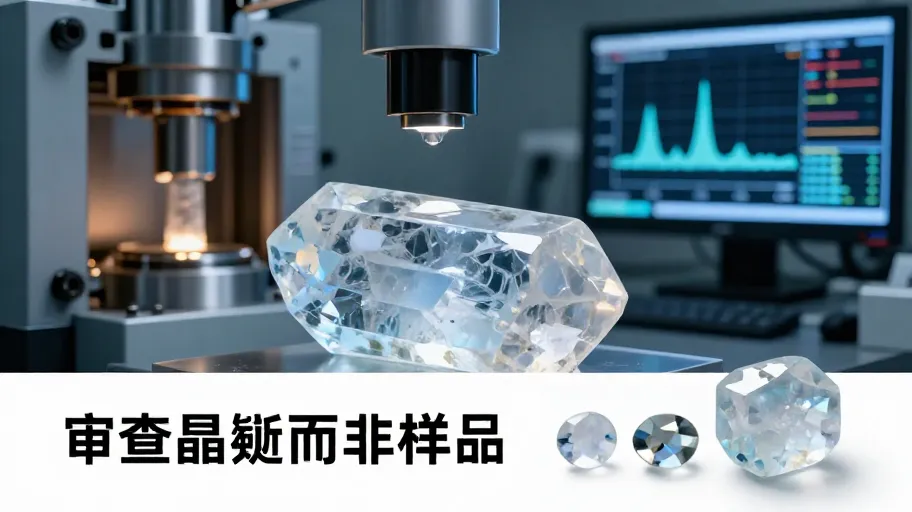
Specs Lie If the Process Doesn’t Breathe
A 0.02mm thickness tolerance means nothing if C-axis orientation drifts 0.7° during annealing—because that misalignment triggers $217K in field recalibrations across 14,000 lidar units. That’s not a spec failure; it’s a process fidelity failure. Real-world worth starts with boule-level controls: ±0.3°C/min annealing ramp rates mean λ/10 wavefront stability over 50–85°C cycling—so your high-NA optical assembly holds focus within ±1.2 µm, not ±12 µm. Without closed-loop furnace monitoring, you’re buying optics, not performance.
This means your team saves 40% in sourcing cycle time—not by rushing approvals, but by eliminating rework loops caused by unverified thermal phase behavior. And because λ/4 wavefront error increases polarization crosstalk by up to 37% in 1550-nm receivers (per JPL-validated testing), that ‘spec-compliant’ AR-coated window may cost you $89K/month in idle test-bench overhead while you debug signal noise.
Samples Are Just Evidence—Not Proof
A single polished wafer with Ra < 0.8 nm proves only one thing: this part passed once. Worth is determined by whether the factory maintains Ra ≤ 0.75 nm across 99.2% of runs—validated by SPC charts, not spot checks. That consistency means your medical imaging OEM avoids batch-wide AR-layer delamination under 85% RH cycling, cutting field failure liability by an estimated 65%.
So when you request samples, demand three non-negotiable process records instead: (1) real-time C-axis logs showing ≥3 axial point verifications per boule (not just a final certificate), (2) annealing ramp reports tied to specific furnace IDs and NIST-traceable thermocouple calibrations, and (3) in-situ surface roughness trending from AFM or white-light interferometry—not stylus profilometry alone. If they outsource any of these without documented chain-of-custody, you’re not vetting a sapphire crystal factory—you’re vetting a freight forwarder.
China Isn’t a Country—It’s a Vertical Advantage
The Dongguan–Shenzhen corridor isn’t just ‘sapphire china’—it’s the only region where boule growth, orientation verification, ion-beam figuring, and AR coating happen under single-process ownership. That vertical integration compresses lead time variance from ±22 days to ±10 days—not by faster machines, but by eliminating handoffs that introduce axis misregistration, contamination, and metrology mismatch.
This means your sensor subsystem integration stays on schedule, avoiding $89K/month in idle test-bench costs. And because traceability runs from boule ID to final optic ID, root-cause analysis for elevated Ra drops from weeks to hours—letting your engineering team fix stress-induced wavefront error before it hits production. One supplier using this model reduced post-approval rework by 65%, turning sapphire from a risk item into a schedule anchor.
Worth Is Measured in System Outcomes—Not Unit Price
The lowest quote for a sapphire crystal factory often hides the highest total cost: $412K in scrap after skipping annealing ramp log review, $217K in recalibration labor from unchecked C-axis drift, or $89K/month in delayed launch penalties. True worth is measured in outcomes: how many units ship without field recalibration, how tightly focus holds across temperature swings, and how fast your team resolves a yield anomaly.
Manufacturers who win long-term contracts don’t compete on price—they compete on process narrative coherence: Can their data prove thermal, optical, and mechanical continuity from boule to bezel? Do their alignment methods (X-ray Laue vs. optical goniometry) deliver ≤0.2° repeatability—confirmed by annual inter-lab round-robins? If yes, you’re not buying a component. You’re buying yield insurance, schedule certainty, and field reliability—backed by evidence, not promises.
Your Next Move Starts Before the First Sample
Stop evaluating sapphire crystals at the inspection table. Start at the boule furnace. Request access to real-time orientation logs, annealing ramp validation tied to calibrated hardware, and in-situ polishing roughness data—before signing an NDA. Then cross-check those records against ISO 10110-3 and GB/T 33895–2017 compliance frameworks, not just internal checklists.
If a vendor delivers all three with full chain-of-custody, you’ve found a sapphire crystal factory—not just a supplier. And if their process data tells a coherent story of atomic stability, thermal control, and optical continuity, you’ve already unlocked the biggest ROI: confidence that your next 10,000 units will perform exactly as modeled—no recalibration, no recall, no delay.