
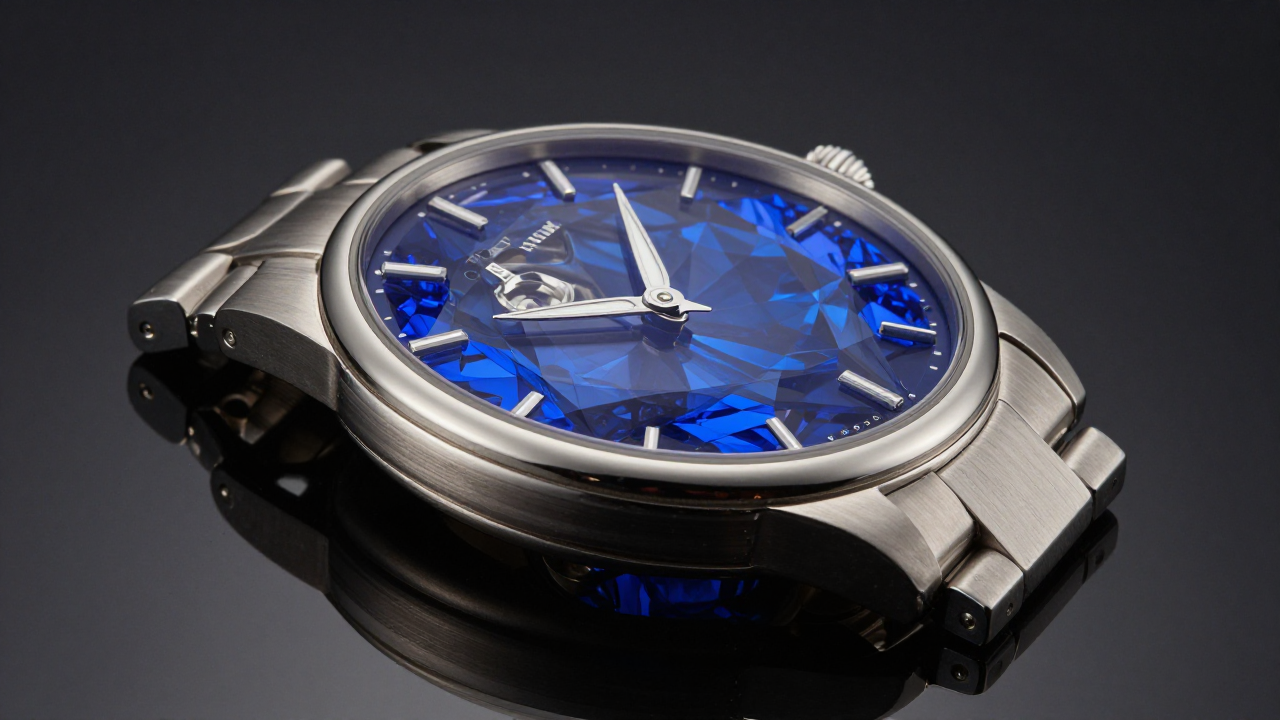
A sapphire watch crystal runs $100 to $300 as a replacement in the US market in 2026, or $12 to $60 per unit at OEM volume, and the payback window against mineral glass usually lands between 2 and 3…
years for a daily-worn watch held for six years. That spread — roughly 6x between the service counter and the factory floor — is where nearly every bad ROI model starts.
What a Sapphire Watch Crystal Costs and How Fast It Pays Back
Sapphire earns its price on one number: 9 on the Mohs scale. Mineral glass sits at about 5.5, which means doorframes, gym equipment and car keys all beat it. Acrylic is softer still, though it polishes out with cerium oxide and twenty minutes of patience.
Hardness alone doesn't close the argument, because a watch crystal is a system. Thickness, dome geometry, anti-reflective coating adhesion and gasket compression all decide whether the part survives five years or comes back as a warranty claim. In February 2024, a microbrand out of Fort Collins, Colorado sent us a batch spec for 600 double-domed crystals at 1.4 mm center thickness with inner AR. Their first supplier quoted $19 per unit. Ours came in at $27. They took the cheaper quote, then replaced 71 units in eleven months because the AR coating crazed after ultrasonic cleaning. The $8 they saved per part cost them $41 per failure in rework, shipping and a hit to their Trustpilot score.
That is the whole game. Purchase price is the visible variable. Everything else is the invoice you get eighteen months later.
Explicit Costs, Line by Line
Explicit costs are the ones on the quote: the crystal itself, the installation labor, and the taxes and freight that move it across a border. In the US aftermarket, a competent independent watchmaker charges $75 to $120 per hour, and a straightforward crystal swap bills out at $100 to $300 depending on whether the case needs re-pressing, whether the crystal is flat or domed, and whether the watch is a screw-down diver that demands a pressure test.At OEM scale the numbers look nothing like that. Here is what we and our competitors actually quote in 2026:
Two things get left out of that table by nearly everyone. The first is the 25% Section 301 tariff on China-origin optical goods, which lands on the FOB price before freight. A $20 crystal becomes a $25 crystal at the port, and that changes your landed-cost model by more than your supplier negotiation will. The second is incoming inspection: AQL sampling on optical parts needs a proper light booth, and budget one to two hours of QC labor per 500-piece lot if you care about coating uniformity.
The Implicit Costs Nobody Budgets For
The implicit costs of a sapphire watch crystal are maintenance, downtime, labor and supplier migration, and on a six-year horizon they typically add 25% to 40% on top of the purchase price. Nobody puts these on a spreadsheet, which is exactly why the spreadsheet is wrong.That last point cost us money in 2019. We shipped a run of 2,000 coated crystals for a fitness-watch program, and the coating lifted at the edges on about 12% of units after repeated sweat exposure and hot-water rinsing. We rebuilt the pre-coat cleaning line, added a plasma treatment step, and ate the replacement cost. Fine — that's the tuition. Clients now get the adhesion data with the shipment whether they ask for it or not.
Running the ROI Math
ROI = (Total Benefit − Incremental Cost) ÷ Incremental Cost × 100. The incremental cost is what you pay for sapphire above the mineral-glass alternative. The total benefit is avoided replacements plus the resale delta at sale.Watch a 6-year hold on a daily-worn $650 field watch, bought with a sapphire upgrade:
ROI = 255 ÷ 150 × 100 = 170% over six years.
Payback = 150 ÷ (405 ÷ 6) = 2.2 years.
Now flip it. If you're the one buying the replacement crystal rather than the watch, the incremental cost jumps to $180 to $260 at the service counter, and the avoided-replacement benefit shrinks because you've already paid for the first one. ROI drops to roughly 40–60%. Still positive. Not a slam dunk.
The Cost Mistake That Breaks Most Spreadsheets
The single most common error is comparing retail replacement pricing to wholesale bill-of-materials pricing as if they were the same decision — they are two different purchases with two different payback structures. A brand exec reading "$250 to replace a crystal" and concluding sapphire is expensive has mixed the service counter with the factory floor.Three more traps we see constantly:
Counting a ten-year hold. The average US watch owner flips or stops wearing a piece inside four years. Run your ROI at 4 years and the mineral-glass "savings" argument collapses fast, because you never reach the second replacement. Ignoring the coating line item. A $12 flat sapphire with no AR coating and a $28 one with inner AR are not the same product. If your spec sheet says "sapphire crystal" and nothing else, you're comparing prices on parts that don't perform alike. Treating scratch resistance as binary. Sapphire chips before it scratches. Thin domes with exposed edges on tall bezels chip at a measurable rate, and a chipped sapphire is a full replacement, not a polish. We quote 0.9 mm minimum edge thickness on any dome over 1.2 mm center height for exactly this reason. (That number came from claims data, not a textbook.)When You Should Not Buy Sapphire
Skip sapphire when the crystal's replacement cost exceeds 40% of the watch's total resale value, when the case is vintage acrylic-era, or when your holding period is under two years. All three conditions break the math.The honest boundary list:
The material has also moved down-market, which changes the framing. Tissot now ships the $400–$700 PRX line with a sapphire crystal, and when sapphire shows up at that price point, "is it worth upgrading" becomes "is the mineral version even competitive." For anyone selling above $500, mineral glass in 2026 reads as a cost cut, and buyers notice.
What Fifteen Years of Cutting Sapphire Taught Us
We started Jadezone Optical in 2010 in Hong Kong with a Shenzhen plant that now runs past 300 people, and the product line moved from watch glass into phone cover glass and other optical parts along the way. The lesson that survived every expansion: substrate hardness is the easy part. Coating durability, edge geometry and dimensional repeatability across lots are what customers actually pay for, and those are process problems, not material problems.
When a US brand sends us a spec, we ask for the failure history on their previous part before we quote. Nine times out of ten the answer tells us more than the drawing does.
Frequently Asked Questions
How much does a sapphire watch crystal replacement cost?
A sapphire watch crystal replacement in the US runs $100 to $300 installed in 2026, with double-domed and box-format crystals at the top of that range. Add $40 to $65 if the case needs a water-resistance pressure test after the swap.
How long does a sapphire watch crystal last?
A sapphire watch crystal typically lasts eight years or more under daily wear, because sapphire rates 9 on the Mohs hardness scale and resists scratching from keys, doorframes and gym equipment. It chips rather than scratches, so edge geometry matters more than hardness for real-world longevity.
Is sapphire worth it on a $300 watch?
Usually not, if the crystal is being replaced rather than specified at purchase. A $150 to $250 replacement exceeds 40% of a $300 watch's resale value, which breaks the payback math. Specified as a $50 to $80 factory upgrade, the same sapphire pays back in about three years.
How do I choose between flat, domed and box sapphire crystals?
Match the crystal format to the case, not to the price sheet. Flat sapphire suits flat bezels and tool watches, double-domed sapphire fits vintage-style cases with a slim profile, and box crystals belong on dress watches with a stepped bezel. Mismatched geometry drives chip rates up.