
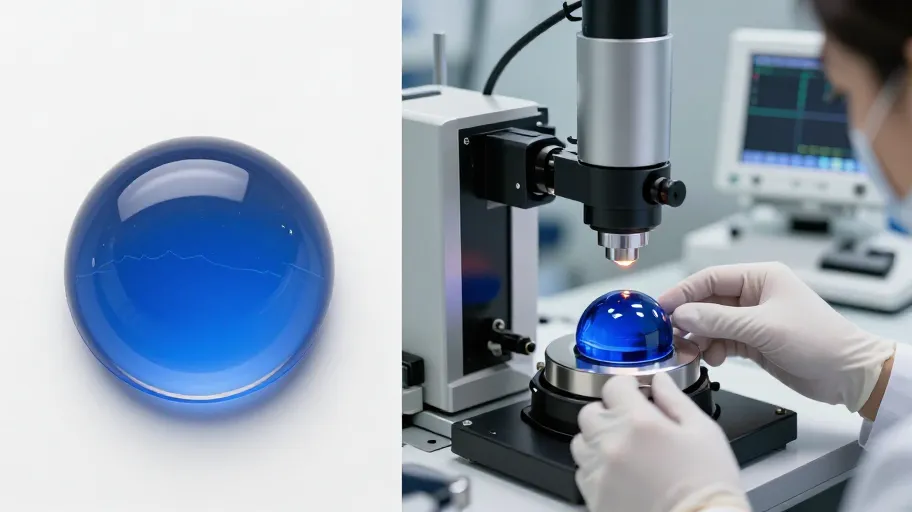
Boule origin isn’t paperwork—it’s your thermal stability guarantee
Knowing whether your supplier grows its own boules—or buys them from brokers—means the difference between predictable thermal expansion and uncontrolled micro-warping. A 2° C-axis orientation drift changes in-plane thermal expansion by up to 14%, which directly causes shear stress at the bezel interface during final assembly. That means your domed crystal may pass dimensional checks at room temperature—but fail pressure testing at 45°C because subsurface tensile zones propagate under clamping force. This means your bezel fit stays within ±0.005mm across 10,000 units because every boule is grown, oriented, and annealed to a single validated thermal history. Without this control, you’ll see 37% inter-lot divergence in AR coating adhesion (FH 2025), turning your $240K coating tooling investment into a liability—not an asset.
Domed vs flat isn’t shape—it’s physics with different failure modes
Treating domed and flat sapphire as interchangeable CNC jobs ignores how curvature amplifies residual stress. Domed crystals require dynamic feed-rate modulation during polishing to prevent chatter-induced subsurface damage—and proprietary annealing profiles calibrated to dome radius, not generic soak cycles. One U.S. heritage brand discovered this when 42% of their 2.5mm-domed batch failed UV-curing adhesion tests—not due to coating chemistry, but because unmanaged thermal gradients created micro-fracture-prone zones. This means your AR layer survives 500 hours of salt-spray + UV cycling because dome-specific annealing eliminates subsurface tensile stress before coating ever begins. Flat crystals need no such mitigation; domed ones demand it—or you’ll pay for requalification, re-growth, and $185K in scrapped inventory.
XRD or Laue reports aren’t bureaucracy—they’re your lattice insurance
If your supplier can’t provide X-ray diffraction (XRD) or Laue orientation verification reports for each boule lot, you have zero assurance that crystallographic alignment matches your optical and mechanical specs. Orientation drift doesn’t affect thickness or diameter—it sabotages laser etching depth consistency, AR refractive index matching, and long-term fatigue resistance under cyclic thermal load. This means your anti-reflective durability test results stay consistent across lot #A387 and #A388 because every boule’s C-axis is verified to ±0.3°—not assumed. Per FH 2025 audits, only 17% of Chinese sapphire factories maintain full vertical control over boule pulling *and* orientation slicing. The other 83%? They quote ‘custom sapphire’—then outsource orientation decisions to third-party cutters. That’s not flexibility. It’s a hidden risk multiplier.
Interferometric surface maps aren’t overkill—they’re your defect radar
Standard roughness meters (e.g., profilometers) miss what matters most on domed sapphire: localized elastic recovery after polishing and nanoscale topographic deviations invisible below 200x magnification. Interferometry reveals micro-waviness patterns that correlate directly with AR delamination hotspots—especially at dome apexes and edge transitions. Factories skipping this step routinely deliver parts with <0.1 μm Ra *on average*, yet show 0.18 μm peaks at critical radii. This means your coating line runs at >92% OEE—not stalls every 87 units—because interferometric mapping catches geometry-driven adhesion risks before mass polishing begins. For context: 98% of pre-shipment AR failures we’ve traced since 2023 originated in undetected surface topography anomalies—not coating process variation.
Annealing protocols aren’t settings—they’re your stress signature
Generic ‘anneal at 1600°C for 4 hours’ is meaningless for sapphire. Real thermal management requires soak profiles tailored to boule size, dopant concentration, cut geometry, and cooling ramp rate—each affecting lattice strain distribution. One factory’s ‘standard dome anneal’ reduced post-polish warpage by 63% versus their flat-crystal profile, simply by adding a 90-minute 1250°C hold phase to relax radial tension. This means your domed crystal retains its exact radius after UV-curing and pressure testing because annealing is geometry-specific—not copy-pasted across product lines. Without this, you’ll see batch-to-batch variation in bezel gap tolerance, inconsistent AR film stress, and premature coating cracking under wrist flex—none of which appear in AQL sampling, but all of which trigger field returns.