
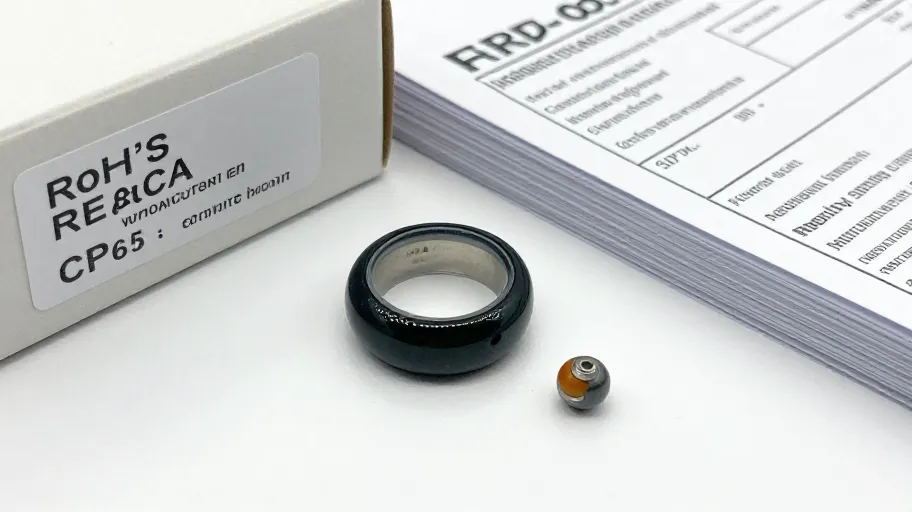
When you evaluate a rohs reach cp65 compliant synthetic sapphire wearable parts supplier, judge the evidence, not the adjective. Synthetic sapphire as a raw material raises few regulatory questions on its own; the risk sits in coatings, engraving fills, packaging inks, and the paperwork trail behind each claim. Use the Five-Gate Compliance Sourcing Framework — Documentation, Material, Measurement, Process, Communication — to compare candidates on verifiable items, and put every commitment in writing before you approve a supplier.
Why compliance documentation is a sourcing decision, not a formality
For a watch brand, a sapphire crystal is not just a hardened disc. Depending on the design it may carry an anti-reflective coating, an edge treatment, printed markers, or mount into an assembly with adhesives and gaskets. Each of those layers can change which regulatory requirements apply:
- RoHS restricts certain hazardous substances in electrical and electronic equipment. If your sapphire part is supplied into a smart or hybrid wearable device, RoHS scoping questions are legitimate and must be answered by the supplier, not assumed by you.
- REACH concerns substances of very high concern across articles and mixtures in the EU market. Your supplier should be able to state whether any substance above reporting thresholds is present in the part, its coatings or its processing aids.
- California Proposition 65 requires businesses to warn California consumers about listed chemicals in products they sell. Whether a warning is needed is a brand-level judgement, but the supplier's disclosure of what is in the part and its packaging is the input that judgement depends on.
A buyer who accepts "we are compliant" without knowing which declaration covers which layer of the product has outsourced their regulatory judgement to the least accountable party in the chain. The framework below exists to prevent that.
The Five-Gate Compliance Sourcing Framework
Apply each gate to every candidate supplier and record the outcome in a shortlist spreadsheet. A candidate that cannot pass a gate is not disqualified automatically, but the gap must be documented and resolved before you approve.
Gate 1 — Documentation. Request the actual documents, not summaries. Ask for a RoHS declaration scoped to the specific part number, a REACH SVHC statement referencing the current candidate list at the time of supply, and any Proposition 65 disclosure covering both the component and its packaging. Ask which lab performed any testing and whether you will receive the report itself or only a declaration.
Gate 2 — Material. Confirm what synthetic sapphire grade is proposed, what the growth method is, and whether any dopants or processing agents are used that could appear in a substance disclosure. Confirm how the supplier traces incoming material lots.
Gate 3 — Measurement. Ask how conformance is verified for your specific part. Is testing done per material batch, per production run, or inherited from a prior test on a different geometry? A declaration is a statement; a measurement is evidence. Ask which one you are being offered, and whether third-party reports are available for review.
Gate 4 — Process. Coatings, cleaning agents, polishing compounds and packaging all sit inside your compliance picture. Ask the supplier to identify each post-growth treatment applied to your part and to confirm that the declarations cover the finished assembly as shipped, not only the bare sapphire.
Gate 5 — Communication. Confirm who your named technical contact is, how updates are issued when regulations change or when the SVHC candidate list is revised, and what the change-notification procedure is if the supplier alters a coating, adhesive or packaging material.
Supplier comparison decision table
Use this table to score candidates consistently. Score each row as Verified / Declared only / Not answered, and require written answers before approval.
| Comparison item | What to request | Why it matters |
|---|---|---|
| RoHS declaration scope | Declaration naming your part number and the finished assembly | A generic declaration may not cover coated or mounted parts |
| REACH SVHC statement | Statement referencing the candidate list applicable at supply, with reporting-threshold answers | The candidate list is revised over time; a stale statement is not evidence |
| Proposition 65 disclosure | Disclosure covering component and packaging | The brand holds the warning decision, so it needs full inputs |
| Test evidence | Which lab, which scope, report copy available to buyer | Distinguishes measurement from assertion |
| Coating and treatment inventory | List of every post-growth treatment for your part | Each layer can change the compliance picture |
| Material traceability | Lot-tracing method for incoming sapphire | Enables targeted response if a question arises later |
| Change notification | Written procedure for material or process changes | Silent substitution is the failure mode buyers overlook |
| Technical contact | Named person, escalation path, update cadence | Compliance is an ongoing relationship, not a one-off document |
| Sample terms | Confirm current sample, fee and shipping policy directly | Do not assume; policies differ and change |
| Production conditions | Ask the supplier to describe relevant process controls and confirm current capability | Capability must be evidenced per project, not assumed |
Questions to put in writing before you approve a supplier
Bring these into the RFQ so answers become part of the commercial record:
- "Which specific documents will you provide for part number X: RoHS declaration, REACH SVHC statement, Proposition 65 disclosure — and will the reports be third-party or self-declared?"
- "Do your declarations cover the finished part as shipped, including coatings, printing, adhesives and packaging, or only the bare sapphire material?"
- "How is conformance verified for this part — per material batch, per run, or by reference to a prior test on a different geometry?"
- "What is your change-notification procedure if you alter a coating, cleaning agent, adhesive or packaging material?"
- "Who is my named technical contact, and how will I be informed when the REACH candidate list or relevant regulations change?"
- "What is your current sample policy, including any fees and shipping arrangements?" (Confirm this directly; JadeZone Sapphire's current policy must be verified with the company before you rely on it.)
- "What is the proposed MOQ, lead time, and dimensional tolerance for this project, and what evidence supports each figure?" (Treat every figure as project-specific until the supplier confirms it in writing.)
How to run a structured sample and document evaluation
Run samples and paperwork through the same gates in parallel:
- Compare crystals under controlled lighting and magnification on the attributes that matter to your design: edge finish, coating appearance, dimensional conformance against your drawing.
- Check that documents reference the same part number and revision as the sample in hand. A mismatch between document and sample is itself a finding.
- Ask each shortlisted supplier the same written questions and file the answers. Consistency across candidates is what makes the comparison legitimate.
- Record every figure — MOQ, lead time, tolerance, sample terms — as supplier-stated and pending your own confirmation, not as fact.
A shortlist built this way takes longer on day one and saves considerably more time at the approval stage, because there is nothing left to argue about when the purchase order is raised.
FAQ
Does synthetic sapphire itself contain restricted substances? Sapphire is a hard, chemically stable material, but the regulatory picture for your part depends on the whole assembly — coatings, fills, adhesives, packaging and processing residues. Ask the supplier to answer substance questions at the finished-part level rather than accepting material-level assurances. This article does not make a compliance determination; it defines what to request.
Do I need all three — RoHS, REACH and Proposition 65 — for a mechanical watch crystal? It depends on the market, the device category and the assembly. A mechanical watch component and a smart-wearable module may be scoped differently under RoHS, for example. Put the scoping question to each supplier in writing and take brand-level regulatory advice where your team needs it. This article does not state which regulation applies to any given product.
What should a compliance declaration actually look like? It should name your part number, reference the applicable regulation and list version, state the scope (bare material or finished assembly), and identify who is making the declaration and on what evidence. If a supplier offers only a generic certificate without part-level scope, ask for the scoping in writing before approval.
How do I compare sample policies between suppliers without assuming anything?
What information is still missing from this article? Deliberately, all commercial and operational specifics: sample terms, MOQ, pricing, lead times, capacity, tolerances, certification scope and current production capability. JadeZone Sapphire has not supplied these for publication, so treat every such item as a question to confirm directly with the company for your project.