
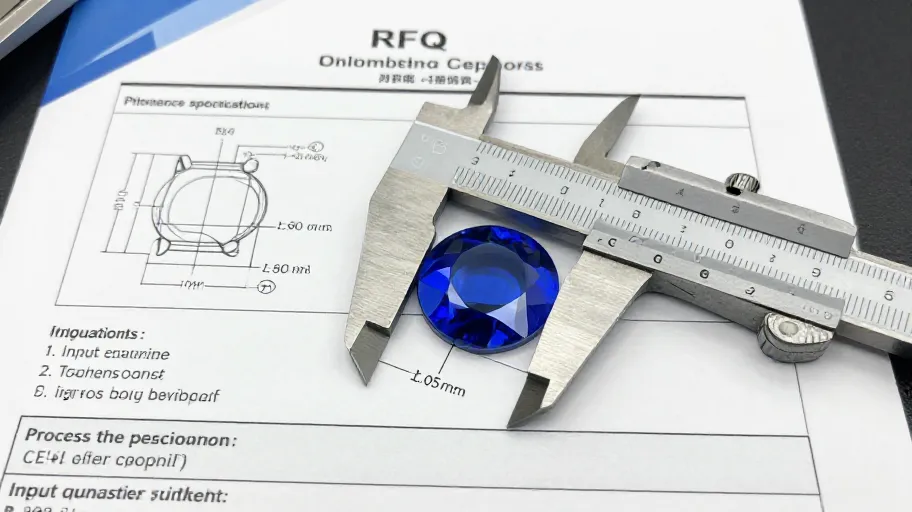
A clear RFQ to a sapphire watch glass supplier contains five things: the crystal specification, a reference drawing, input quantities, the tolerances you will accept, and the process questions you need answered. Teams that structure their brief this way receive quotations they can actually compare — and avoid the re-quotes, clarifying emails and delayed decisions that follow a vague first enquiry. This article gives you that structure.
Why quotation quality depends on brief quality
Sourcing teams rarely struggle because they asked too little; they struggle because they asked imprecisely. A brief that says "sapphire crystal for a 40 mm dive watch, please quote" forces the supplier to assume dome profile, edge treatment, coating stack, mounting method and packaging — and each assumption becomes a line item you cannot yet compare. When three suppliers make three different sets of assumptions, the quotations arrive at three different scopes, and no one can tell which offer is genuinely more competitive.
The fix is not more detail. It is the right detail, organised so both sides read the same document the same way.
The CRISP framework for a sapphire crystal RFQ
Use CRISP — Crystal spec, Reference drawing, Input quantities, Specification tolerances, Process questions — as the spine of every enquiry you send.
C — Crystal specification. State the crystal type and geometry: flat, domed, box-shaped or a custom profile. Describe the mounting approach you intend to use — press-fit, gasket-sealed, adhesive or a bezel-retained design — and the watch head it must fit. If the crystal is an anti-reflective coated part, say so here, including which surfaces you expect coated, and note that final coating availability and configuration must be confirmed with the supplier.
R — Reference drawing. Attach a drawing with dimensions, cross-sections and critical features marked. If you only have a design render, label it as reference intent, not as a manufacturing document, and ask the supplier what additional data they need before quoting. Version-stamp every drawing you send: file name, revision number and date. When revision B replaces revision A mid-negotiation, the version trail is what keeps both quotations on comparable scope.
I — Input quantities. Give the supplier the quantity picture in tiers — your initial order, your first-year estimate and any longer-range planning volume you are willing to share. Quantities shape how a supplier prices and plans tooling, so a single flat number produces a single flat quote that hides the options. Present volumes as planning figures, not commitments, and ask how pricing structure changes across the tiers.
S — Specification tolerances. Define what "accurate enough" means for your project: which dimensions are critical, which are cosmetic, and where you can accept variation. Rather than stating a number you have not validated, phrase this as a question: "Here are the critical features; please confirm the tolerance capability you would hold for each at our volume." That turns the tolerance conversation into documented, supplier-confirmed data instead of a guess.
P — Process questions. List what you need to know to approve the quotation: what the quotation covers and excludes, what sample and approval steps are proposed, what information the supplier needs from you to start, and what would trigger a re-quote. Ask for these answers in writing, attached to the quotation, so the commercial document and the technical understanding travel together.
What to include and what to hold back
| Include in the RFQ | Hold back until the supplier confirms | Why it matters |
|---|---|---|
| Crystal type, geometry, mounting intent | Coating availability and configuration | Coating scope varies by project; confirm rather than assume |
| Versioned drawing with critical features marked | Final tolerance commitments | Tolerances are a capability question, answered by the supplier in writing |
| Tiered planning quantities | Confirmed pricing per tier | Pricing follows quantities; tiers expose the options |
| Target schedule for quotation, sampling and order | Any lead time or delivery date | Dates come from the supplier's current plan, not from your assumption |
| Project contact and decision path | Any expectation about samples, fees or shipping | Sample and cost policies must be confirmed directly, per project |
Approval questions before you accept any quotation
Before your team approves a quotation from any sapphire watch glass supplier, get written answers to these questions and file them with the quote:
- Exactly which items, documents and services does this quotation include — and which are explicitly excluded?
- What sample and approval steps does the supplier propose before production, and who provides what at each step?
- What is the current policy on samples and any associated arrangements, confirmed in writing for this project?
- Which drawing revision and specification does this quotation reference, and what happens to pricing and scope if the drawing changes?
- What information or materials does the supplier need from us to move to the next stage?
- What conditions would cause the quotation to be revised?
A quotation that arrives without answers to these questions is not unfinished business for the supplier — it is unfinished business for your approval file. Require the answers before sign-off, not after.
FAQ for sourcing teams
What is the minimum information a supplier needs to quote a custom sapphire crystal? At minimum: crystal type and geometry, a versioned drawing with critical features, mounting method, and quantity tiers. Coating requirements, packaging expectations and schedule targets should also be stated. Anything you leave out becomes an assumption on the supplier's side, so list open points explicitly and ask how each affects the quotation.
Should we send one drawing or several options? Send the drawing you intend to manufacture, and clearly label any alternatives as options under evaluation. If you want alternatives priced, ask whether the supplier can quote them as separate line items. Mixing options into one specification without labels is a common source of scope confusion.
How should we compare quotations from different sapphire suppliers? Compare like with like: same drawing revision, same quantity tiers, same definition of what is included and excluded. If quotations differ in scope, ask each supplier to restate their offer against your RFQ document. The CRISP framework exists precisely so every supplier responds to the same structure.
When should tolerances be fixed? Ask the supplier to state, in writing, the tolerance capability they propose for your critical features at your volume. Fix tolerances in the approved specification before production planning, and treat any later tightening as a change that triggers a re-confirmation of scope and pricing.
What should we do if the design changes after quoting? Notify the supplier immediately with a new drawing revision and a summary of what changed. Ask explicitly whether the change affects the quotation, any approved sample status and the proposed schedule. Document the answer in writing and attach it to the project file before proceeding.
A note on confirming current terms
This article describes how to structure an RFQ. It does not state any sample policy, cost arrangement, shipping arrangement, production capability, certification or performance outcome for any supplier, because those details vary by project and change over time. Every policy and capability relevant to your project must be confirmed directly and in writing with JadeZone Sapphire before you rely on it. Treat this article as preparation, not as a commitment.
Primary CTA
Prepare a quote-ready brief. Use the CRISP framework above to assemble your specification, drawing, quantities, tolerances and process questions, then send it to JadeZone Sapphire for a structured quotation. Confirm every current term directly with the team as part of your enquiry.
Low-friction checklist CTA
Before your next enquiry, run this checklist:
- Crystal type, geometry and mounting intent written down
- Drawing attached, version-stamped and dated
- Quantity tiers stated as planning figures
- Critical features listed, tolerances posed as a question
- Process questions drafted for written answers
- Open points listed explicitly as "to be confirmed"
Send the checklist alongside your brief — it signals to any supplier that your team quotes and approves in a disciplined way.