
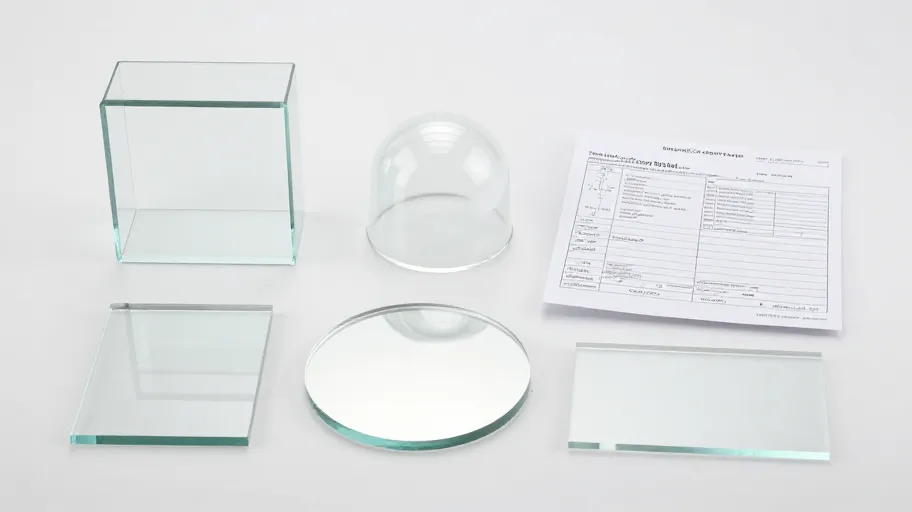
Sapphire watch glass types differ mainly in geometry — flat, boxed, domed (including double-domed), and shaped or cut crystals — and a disciplined quote comparison should review five lines: material specification, geometry, coating, edge and finishing treatment, and documentation. Comparing those five lines side by side turns two differently formatted quotes into one like-for-like decision.
Why two quotes on the same design rarely look alike
If you have sourced a custom sapphire crystal before, you will recognise the situation: two suppliers respond to the same drawing, and the quotes arrive in formats that cannot be compared. One prices a single line item; the other itemises geometry, coating and finishing separately. One states a material grade; the other simply says "sapphire". Neither is necessarily wrong — but until the specifications are broken into the same categories, you are comparing documents, not crystals.
The fix is a fixed comparison structure. Below we use the Five-Line Quote Comparison: five specification lines that should appear, explicitly, in every custom sapphire crystal quote. If a line is missing, that absence is information — and a question to put back to the supplier.
The main sapphire watch glass types
Before comparing quotes, confirm which geometry your design actually calls for. The main sapphire watch glass types are:
- Flat crystal — a single-plane disc. Simplest geometry to specify and inspect; suits cases with a flat bezel seat and a straightforward gasket channel.
- Domed crystal — a curved upper surface, adding visual depth and reducing reflection angles off the dial. Single-dome curves one surface; double-dome curves both, which changes how the edge sits under light.
- Shaped or cut crystal — non-circular geometries cut to match tonneau or cushion cases, or crystals with cutouts for complications.
Each geometry changes the tooling, the inspection method and the finishing work. That is exactly why the geometry line in a quote deserves its own row in your comparison.
The Five-Line Quote Comparison
| Line | What to compare | Question if the quote is silent |
|---|---|---|
| 1. Material specification | How the supplier identifies the sapphire itself, and any optical or structural characteristics stated on paper | "Please state the material specification you are quoting, in writing." |
| 2. Geometry | Flat, boxed, single-dome, double-dome or shaped — and whether the quoted price covers the geometry in your drawing | "Is the quoted geometry exactly as drawn, including curvature and seat profile?" |
| 3. Coating | Whether anti-reflective coating is included, and if so on which surface(s) | "Is coating included in this quote, on which surfaces, and how is it specified?" |
| 4. Edge and finishing | Edge treatment, seat finish, and any polishing or coating of non-viewing surfaces | "What finishing is included, and what is excluded?" |
| 5. Documentation | What written specification, drawing confirmation or inspection documentation accompanies the quote and any sample | "What documentation will I receive to approve against?" |
Two rules make the table work. First, insist that both suppliers answer against the same five lines — send them the table if needed. Second, treat "included" without detail as an unanswered line. A quote that says coating is included, but does not say which surfaces, is not yet a comparable quote.
Reading the price against the lines
Once both quotes are itemised, the price becomes interpretable. A lower line item may reflect a narrower geometry, an uncoated surface, or an unspecified finishing step — not better value. Conversely, a higher quote may simply be more complete. Your job as a buyer is not to find the cheapest document; it is to find the supplier whose specification, once written down line by line, you can approve with confidence.
For private-label brands and designers, this also protects the product. The geometry you approve on paper — dome profile, seat depth, edge finish — is what your customers will see on the wrist. Any gap between the drawing and the quoted specification surfaces late and expensively. The five-line structure pulls that gap forward, while the quote is still a document you can mark up.
Approval questions to put in writing
Before accepting either quote, send both suppliers the same set of questions and file the answers with the quotes:
- Which sapphire watch glass types did you price, and does the quoted geometry match the attached drawing exactly?
- Please itemise coating: is it included, on which surface or surfaces, and how is it specified in writing?
- What edge and finishing treatments does the quoted price cover?
- What is your current sample policy, including any associated costs, and who arranges shipping? (Confirm the current policy directly — do not rely on assumptions from a previous project.)
- What is your current minimum order quantity and production lead time for this geometry? (Both are project-specific; ask rather than assume.)
- What documentation will accompany pre-production and production units, so approval can be checked against it?
- How will dimensional conformity to our drawing be demonstrated before mass production?
Note what these questions deliberately avoid: none presumes an answer. Sample fees, shipping responsibility, refund terms, lead times and minimums all vary by project and policy, and the correct figure is whatever the supplier confirms in writing today.
A short geometry-mapping guide for designers
If you are still deciding which of the sapphire watch glass types fits your design, map geometry to design intent rather than to cost:
| Design context | Geometry to consider | Why |
|---|---|---|
| Flat bezel seat, minimalist dial | Flat | Clean reflection behaviour; straightforward specification |
| Deep seat or crystal-as-case-wall design | Boxed | Vertical sides integrate into the case structure |
| Dress piece where depth matters | Single- or double-dome | Curvature adds depth and changes light behaviour across the dial |
| Tonneau or cushion case, complication cutouts | Shaped / cut | Geometry follows the case, not the reverse |
Bring this table to your suppliers. Asking each to quote against the same geometry — not their preferred default — is what makes the five-line comparison valid.
FAQ
Are all sapphire watch crystals the same material? Sapphire crystal is synthetic sapphire, but quotes can differ in how the material is specified and documented. Rather than assuming equivalence, ask each supplier to state the material specification in writing and keep that line in your comparison table.
Does a double-dome crystal cost more than a flat one? Curvature and shaping add work, but no figure published here can be assumed. Price is project-specific — tooling, dimensions and finishing all affect it. The correct comparison is the two written quotes, itemised line by line, against the same geometry.
Is anti-reflective coating always included? Never assume so. Treat coating as its own quote line: ask whether it is included, on which surface or surfaces, and how it is specified. Any supplier's current policy should be confirmed directly.
Should I request a sample before approving a quote? A sample lets you verify geometry and finishing against your drawing, but sample terms — cost, shipping, availability — are project- and policy-specific. Ask each supplier to confirm their current sample policy in writing, and file it with the quote.
What if one supplier will not itemise the five lines? A supplier who will not put the specification in writing leaves you approving an undocumented product. You can still proceed, but the risk sits with you. The five-line structure exists precisely so that you can tell a complete quote from an incomplete one before commitment, not after.
Compare crystal geometries
Ready to put your two quotes through the Five-Line Comparison? Compare crystal geometries — send your drawing and both quotes, and we will walk through each line with you so the decision rests on specifications, not formatting.
Pre-approval checklist
Before you approve either quote, confirm you have:
- Both quotes itemised against the same five lines
- Geometry confirmed as exactly matching your drawing
- Coating specification in writing, with surfaces stated
- Edge and finishing treatments stated as included or excluded
- Sample policy, shipping arrangement and any costs confirmed directly with each supplier
- Current MOQ and lead time confirmed for this specific geometry
- Approval documentation method agreed before production
JadeZone Sapphire manufactures custom sapphire watch crystals and precision sapphire components, serving watch brands, component buyers and watchmakers from Shenzhen and Hong Kong. All commercial terms discussed above should be confirmed directly for your project.