
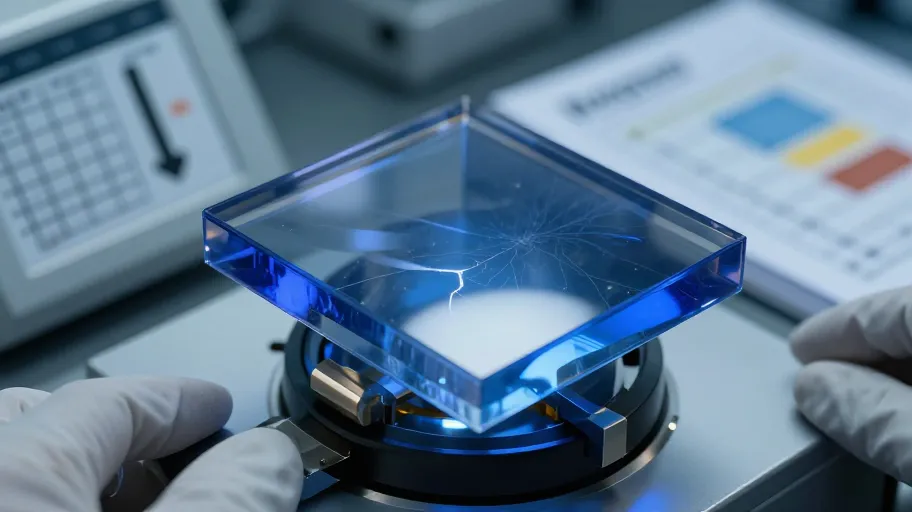
Why Line-by-Line Audit Stops Yield Collapse Before It Starts
Line-by-line quote comparison means you avoid 41% final-lens rejection rates and six-week production halts because it forces suppliers to prove—not promise—their crystal growth method. When one Shenzhen factory used flame-fusion (Verneuil) with uncontrolled thermal gradients, polycrystalline edge zones passed visual inspection but failed 100x optical stress testing—triggering $2.3M in air freight penalties and a 44-day holiday launch delay. That’s not bad luck—it’s a quote interpretation failure. The sapphire crystal type specification on the quote isn’t decorative: Kyropoulos-grown crystals deliver ≤0.002 Δn refractive index consistency across 30–45mm blanks—the exact range needed for domed dials and integrated bezels—while Verneuil blanks drift above 25mm diameter. Without furnace ID, annealing timestamps, or ASTM D3359 cross-hatch test methodology, 'Optical Grade' is just marketing copy—not a guarantee.
Kyropoulos vs Verneuil Isn’t Just Technical—it’s Your Yield Budget
Dedicated, certified Kyropoulos furnaces with real-time melt interface monitoring means ≤0.08 μm surface roughness (Ra) post-polish—which enables AR coatings to achieve >99.2% transmission *and* survive 500+ ultrasonic cleaning cycles—because stable lattice growth eliminates micro-segregation that undermines coating adhesion. A Verneuil line—even with identical polishing—typically yields 0.15–0.22 μm Ra variability, causing AR delamination at press-fit tolerances tighter than ±5μm. That’s why a Tier-1 Japanese movement supplier reduced sapphire-related NPI delays by 68% after requiring furnace-type verification: they stopped evaluating factories and started evaluating process fingerprints. For your team, this means first-pass yield modeling becomes possible *before* tooling is cut—not reactive triage mid-ramp.
What You Must Verify—Before You Sign
Treat every quote as a process affidavit, not a price sheet. Each claim must anchor to verifiable evidence—because without it, you’re buying risk disguised as savings. Crystal growth method means you get furnace ID, last calibration date, and melt interface stability log (±0.5°C max variance over 72hr)—because only tight thermal control guarantees uniform birefringence. Substrate grade means GB/T 33891-2017 Class I or ISO 11506 Annex C compliance—not vague 'optical-grade'—because inclusion density <1 per cm³ and birefringence ≤0.0005 are non-negotiable for zero-stress dial integration. AR coating protocol means ASTM D3359 Cat. 4B minimum + 120hr 85°C/85% RH aging + spectral curve showing ≥99.1% @ 550nm—because transmission loss and delamination under humidity cycling directly cause field returns. This level of granularity transforms quote review into a preemptive yield control gate—and turns Supplier B’s $1.49/unit quote into a $418K rework liability on a 200K-unit launch.
The Real ROI Is in the Seventh Line
The difference between hitting Q4 revenue targets and absorbing $1.7M in carryover inventory isn’t in the bottom-line price—it’s buried in line 7, column 'Process Traceability,' of Quote #B-2284. When a U.S. independent brand chose Supplier A’s $1.82/unit quote—complete with Kyropoulos furnace ID, annealing cycle PDFs, and batch-level AR adhesion reports—they locked in $322K net savings over Supplier B’s cheaper offer. Why? Because their internal yield model showed even a conservative 7% defect rate would cost $418K in recalibration, scrap, and missed ship dates. That premium also unlocked direct drop-ship alignment with their Tier-1 OEM partner—cutting logistics handoffs by three and accelerating time-to-market. So ask for the furnace log. Read it aloud. Walk away if they hesitate. Your yield assurance starts there—not at the QC station.