
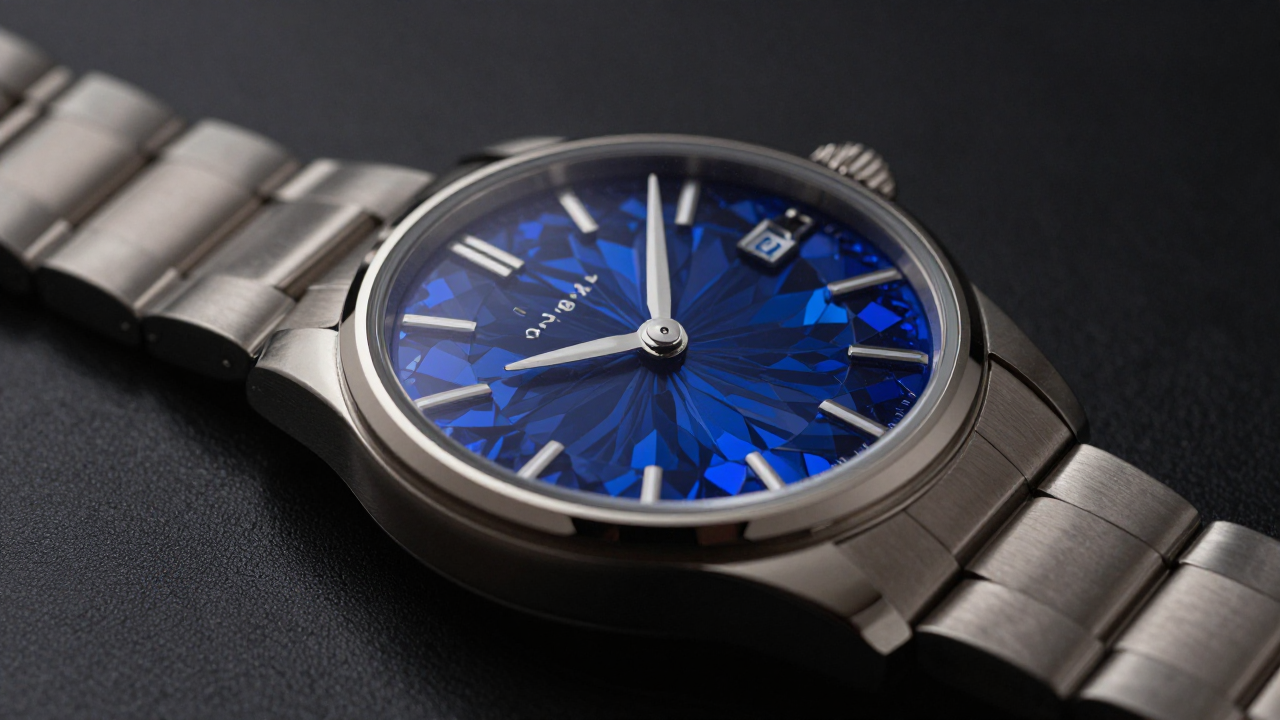
At 11:42 p.m. EDT on September 17, 2025, our Shenzhen shift supervisor sent a message to my phone: a Miami-based dive watch brand had rejected 400 sapphire watch crystals over a 0.…
03 mm bevel mismatch. The founder, Dan Ressler, was three weeks from a $340,000 Kickstarter fulfillment window. He had already printed the owner’s manual. The sapphire watch crystal was listed on page 4, right under “unidirectional bezel.” One spec deviation and a finished product becomes a warehouse liability.
A September Call From Miami
I called Dan back at 7:15 a.m. his time. The problem wasn’t the crystal’s face—it was the edge radius where the gasket seats. Too sharp, and water pressure would cut the seal during assembly. Too flat, and the case would leave a visible gap at the 6 o’clock side. Dan didn’t care about the optics. He cared about 400 chargebacks.
We reworked the bevel on two CNC chamfering machines and shipped replacements within 11 days. Dan’s watches went out on schedule. That call, and a dozen like it every quarter, is why we treat sapphire not as a commodity disc but as a performance component with its own failure modes.
What Sapphire Actually Is Under a Loupe
Sapphire watch crystal is not a glass. It’s a single crystal of aluminum oxide—Al2O3—grown in a controlled lab environment. The industry term is synthetic corundum. Natural sapphire exists, of course, but no serious watch buyer wants a million-year-old lattice with inclusions. Lab-grown material gives uniform hardness and predictable light transmission.
The crystal structure is the reason it works. Sapphire scores a 9 on the Mohs hardness scale. Diamond sits at 10. A hardened steel file, by comparison, lands around 6.5. In practical terms, car keys, sand, concrete dust, and most metal edges will not leave a visible mark on a sapphire crystal.
Clarity gets messier. Uncoated sapphire transmits roughly 85 to 86 percent of visible light. That sounds fine until you notice the reflections. Sapphire’s refractive index sits around 1.77, which means uncoated sapphire can reflect more light than mineral glass with a refractive index near 1.52. Multi-layer anti-reflective coating—often four to six layers of metal oxides—can push light transmission above 95 percent and cut surface reflection below 1 percent per side.
Thickness runs from about 1.0 mm on thin dress watches to 2.5 mm or more on dive watches. A double-domed crystal can measure 3.0 mm at the center and taper to 1.8 mm at the edge. Those numbers sound small, but a 0.05 mm deviation in edge thickness changes how the gasket compresses.
Mineral Glass, Acrylic, and the Cost of Compromise
The older alternatives are not obsolete. Acrylic still appears on vintage reissues because it flexes and takes impacts without shattering. It also scratches if you look at it wrong and yellows after years under UV. Mineral glass offers more scratch resistance than acrylic but less impact tolerance. A hard knock on a tile floor can send cracks through a mineral crystal long before the movement stops.
The table below is what we show US microbrand founders before they commit to a production run.
Material | Hardness (Mohs) | Scratch Resistance | Impact Behavior | Typical 2026 Use | Relative Cost |
|---|---|---|---|---|---|
Acrylic | 3–4 | Poor; daily marks appear quickly | Bends, absorbs shock | Vintage reissues, field watches | 1x |
Mineral glass | 5–6 | Moderate; keys can still mar it | Cracks under sharp force | Sub-$300 fashion watches | 2–3x |
Sapphire crystal | 9 | Excellent; only diamond and silicon carbide scratch it | Hard surface, but brittle at edges | $1,500+ luxury and tool watches | 8–15x |
Cost spread changes with diameter, dome profile, anti-reflective layers, and edge geometry. A flat 30 mm sapphire disc costs far less than a 42 mm double-domed crystal with six-layer AR and a polished bevel.
Why Sapphire Watch Crystal Became the Default at $1,500
In the US market, buyer expectations shifted fast. Around 2018, Kickstarter microbrands started listing “double-domed sapphire crystal” as a default upgrade on dive watches priced under $600. By 2023, skipping sapphire at $800 looked like a corner cut. By 2026, even some $400 tool watches offer sapphire as standard.
Retailers noticed. A service manager in Chicago told us in March 2024 that his shop replaces mineral crystals weekly, but sapphire replacements mostly come from impact damage, not everyday abrasion. He estimated the average sapphire-equipped watch comes in for crystal work once every six to nine years, while mineral glass watches return every 18 to 24 months if worn daily. Those are not peer-reviewed numbers—they are bench-level observations from a single shop. But the pattern matches what we hear from service centers in Dallas, Seattle, and Miami.
Aesthetic function matters just as much. A well-polished sapphire crystal lets the dial sit closer to the surface without visible distortion. Double-domed profiles reduce edge-to-edge parallax on dive watches. AR coating changes how the dial reads under harsh sunlight. A sapphire crystal with no AR can look like a mirror at certain angles, which drives buyers crazy when they photograph a new watch for resale.
Functional benefit: repeated daily wear does not fog the surface with micro-scratches, so resale value holds. That’s not a small detail in a US market where collector turnover on platforms like eBay and Chrono24 runs high. A scratched mineral crystal can knock 20 to 30 percent off resale; a clean sapphire crystal preserves the listing photograph.
Where Shenzhen Actually Fits Into This
We did not start with watch crystals. Jadezone Optical (HK) Ltd opened in 2010 with a small phone cover line in Shenzhen. Watch crystals came later, after a client asked whether the same polishing line could handle 36 mm sapphire discs. By 2023, our Shenzhen facility had around 300 employees and watch-grade sapphire had become a core line.
A real production example: In January 2024, a microbrand owner in Austin, Texas sent us three competitor crystals after his first 1,000-piece batch posted a 6.1 percent cracked-crystal return rate over six months. The fractures all started at the 9 o’clock seat. Our engineers scanned the edge profile and found a flat section roughly 0.2 mm wide where the case should have received a full bevel. That flat focused stress into one narrow band.
We recut the edge with a 0.08 mm chamfer, switched from single-layer to four-layer AR coating, and tightened flatness tolerance to within 0.02 mm across the face. The brand’s next 2,400 watches shipped with one crystal-related return in the first year. One return out of 2,400—that number surprised even us, because sapphire is not magic. It just fails differently.
Honestly, the material will still crack if you drop a watch onto concrete from waist height and the impact hits the edge. No coating fixes that. What good edge geometry does is move the failure threshold far enough that normal wear and accidental knocks stop becoming warranty claims.
The Myths That Refuse to Die
Sapphire is unbreakable
False. It is extremely scratch-resistant but more brittle than acrylic under a concentrated edge hit. A sapphire crystal can survive a face-first slide on sand and still crack when dropped onto a tile corner.
All sapphire crystals are the same
Also false. Growth method, polishing time, edge bevel, and AR coating separate a $6 commodity crystal from a $40 performance crystal. We have rejected whole boules because internal lattice strain showed up as faint birefringence under polarized light. Most buyers never see it until a dial looks hazy at certain angles.
A thicker crystal is always stronger
Not exactly. Thickness helps, but edge geometry matters more after about 2.5 mm. A thick flat crystal with a sharp seat can fail before a thinner crystal with a proper bevel.
Sapphire removes reflections by itself
No. Uncoated sapphire reflects more than mineral glass because of its higher refractive index. AR coating is the part you’re seeing, not the sapphire itself.
Cleaning, Chips, and the Five-Year Rule
Daily maintenance is simple. Warm water, mild dish soap, and a microfiber cloth remove most skin oils and sunscreen. Do not use abrasive pastes, ammonia-based glass cleaners, or paper towels. Paper towels can leave micro-scratches on exterior AR coating, not the sapphire itself.
Ultrasonic cleaning is fine for an intact crystal, but if there is a known chip or crack, skip ultrasonic. Vibration can turn a small chip into a full fracture. The same rule applies before any water pressure test.
Check the gasket. A sapphire watch crystal does not fail in isolation. When a watch loses water resistance, the culprit is usually a flattened gasket or a case seat that got nicked during a previous crystal swap. We tell repair shops to replace the gasket every time the crystal comes out, even if the old one looks fine.
Exterior AR coating has a realistic service life. On a daily-worn watch, the outside coating can show wear after four to six years, especially around the edge where the cloth rubs. That is not a sapphire failure—it is a coating failure. A watchmaker can recoat or replace the crystal, but the sapphire substrate underneath is often still perfect.
Edge chips are the most misunderstood damage. A 0.2 mm chip on the underside edge can compromise water resistance before the owner notices. If you can catch a fingernail on the edge, stop wearing the watch in water until a service center checks it.
What Happens When Every Crystal Is Flawless
Sapphire watch crystal became the default because it solved a visible problem: scratches ruin a dial. But we are entering a period where scratch resistance alone no longer separates a $1,000 watch from a $3,000 watch. The differentiator has moved to edge geometry, AR color cast, dome profile, and how precisely the crystal sits against the dial.
In 2025, the requests we received from US brands shifted from “give us a standard flat crystal” to “can you match this 1960s dome radius and add a warm AR tint that doesn’t turn blue under LED lights?” That requires more than hardness. It requires metrology, coating partnerships, and a willingness to reject material that looks fine to the naked eye but fails under a spectrophotometer.
The open question for 2026 and 2027 is whether US buyers will keep paying a premium for sapphire as it becomes ubiquitous at lower price points. Some will not. Others will follow the photographers, the modders, and the collectors who now judge a crystal by how it makes the dial look, not just whether it scratches.
That question is already being asked on service benches from New York to Seattle. We don’t have the answer. But we are making the crystals anyway.