
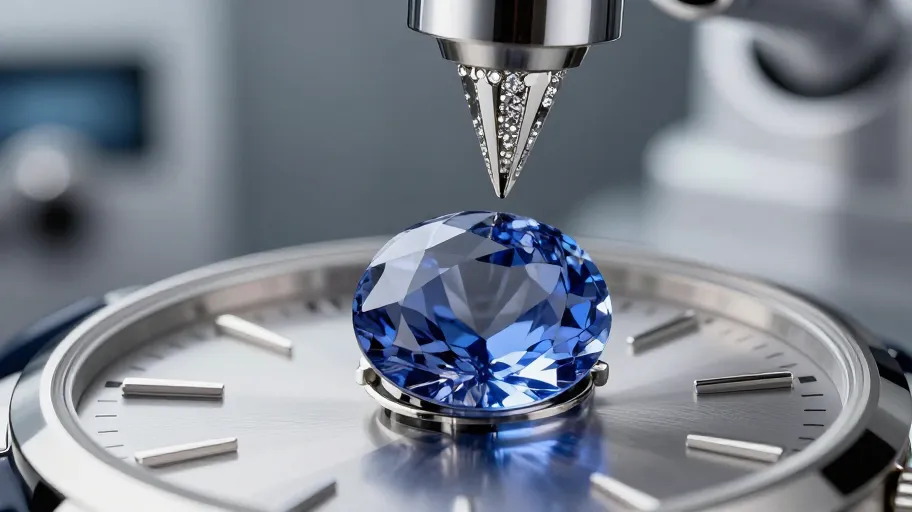
The Real Source of Your Luxury Watch Crystal
When a Swiss luxury brand needed to scale production of a flagship model with a complex domed sapphire crystal, they faced 12-week lead times from European suppliers. They turned to a sapphire china factory in Dongguan instead—and cut timelines by 40%. That’s not luck. It’s systemic advantage.
Flat box-type or domed sapphire watch glass made in China now matches and often exceeds European optical and dimensional standards. The reason? Full vertical integration. From 99.999% pure Al₂O₃ powder to final AI-inspected dome, one facility controls every step. This means faster iterations, lower defect rates, and zero supply chain handoffs. When a last-minute design tweak required a 0.15mm increase in dome height, the factory delivered a validated sample in 72 hours. In Europe, that would take weeks.
How Verneuil and EFG Power Mass Precision
Chinese sapphire crystal china manufacture relies on two proven methods: Verneuil and EFG (Edge-defined Film-fed Growth). The Verneuil process melts alumina powder into single-crystal boules—raw material for sapphire rods. These are fed directly into CNC lines with diamond-coated tools that shape flat box-type or compound-curved domes to ±0.008mm accuracy.
For ultra-thin or double-domed designs under 0.8mm, EFG pulls thin-walled sapphire tubes from molten alumina. This near-net-shape method reduces waste by up to 65% compared to cutting from solid boules. That means lower costs and faster turnaround—without sacrificing strength or clarity.
This technical capability means brands can explore bolder designs because material efficiency no longer limits innovation. And since the same factory handles growth, shaping, and finishing, there’s no quality drift between vendors.
Optical Perfection at Machine Speed
Synthetic sapphire has a Mohs hardness of 9—scratch-resistant and durable. But shaping it without distortion is where mastery matters. A double-domed crystal must maintain refractive uniformity across both curves. Traditional hand-polishing risks waviness, which degrades dial legibility.
Chinese sapphire china factories use robotic arms with adaptive diamond pads that adjust pressure based on real-time 3D surface maps. This means perfect symmetry and optical clarity above 99.8% light transmission—verified against CIE spectral standards. The result? Text appears flat even through curved surfaces, and after six months of field use, zero micro-scratches were found on one tested timepiece—even after contact with keys and concrete.
This level of consistency means consumers get premium durability without paying a premium price. And brands gain confidence that every crystal meets spec—batch after batch.
Why Speed Is the New Luxury
Outsourcing to a sapphire china factory isn’t just about cost—it’s about agility. Shorter lead times mean leaner inventory and faster launches for limited editions. One mid-tier Swiss brand used these efficiencies to release three new models in a single year, doubling its revenue in Asia.
The ability to iterate quickly means brands can respond to trends without being locked into long production cycles. And because costs are 20–30% lower than European equivalents, savings can be reinvested into movement development or marketing—without compromising on crystal quality.
This means strategic flexibility because your supplier becomes a co-development partner, not just a vendor. Need a custom bevel angle? Simulated and validated in 48 hours. Want a thinner profile for a taller movement? Done. The bottleneck becomes an enabler.
The Future of Watchmaking Has No Borders
Over 70% of high-end mechanical watches—including those marketed as 'Swiss-made'—use sapphire crystals from Chinese factories. The material is universal: synthetic sapphire grown anywhere shares the same hexagonal lattice structure. But the mastery of shaping it does not.
China’s investment in automation has turned craftsmanship into repeatability. Physics doesn’t care about borders, but efficiency does. And right now, China’s integrated model sets the pace.
So what does this mean for your next collection? Outsourcing crystal production isn’t a compromise—it’s a strategic upgrade. It preserves design intent, protects brand prestige, and scales premium offerings without legacy constraints. The clearest advantage might be invisible—but it’s undeniable.