
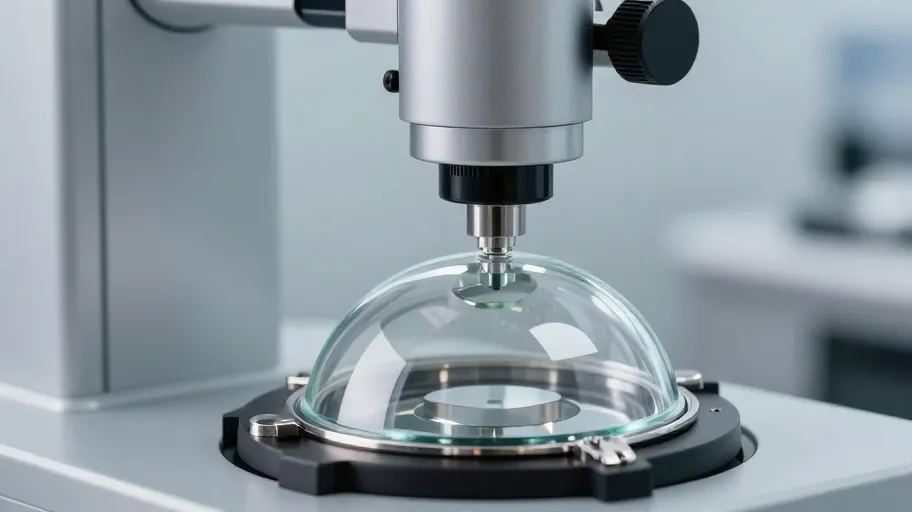
Domed sapphire watch glass production in China doesn’t have to be a gamble. A smart verification plan cuts defects below 2%, slashes rework by up to 40%, and keeps luxury brands from launching disasters.
Why skipping verification is like betting the brand on a coin toss
Building domed sapphire watch glasses without a formal verification plan means you're trusting aesthetics and luck over precision. One Swiss brand learned this the hard way when their limited edition—centered on a sleek 42mm domed sapphire crystal from Guangdong—started arriving with warped profiles and micro-fractures. The root cause? No real-time checks during CNC grinding. They relied on visual QC, which missed subsurface stress and geometric drift. Result: six weeks of delays, $1.8M in rework, and a contract nearly voided.
Sapphire scores 9 on the Mohs scale—great for scratch resistance, but brittle under stress. A 0.05mm thickness variation may not look like much, but under thermal shifts or impact, it becomes a crack starter. That’s why ISO 9001:2015 demands design and process validation before full production. Yet many sapphire china factories treat compliance as paperwork, not process control. Annealing time, coolant flow, grinding pressure—these aren’t just settings; they’re make-or-break variables.
Subsurface birefringence is invisible at first but shows up under polarized light as strain patterns—early warnings of structural weakness. Only a verification protocol using polarimetric imaging catches it. Manual inspection misses it every time. The Horological Manufacturing Institute found in 2024 that manual-only facilities had a defect escape rate 7.3 times higher than those using automated systems. That’s not quality control. That’s Russian roulette with your brand.
Metrology isn't overhead—it's your early warning system
Automated Optical Inspection (AOI) scans domes at 5-micron resolution, spotting polishing swirls and pits no human eye can catch. Pair that with Coordinate Measuring Machines (CMM), and you get hundreds of data points across the curve—real feedback on symmetry, edge thickness, and dome profile. One Shenzhen supplier cut curvature deviation from ±0.15mm to ±0.03mm by feeding CMM data back into their CNC toolpath. That precision dropped customer returns by 40% over 18 months.
This isn’t just about catching bad units. It’s about closing the loop between design intent and factory output. AOI and CMM mean engineers can adjust spindle speed, wheel wear compensation, and clamping pressure in real time—before thousands of units are flawed. Metrology-driven verification turns reactive QC into proactive control.
- Digital dimensional checks ensure perfect fit with case bezels, so press-fit stress won’t chip edges
- Stress birefringence testing prevents hidden fractures, slashing long-term warranty claims
- Dome symmetry analysis preserves optical clarity, so luxury watches look flawless in any light
For global brands, the issue isn’t capability—it’s consistency. A robust verification plan acts as a translator between Swiss design specs and Chinese manufacturing execution. When both sides measure ‘±0.05mm’ the same way, trust replaces doubt.
Late-stage failure costs more than glass—it costs time and trust
Catching defects at final audit means the damage is already done. Rework often involves disassembling entire watches—removing crystals, replacing gaskets, recalibrating movements. One European brand spent €600,000 fixing 8,200 units due to inconsistent dome height. Worse, the delay pushed launch past holiday season, cutting margins by 22%. The real cost wasn’t the parts—it was lost market timing.
That’s why embedding verification at pilot-run stage changes everything. Testing the first 50 units during New Product Introduction (NPI) exposes instability early. Engineers tweak parameters on the fly—spindle speed, clamping force, cooling cycles—so full production starts stable. One Hong Kong OEM compressed qualification from eight weeks to under five, launching two months ahead of competitors. That’s not efficiency—it’s market dominance.
Faster NPI means capturing retail shelf space, hitting peak sales, and staying ahead of counterfeiters. Early verification doesn’t slow you down. It accelerates time-to-market while lowering total cost of quality. For executives, that’s growth. For engineers, it’s peace of mind. For brands, it’s survival.
The future isn't just reliable—it's predictive
The ROI of a verification plan goes beyond fewer defects. It’s faster launches, lower rework, and protected brand equity. When you can scale production without fear of field failures, you’re not managing risk—you’re driving growth.
But the next leap is already here: AI-powered analytics that predict tool wear and stress buildup from historical metrology data. These systems don’t wait for deviations—they anticipate them. A sapphire china factory using machine learning can adjust annealing schedules before birefringence appears, or replace diamond wheels before surface finish degrades.
Soon, verification won’t just confirm quality. It’ll prevent defects before they form. That’s the shift—from reactive checks to anticipatory intelligence. And for brands investing in domed sapphire watch glass production in China, that’s the difference between surviving and leading.
Want to see how your current process stacks up? Run your specs through our free verification gap analyzer—find weak points before the next batch ships.