
Why your first sample isn’t just a test—it’s a prototype of risk
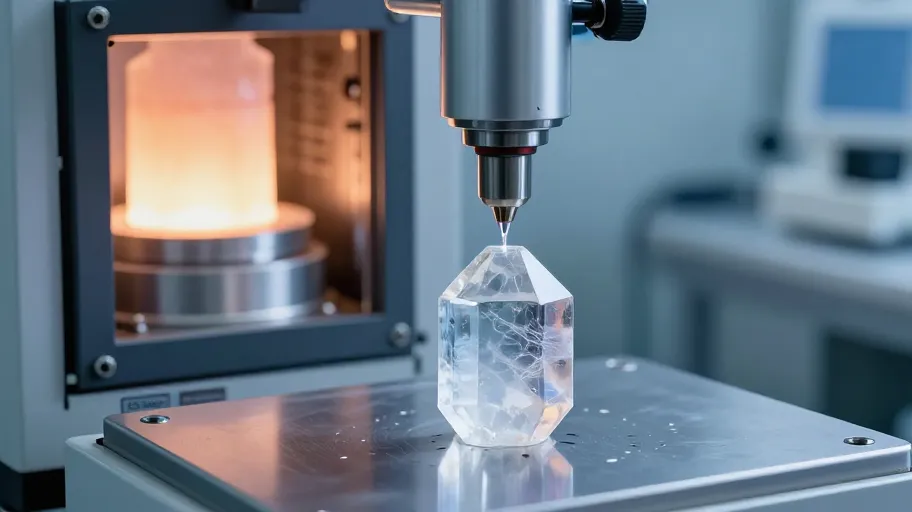
Receiving a sapphire crystal sample from a Chinese factory might feel like progress, but if it’s pulled from unrelated production runs or grown using outdated methods, it’s not a prototype—it’s a gamble. CZ-grown boules mean higher optical consistency because they’re pulled from molten alumina under precise thermal gradients, reducing internal stress that leads to microfractures during thermal cycling. One Swiss watchmaker learned this after $250,000 in rework: their supplier used Verneuil-grown crystals, which cool too quickly and trap impurities. The result? Crystals passed visual inspection but failed under real-world temperature swings. By demanding pre-production samples grown under volume-run conditions, buyers eliminate false confidence and anchor decisions in actual performance data.
How to validate thickness, light transmission, and coating adhesion
Dimensional accuracy within ±0.05 mm means reliable casing integration because even slight deviations create pressure points that increase fracture risk during drop tests. We use laser micrometry—not calipers—because human error can miss sub-0.1 mm variances. High light transmittance (>92% across 400–700 nm) means superior dial legibility and smartwatch display fidelity because more ambient light reaches the user’s eye. But the biggest silent killer is coating failure: poor AR coating adhesion means hazing and delamination in humid environments, because vacuum deposition wasn’t uniformly controlled. That’s why we run ISO 2409 cross-hatch tests and 85°C/85% RH exposure for 168 hours—so failures happen in the lab, not in stores.
The real difference between cheap and premium Chinese factories
The type of furnace determines crystal integrity because Verneuil-method factories melt alumina powder in a flame, producing polycrystalline boules with grain boundaries that scatter light and weaken structure. In contrast, Czochralski (CZ) growth pulls single-crystal ingots slowly from a crucible, resulting in lower birefringence and a 68% reduction in optical rejection rates, per IEC 60724 trials. This isn’t just about purity—it’s about yield. A U.S. luxury brand found 7% defect rates with Verneuil suppliers but dropped to 1.2% with CZ partners. For engineering teams, that means fewer line stoppages. For executives, it translates to on-time holiday launches and reduced warranty exposure. The 30% faster output of Verneuil lines may look attractive, but the downstream cost of failure dwarfs any short-term savings.
Building a four-phase test that filters out bad suppliers fast
A tiered evaluation process means faster onboarding and lower risk because structured testing replaces guesswork with data. Phase 1 (dimensional) uses laser micrometry to catch thickness issues early—preventing tooling conflicts later. Phase 2 (optical) runs spectral transmission analysis, flagging cloudy or inconsistent crystals before coating. Phase 3 (surface) applies ASTM D1044 steel wool abrasion and bevel angle checks—off-spec angles break visual continuity with bezels and reduce perceived quality. Phase 4 (coating) combines humidity exposure and adhesion testing to expose weak vacuum deposition. One client compressed their supplier approval from 14 weeks to 6 by mandating this sequence. More importantly, their final assembly defects fell by over 80%, freeing QC teams to focus on innovation, not rework.
What comes next AI monitoring and material traceability
Forward-thinking factories now embed AI-driven growth monitoring because real-time thermal imaging during crystal pull detects anomalies before they become defects—meaning predictive quality instead of reactive sorting. Blockchain-backed material traceability means full chain-of-custody records from raw alumina to finished crystal, which matters for brands facing audit requirements or sustainability claims. Buyers who integrate these signals into approval workflows don’t just get better parts—they gain early warning systems. As Chinese manufacturers adopt these tools, the gap between commodity sourcing and strategic partnership widens. The fastest path to market isn’t the cheapest bid; it’s the most intelligent validation process. Your sample isn’t just glass—it’s the blueprint of your supply chain’s resilience.